



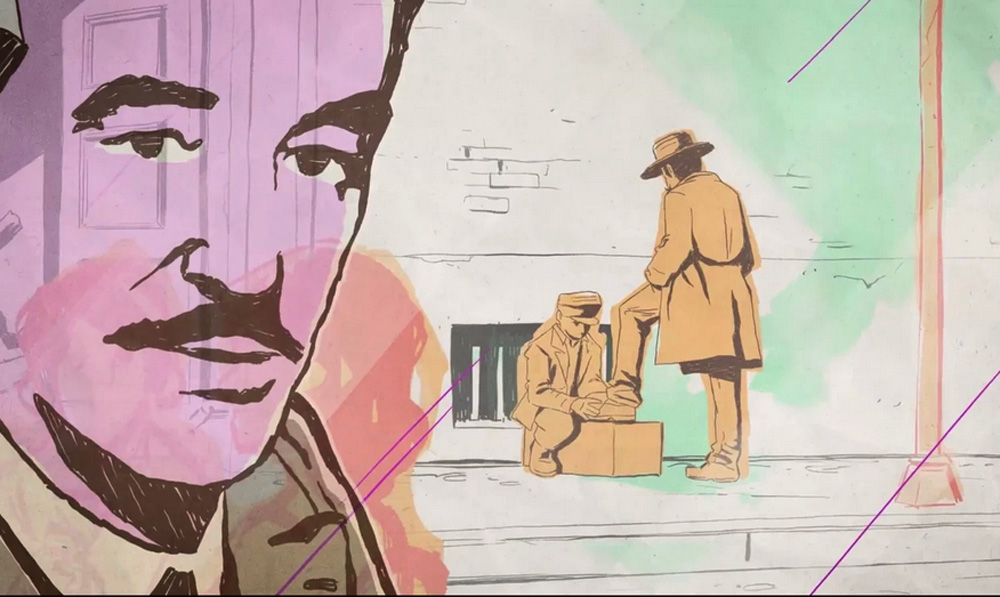

From one of the old clips Francesco Zippel digs up in “Vittorio de Sica: Staging Life” of the “Bicycle Thieves” filmmaker discussing his films on a TV show, saying he’s spoken too much about his work and not enough about his kids, you get the sense that Zippel knew that to make a film about de Sica, it would have to be a family portrait. Although filmmakers ranging from Andrey Zvyagintsev, Asghar Farhadi and Ruben Ostlund show up to pay their respects, a savvy selection of filmmakers that not only show De Sica’s reach over time but across nations, Zippel’s biography is a special treat when it spends so much time with his family, sharing potentially apocryphal stories that they charmingly debate the truth of at times, but all put the man before the movies he made as the great humanist director would’ve done himself.
When Marcello Mastroianni describes De Sica as “everyone’s uncle” in Italy, not only renowned as a director, but building a groundbreaking career behind the camera after being such a presence in front of it as one of the first actors to appear in an Italian sound film, Zippel doesn’t necessarily need to go over the basics of the director’s career upfront or offer a comprehensive overview, but those only learning of him for the first time may feel as if they’re playing catch up at times when the film doesn’t fully adhere to a conventional chronological structure, jumping ahead at the start when “Umberto D,” his ninth solo film as a director, is among the first to get a real spotlight since it was inspired by his father. As De Sica’s son Christian remembers, the real-life Umberto was a banker who was frequently in debt and yet was very supportive of his son’s artistic endeavors, to the point of buying all the tickets at a playhouse when he was starting out as an actor, just for family and friends to see him deliver the one line he had in his first play.
Zippel prioritizes these personal insights throughout “Staging Life” when De Sica was so intent on conveying the human experience in his films, having the impulse to show Italy as it really was after the devastation of World War II and helping to forge an entirely new form of filmmaking with neorealism. (As Isabella Rossellini, daughter of De Sica’s fellow pioneer Roberto, clarifies, it wasn’t so much a style until the critics deemed it such when the use of nonprofessional actors and few takes was as much a budgetary decision as a creative one, highlighting how much of a risk it was.) Family members relate how conscious De Sica always was of others, but it isn’t only the memories that express how that empathy led to such meaningful films but in sharing them in such an intimate way, and that extends to the genuinely passionate responses to specific films from the likes of typically reserved filmmakers such as Luc and Jean-Pierre Dardenne and Wes Anderson (an executive producer on the film as well), who talks about screening “Shoeshine” for his nine-year-old daughter.
The film takes on the quality of a great dinner table conversation that extends deep into the evening when Zippel and editor Michele Castelli find elegant segueways that surely weren’t easy to pinpoint when the film doesn’t move in a straight line, as it makes space for the director’s enduring partnership with writer Cesare Zavattini (with remarkable footage of the scribe feverishly dictating pages to a secretary in his office) in relation to De Sica finding his footing in 1930s Italy and parlaying an interview with Francis Ford Coppola, talking about meeting him for dinner not once but twice with two different wives, into a tasteful section on the director’s dual marriages at a time when divorce was prohibited in the Catholic country and De Sica tried to balance having two families simultaneously with his children from both describing how hard it must’ve been on him.
Not everything is covered, with de Sica’s acting career after he began directing falling by the wayside as well as his directing career outside of the films he’s most well-known for, with “Two Women” and “The Garden of the Finzi-Continis” receiving special attention beyond his decade-long prime from 1943-1953. (Not much more needs to be said after he quips at one point, “We were asked to make movies that would make their money back.”) But nothing seems absent, either, when “Staging Life” is filled with love far more authentically than the fawning admiration of many celebrity biographies and it evinces what was important on a personal and professional level to its subject. De Sica’s family really welcomes audiences in with tender tales it seems they’d only share with those they were close with and as a result, “Staging Life” pulls you in.
“Vittorio De Sica: Staging Life” does not yet have U.S. distribution.