



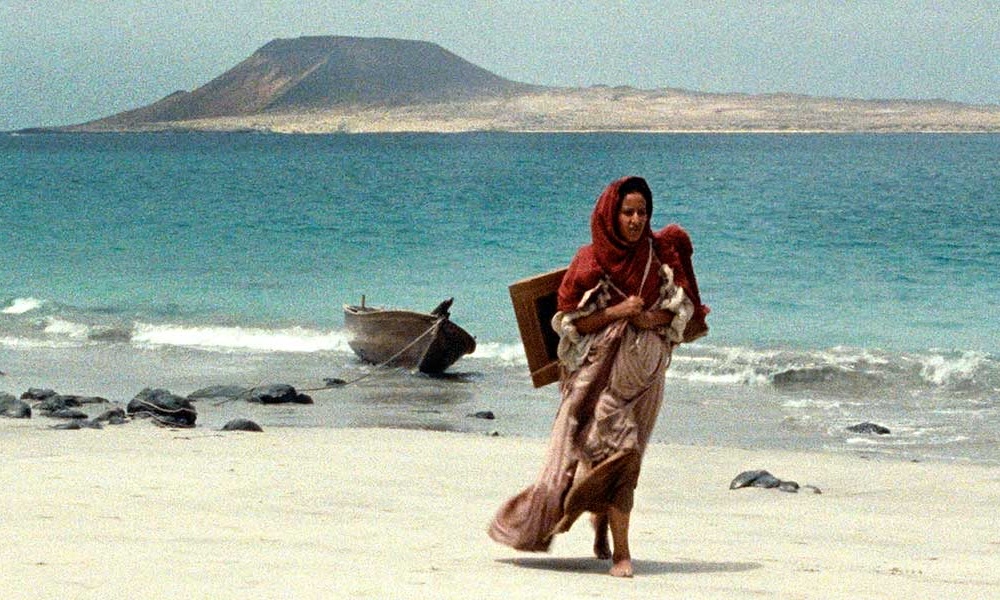

You realize how revelatory it is to be able to catch a glimpse of yourself for the first time as Fatima (Luisa Ahl Laabiad) does in “The Fortunate Isles” when a mirror washes ashore on the Eastern Canary Islands where she toils as a slave. It is the 16th century and surrounded by water, she’s never been given chance to see what the rest of the world looks like, let alone herself, being at the mercy of a blind Marquis (Lou Castel) who conquered the island on behalf of the Crown of Castile a century prior and does nothing now these days but drink red wine and order his help around. The lifestyle surely hasn’t been pleasant, but it has been consistent, with Fatima in the privileged yet unfortunate position of acting as the conduit for the Marquis, controlling the flow of information to him when he must rely on her descriptions to picture things and ladling out rations of water to the other slaves at the Marquis’ discretion, enduring their anger when it is never enough. All can be considered lucky that she’s a person of great conscience, never even thinking of abusing the power she could have, but in Samuel M. Delgado and Helena Girón’s beguiling drama, it isn’t only holding up a mirror that leads to seeing herself in a new way, but the possibility of death by starvation if she doesn’t.
While the Marquis and his slaves live off the sea, with all the fish brined with salt making it last a little longer, they could easily die by it too when all that ocean water isn’t safe to consume straight up and the local well is always at risk of running dry. Supplies may be brought in on occasion, but the Marquis is known to only ask for red wine and he keeps a tight grip on how much everyone drinks of the clear stuff. Although many of the slaves are eager to see him die sooner than later, Fatima is far more conflicted as his caregiver – the proximity shouldn’t be endearing when the Marquis is a boorish oaf, but she can’t help but see the humanity in him from closeup – and when he’s survived this long in an inhospitable environment (dry, parched land unsuitable for agriculture), there’s likely something he knows that they don’t. Unfortunately, that is put to the test when there’s a slave rebellion and what looked like cruelty in small disbursements of fresh water – and certainly was to some degree – was also necessary conservation as any remaining supplies are drained in celebration.
Star Laabiad has a captivating presence about her, but Delgado and Girón put her in a particularly fascinating position as someone accustomed to being a servant with whether she should take the lead, watching as everyone around her starts to wither away in the unforgiving heat with no sustenance to speak of and pursuing the surely unsuccessful path of seeking out the Marquis’ son (Gregoire Colin) on another island who didn’t look kindly on his father and can be expected to be no better towards her. The constant sound of rolling waves in the background as people are desperately thirsty at the fore become a stirring reflection of the abundance the privileged choose to hold back, not only in material wealth but education that when deprived extends poverty for generations. The film is given an effective ticking clock when Fatima learns she’s pregnant early on, giving her an additional incentive to try to secure more water for her island as well as having her body feeling as if it’s rebelling against her on an already arduous journey, but it also leads to considering what type of world the child will be born into, one where social mobility is by no means going to keep up with progress on other fronts and as much care and craft have gone into recreating the 16th century, “The Fortunate Isles” can also look a lot like the 21st.
“The Fortunate Isles” will screen again at the Toronto Film Festival at the Scotiabank on September 17th at 11:45 am and September 20th at 3:50 pm.