
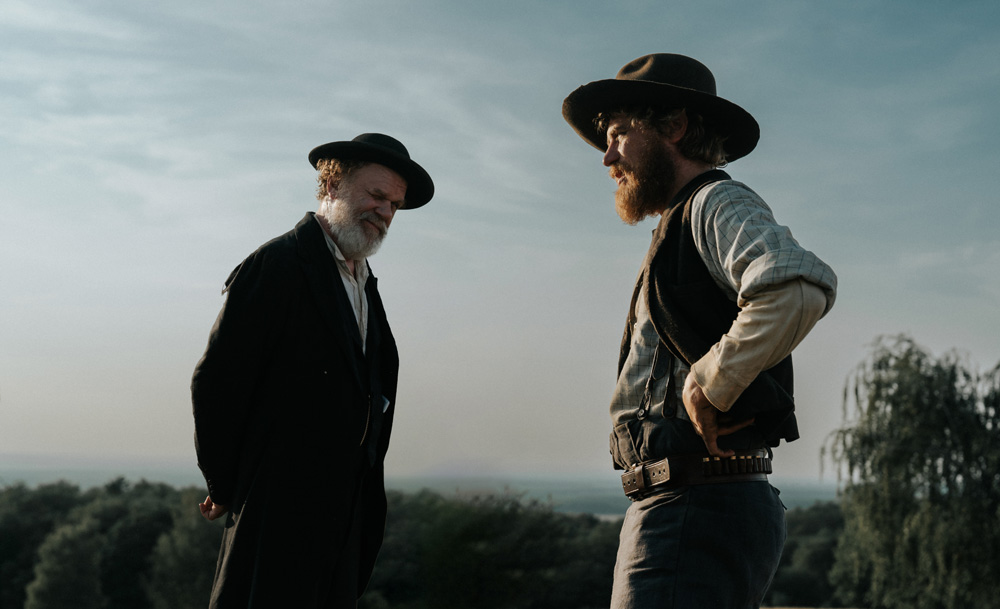

Ashes fall from the sky as if it were snow, the way one might typically recognize Wisconsin circa 1870 when “A Prayer for the Dying” is set. However, rather than the bitter cold, a fire just over the horizon of a small town ironically called Friendship makes it appear as if the gates of hell have opened as Jacob (Johnny Flynn) tries to salvage what’s left of the fraying trust of his community as its sheriff, stepping lightly towards a real inferno as he faces one in the other direction from the inflamed passions of locals discontent to sit still. Stewart O’Nan’s 2001 book of the same name was a downer for sure when Jacob’s desire to do right by his people, but as writer/director Dara Van Dusen was invigorated by being transported to another place and time, she follows suit in her riveting adaptation in which the man of faith – he acts as the town pastor as well – is confronted with unfathomable evil.
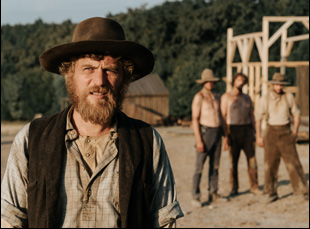
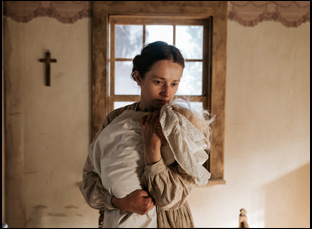
When bad things happen and it can make a response unpredictable, Van Dusen’s striking feature debut puts a precise yet wily camera into the mix to follow Jacob and his loving wife Marta (“Sick of Myself” breakout Kristine Kujath Thorp), who have just had a baby girl and put about as much care into the town she’ll grow up in as they do towards her, holding multiple roles in the community, even though at times it can look like too much responsibility to take on. Just as Jacob was welcomed after surviving his service in the Civil War, he extends open arms to a group of outsiders led by Chase (Hilton Pelser), raising suspicions with the harem of women that trail him, to the dismay of other townsfolk whose begrudging acceptance turns to fierce anger when the town’s doctor (John C. Reilly) is presented with an unrelated first case of diphtheria, the fatal disease for which there was no obvious cure at the time. Not wanting to cause a panic, Jacob and the doctor have to decide how much information to pass along to the locals, weighing the health risk to those around them versus letting the disease travel even further should they decide against a quarantine and as locals take ill, Jacob has to wonder what god would force such cruel choices upon them.
If the parallels to the recent pandemic make its period setting seem incidental, so too does the bold filmmaking behind it where Van Dusen and cinematographer Kate McCullough brilliantly create a visual language where a sudden whip-pan after a series of scenes unfolding in long, slow pivots can make the heart race and the director immaculately crafts a world on screen where it feels like someone is always watching as people talking on one side of town can always be seen from the other in a remarkable feat of set building as much as cinematography. Jacob’s brutal march towards a painful reckoning of one kind or another as he hopes to lead residents to safety while being conscious that may not actually align with a greater good may be excruciating to watch in one sense as a terrible moral dilemma, but made electrifying by Van Dusen’s sharp control over the proceedings and the gripping performances of a strong cast. With the film feeling both at home in Berlinale where it premiered earlier this year and the genre set Sitges where it will be soon playing, the film is something special and as it opens across the U.S. this week, Van Dusen spoke about how a blissful ignorance of the film industry led to such a formidable first feature, building sets from scratch in Slovakia and instilling points of collaboration at every part of the process to make everyone feel fully invested.
 From what I hear behind the scenes, the story of how this made its way to the screen may be as wild as what happens in the story when you were a first-time director who picked up the rights to a book from a well-regarded author. How did you connect with Stewart O’Nan?
The process started because I was a very naive 20-year-old who didn’t understand that contacting this huge amazing author would be a dramatic thing at all. I’m a New Yorker, but I had studied at the Polish National Film School in Łódź, and my father found the book for me and I read it in one sitting. It gripped me and when I put it down, I was wandering around my apartment, staring at the walls and thinking, “What just happened in that book? What has happened to me now?” And it was at a point in time where you could go online and I just found Stewart O’Nan’s e-mail and I sent him a message and I told him how much I loved the book. He wrote back to me immediately. The rights were taken at the time, but we stayed in touch and over the years I eventually got them, but only because he so believed in me and my love of his novel. He was cheering for me and allowing me to take the many, many, many years it took to bring this to the screen. And it’s so bizarre now — that’s my favorite book ever written. It’s the most beautiful novel and he’s such an amazing author, so to say that not only did he support me, but he is a friend and continues to support me now is a bizarre, amazing thing.
You certainly didn’t disappoint. And the film is immediately distinctive in the visual approach you take to it with lots of camera pans. Did you have an idea early on what this film would look like?
I’m definitely somebody that, even from film school days and short films, I’m very visually inclined, so when I read this book which is written in the third-person singular, [it has directions like] “You stand, you think, you open the door.” It immediately was both at once very intimate but also very distancing, which I thought a camera can communicate well. Then on top of that, it’s a story where the monster — or demon, villain, whatever — is something other. It’s nature, it’s faith, it’s spiritual, it’s whatever you think it is, so [Kate McCullough], the DP and I, who I also went to school with, thought what a perfect story where the camera can be a character representing all of those things and interacting with the other characters in the environment. We felt it was appropriate for this story and necessary to have this biblical, aggressive camera that did its own thing and behaved in its own ways regardless of the others in the scene with it, which is something I was just fascinated by and still love to this day.
There are a lot of shots in this that seem to have required planning on a fundamental level and from what I understand, you built the sets for this town from the ground up. Did that involve the cinematographer?
Yeah, I was really fortunate that Kate is my best friend and I’ve known her for 20 years and our production designer Hubert Pouille quickly came in and the three of us were this really tight unit. We loved and respected each other and had a great creative dialogue. And everything was intentional. The locations were built sometimes for the shots, which is wild because the shots were completely abnormal or different [from one another] and it required the buildings to be built in that way. But as we were all in sync, we were able to do that. There’s one scene where the camera is traveling through a home at 90 degree angles and the production designer needed to build that location and also build the floor in a way where we could put the camera equipment that needed to be adjusted and built into that exact space for it to move that way. It’s super risky business because when you do that, you cannot shoot it any other way, so you better hope it works. And on take nine, you start to go, “Oh no.” But for the most part, we were really lucky and when you shoot it this way and create a surreal universe, you do need to plan. You’re not winging it on set. You, the actors, the DP, the production designer, everybody knows what’s going on. There’s no accidents. Or very few.
 Johnny Flynn has said he actually was a bit involved in that part of it, which was unusual for him. How did you engage the actors in that process?
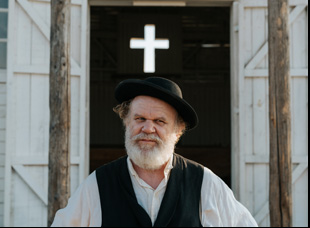
The gift of building [the sets from scratch] is that you have your actors and they can actually come and be on location and see the world step by step coming together and coming alive. So they were involved and we were going through their characters as the church literally was being built up in front of us. It did so much for all of us in understanding the world and the story, but I think also for them and their characters. Johnny was also an actor who was super excited to be working with the camera — to have that camera as a character. And he leaned into that so much. Some of the shots in the film are his. He completely understood and loved the idea of being in character and then running around the camera, dancing under the thing, getting through the door without making a sound and coming back in in character, which meant that this was really a collaboration. This is not like “Dara Van Dusen made a film.” We’re a huge team of people [where] everybody was contributing and trusted my vision in it so that they could contribute and be a part of it.
The cast in general is not necessarily who you’d expect in these roles, both John C. Reilly and Kristine Kujath Thorp seem better known for comic roles these days. Was that something you were looking for?
Yes, I have my dream cast and I have the best casting director in the world, so it wasn’t like they all just fell into my lap. Colleen Crawford just put together this amazing team. But Kristine is a Norwegian actress and I live in Norway, so I was very, very well aware of her and she actually came to us because she saw the Norwegian Film Institute had given [the production] money. And she said, “I want a job, would you hire me?” [laughs] And she’s just a really good human being and a really good actress. She does have a background in some comedy and also drama, and John C. Reilly obviously — “Step Brothers” is the end all, but I think comedic actors are the best actors in the world. They have to be so much braver and more confident and they are risk takers in front of the camera, so to have somebody like that on this kind of production was just a gift. And Johnny Flynn, I was at his concert the day we got a call that he wanted to be in the film, so it was like completely like, “Is the universe doing something? What’s happening?” He’s just so good at what he does, but he’s also such a good number one on the call sheet in terms of [being] the leader and the way he chooses to work and be on a part of a film set. We were this great unit that allowed for everybody to really contribute and give what I think are amazing performances.
For the fire scenes that bookend the film in intense burnt orange light, was that actually done practically?
That’s all shot in studio. We loved how it looked in studio to have practical smoke in there with built elements, like a train or certain posts we put in to leave elements of reality like grass and leaves on the ground. We had that and then the rest was all green screen and CGI, so it is a full mix of practical and CGI, but the goal with that was also to create [something] unnerving because it’s both very realistic and also completely unrealistic, and it’s blended together in the environment. The actors are all just unbelievable professionals. They were acting in a studio with horrible smoke up their nose and in their throats with green screen and completely submerged themselves into the roles and give hugely believable realistic performances within this very unrealistic world that was created after the fact.
 The film ends up being eerily relevant coming after a pandemic, yet obviously this was in the works for some time before. Did you actually revisit it throughout the years as a script?
It was wild, right? Because I had been pushing around this script for years pre-pandemic and people were going, “No, no, no, it’s a period piece and nobody can relate to this.” And then suddenly the pandemic hit and it became, “Oh whoa, whoa, whoa, this is way too close to people. Nobody’s going to want it.” But during the pandemic, I was suddenly sitting with this material and I had a two-year-old and I was quarantined at home, so it became much more real and personal to me and I think it allowed me to add extra layers to the script. It also allowed for the players at large to have a bit more faith in the project and in its relevance. The project itself, pre-pandemic or post, is about how things are cyclical. History repeats itself and unfortunately it did. And as humans, it’s very difficult for us to acknowledge that. We say it all the time, but what we do with that information, that the things that are happening now have happened before, is important. I’m not saying it gives us any clear direction or answers, but it’s definitely something that’s worth acknowledging and thinking about.
When it’s your first feature, in spite of all the experience you have, what’s it like to have one of these under your belt? Was it what you thought it would be or different?
It was so different. I’m so proud. I’m so relieved. But you have to be completely delusional to make a film and I think that delusion is different for everybody. There is some goal you have, and I will never admit what mine is, nobody will, but you imagine something at the end. And that something is so big, so grandiose, so unachievable is what drives you to make it. When you reach the end, you don’t have that. That’s not going to happen, so you’re left with this kind of strange empty feeling of “Is this what I wanted?” And it’s so confronting personally, because you have to think about that. It’s also interesting because like giving birth, you’re immediately like, “I need to do the next one. I’m traumatized, I’m in pain, I can’t believe it. On to the next. Let’s do it again.” [laughs] So it’s a wild experience, and I’m just unbelievably lucky to have gotten to make anything ever, to create something new and put it into the world. I mean “Jesus, how lucky am I?” But it’s a strange feeling that maybe in a couple of years we look back on and really understand how you actually felt about it.
“A Prayer for the Dying” opens in select theaters on October 9th, including in Los Angeles at the Alamo Drafthouse DTLA and AMC Ontario Mills and New York at the Alamo Drafthouse Lower Manhattan and AMC Palisades Center 21.