



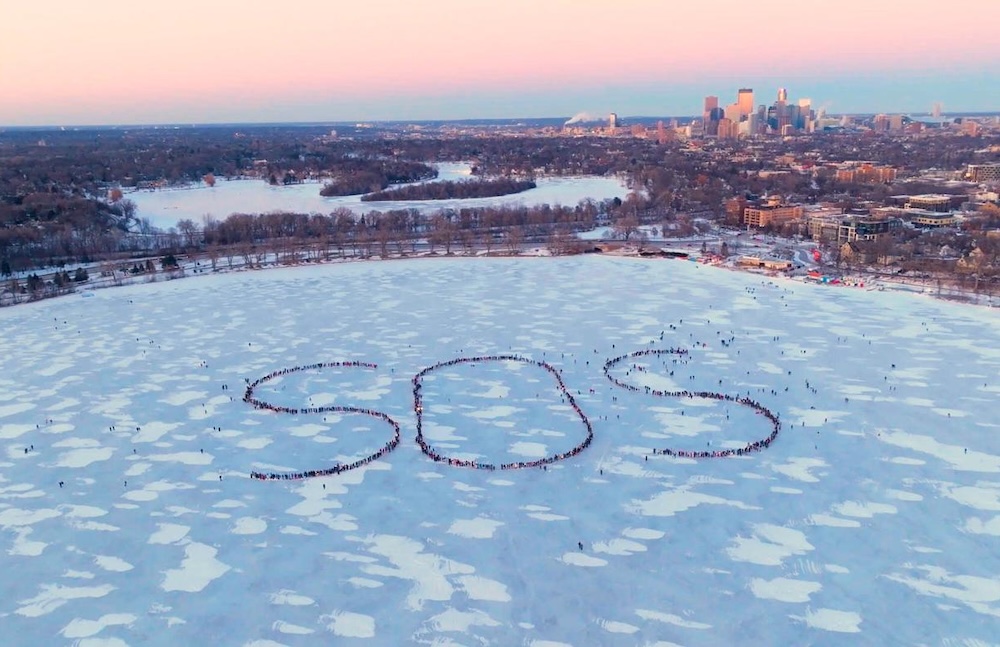

For the image seen above of the night sky lit by an “SOS” from the ground in Minneapolis and used as the primary artwork for “A Month in Minnesota,” co-director Brian Lucas was asked by a friend if it was real.
“He was like, ‘Boy, that’s a great use of AI,’” Lucas recalls of the scene in Minneapolis that was indeed authentic yet felt unreal in other ways when the presence of ICE officers galvanized the community into standing up against friends and neighbors being subject to racial profiling and unsubstantiated arrests. “And I was like, that’s not AI, that’s people. out there dressed warm in 25 below temperatures coming together for this moment to make a statement like that — and we had a lot of moments like that where we where we were able to capture the way that this community just stood up and said, ‘Not on our watch. We’re not going to let this happen.’”
That sentiment extends to Lucas and co-director Anne Sundberg, who dropped everything to film the direct action occurring in their hometown when ICE’s abuse of power has largely only been curtailed by the video capturing their violence. “A Month in Minnesota” begins with a woman refusing to stop filming as she’s threatened with being pulled out of the car she’s driving, clearly not someone who has to be concerned with being questioned about her status as a U.S. citizen but righteously angry after the Twin Cities were targeted by the Trump Administration in an incendiary effort to reopen the wounds of a city still grieving the loss of George Floyd and the attitudes within law enforcement that led to his death. After opening their arms to Latino, Hmong and Somali immigrants over the years, those born in the area weren’t about to let anyone question those that had become as proudly Minnesotan as they were and “A Month in Minnesota” shows collectively how residents worked together on mutual aid efforts that would assist anyone who felt uncomfortable going outside as ICE occupied the city and eventually hounded the officers out.
Of course, what Lucas and Sundberg don’t only capture triumph, but also tremendous loss with the tragic deaths of Renee Good and Alex Pretti occurring during the turbulent time and while Minneapolis Mayor Jacob Frey and Minnesota Governor Tim Walz describe bracing the state as best they could against federal overreach, power is shown to lie with the people on the streets who turn outrage into resilience, including moms who couldn’t fathom parents being ripped away from their children and veterans of foreign wars that now believe they are defending the Constitution from their own government. When part of fighting back comes to include the Singing Resistance as well as joyous light displays, the film feels like a celebration of what America can be at its best when combating what it is at its worst and it’s galvanized audiences at stops at the Hamptons, Chicago and Twin Cities Film Festival in recent months, shaping up to be a potential Oscar nominee in the Best Documentary Short race. Recently, Lucas and Sundberg spoke about their own joint effort to chronicle this collective response to the horrors of ICE, quickly mobilizing a production and watching a community come together.
How did this come about?
Anne Sundberg: This whole film is a deep Minnesota project. Everyone on the team is a Minnesotan and I had been tracking what was happening in in Minnesota because I have a Korean-American niece who in December started telling me that she did not like to go to the grocery store anymore because she has a five-year-old and a newborn and she didn’t want someone with a gun coming up to the car and asking for papers and terrifying her son. So when we were watching the news, I was astonished to see to see the coverage of Renee Good’s death and then to hear the [Kristi] Noem press conference and to see the allegations of terrorism. I felt like what I was seeing and what I was hearing did not compute, so I texted Brian as we were watching the news that night, saying “This is outrageous. What’s going on?” And full disclosure, Brian and I have known each other since the seventh or eight grade. We immediately felt that we needed to jump in and document this moment. It felt very historical in a profoundly disturbing way.
Brian Lucas: Yeah, I think my exact words were “This feels like the last stand for democracy. We need to be covering this.” I still live here and and you start to think how how much is this permeating the entire community? That was the moment when fear was amping up everywhere. You couldn’t go anywhere without seeing the trucks coming by, worrying are they going to run a red light and hit somebody. All of a sudden, you felt like you were in this escalating war zone. So it was really nice for me when Annie suggested that we work on this together because it gave me something more productive to do than to doom scroll and to drive around the streets and look for ICE agents. We were trying to find the stories that would help put some context to this and show the way the community was coming together and look for the helpers, like Mr. Rogers always said. It was this turning point for me where I could do something that was productive and start looking for really positive stories that could come out of this horrible situation.
You obviously had to mobilize quickly, but did you know the kind of shape this would take as far as covering a lot of ground as opposed to following one or two specific people?
Anne Sundberg: What became clear to us very early was that was a collective resistance. My first instinct was let’s embed with either the governor in the control room or Mayor Frey’s team, find one activist on the ground and then maybe one vulnerable family and how they’re navigating it. But we realized, “No, no, this is a mesh. Everybody was finding a way to participate, to do something.” And Brian and I have often talked about this idea that none of this work was done alone. Lucy Olson, one of the voices in our film says, “I had no doubt that if I knew of a family in need and I cold-called my neighbor down the street and said, ‘Can you go pick up these kids because the family’s been detained?’ They would say yes.” What was happening in Minnesota was there were clear asks being put to people [and with] what they were seeing, they were not moved by political outrage, they were moved by moral outrage and they found it very easy to step in. And that to me became the heart of the film, which is when you’re faced with something that is so outrageous, so performatively cruel, and so fundamentally wrong, you’re looking for a way to step in and help.
Brian Lucas: What we arrived on was this almost mosaic that paints a bigger picture. We have a lot of different voices in here, but they’re each finding their way to plug in. Some of them are more active like Deb and Steve, who were out at Whipple [the regional ICE detention facility] and tracking ICE agents and then there’s the older woman that goes to the grocery store and buys 36 bags of rice [to feed families who can’t leave their house]. Everybody found a way and it almost felt like if we didn’t showed how [everyone] contributed, we’re giving an incomplete picture. You could narrow it down, but from our perspective, we wanted to show how the community as a whole came together and the beauty that came out of this really cruel moment in our history and each of those voices is really important in their own way.
You do have Governor Walz and Mayor Jacob Frey sit down for interviews, but it still feels like there isn’t a top-down approach as far as presentation. Was that difficult to achieve in cutting it together, particularly in a short?
Anne Sundberg: This goes back to the idea that none of the work was done alone. Senator Tina Smith was at a screening of ours in Minneapolis at the Twin Cities Film Festival, and she said Minnesotans are really good organizers, and I think that speaks to a history in particular in the Twin Cities of community organizations and social cohesion. There is a sense of community involvement and there was a neighborhood network element that came out of what we saw with George Floyd in 2020. That was a city that really did blow apart, but when Minneapolis was doing the work to come together after that, there were incredible networks that really happened and there wasn’t a leader. What people were saying is “I’m seeing this in my area. How can you help over here?”
The other thing that was really an issue, and we had more on this that we couldn’t include in the film, Minneapolis was on a knife’s edge, not looking to inflame the federal government any further. So I entered this project with a fundamental question, which is why did Minnesota not explode in the wake of the incredible ICE violence, the shooting deaths of two citizens in broad daylight. They held it together because to do anything beyond that would have given the administration even more justification to come in. There were many interviews that we did with people where they said they felt abandoned by state and local government because their hands were tied. Governor Walz, the best he could do was bring in the National Guard, but even there he made a decision. Our National Guard will not wear masks. We are there to help keep the peace and they served coffee, hot chocolate, and donuts to people who were out protesting at Whipple because they wanted to be the antithesis of the federal forces that were coming in. So when I think to the question about was there leadership, it was a leadership [in that] everybody who took a step and had a role in what happened in Minnesota to help preserve the community. Leadership was completely shared.
What was it like to literally cover the ground that you had to cover and figure out where to be in order to capture this?
Anne Sundberg: There were a lot of logistics and we had three main camera people who we worked with who were Minneapolis camera folks and there were two journalists who we met who were wonderful. One came in from Dallas, Texas, one from Chicago, and they were really, really helpful with material as well. It’s funny because there were many shoots. There was one in particular where I was like, “Why are we shooting this protest? And then in the end, it became the final scene of our film because it was so meaningful. It’s when you see the Monarca, the big beautiful butterfly at the end [produced by] a [art collective] called Big Animal Productions, and that spoke to this idea that we wanted to show that as things were unfolding on the ground, we were able to tap into an incredible web of journalists who were also there.
We met Ben and Sam Luhmann, who were at the time 15 and 17, and also had footage. They were often on the scene where things were happening before regular news crews were, so they had footage that then they were trying to get out to other people. But then we were trying to create the sense of the beauty of what Minnesota was finding even in the worst of it. Those were the scenes of the luminaries set out on the lake to show the rest of the world the messaging that was coming from Minnesota at night. These protests were, in essence, huge collections of joy, [from the idea] you don’t get to take our city from us. That was really important to include.
When you were conscious of the larger media narratives around Minnesota, was there anything you were capturing that you really felt needed emphasis when it wasn’t part of that picture?
Anne Sundberg: It goes back to the impetus for making the film where we were watching the coverage of Renee Good’s death on January 7th against the Kristi Noem press conference at five o’clock. It really did feel like we were being spun an entirely different narrative by our own government. So it was important to show how Minneapolis experienced what happened this winter and the best thing that we did was to try to find those shots and that coverage that really spoke to that. It was also for that reason important for us to include the deaths of Renee Good and Alex Pretti, because I think many people didn’t fully understand how that happened. To really see it and feel it as though you’re on the street that day in Minnesota was critically important because it was shocking globally, but it was in particularly shocking to a community that felt that was such a violation and such heartbreak.
Brian Lucas: Yeah, the Alex Pretti murder was what I thought could be the tipping point. I thought that this community was going to explode because one murder is awful enough, but that one almost seemed intentional because there was a huge protest the day before. Everybody was feeling, “We’re standing up, we’re doing it,” and then they shot Alex Pretti in broad daylight and then spun this terrible narrative about him. That was also when a lot of people here saw themselves written into the story because I’ve heard people say that “he was shot in front of my favorite donut shop. I go to that restaurant all the time. He was trying to help a woman up who had been pushed over and then was called a domestic terrorist.” So it was this very George Orwell “Don’t believe your eyes” moment that really unified this community, even more so than we had been before. And when we didn’t go over the edge that day, that was when I knew we were never going to go over the edge.
Anne alluded to this, but you recently screened the film at the Twin Cities Film Fest. What was it like to show it locally and in general start to get it out into the world?
Anne Sundberg: We finished the film in September, and as I’ve joked with other people in the industry, I don’t know that I would ever recommend trying to make an Oscar run by finishing a film in September. But we are going to try to get people to watch this film because it’s really connecting with audiences. We premiered it at Woodstock and then we were at Chicago where we won the Audience Award and that was a really meaningful screening because Chicago had its own experience with ICE, and we screened together with Bill Morrison’s “Sawyer Avenue Sunday Afternoon,” which is a really remarkable film that incorporates body cam footage that was obtained during an investigation of an [ICE] incident in 2025. The film is really resonating with audiences. What we’re hearing is that people didn’t realize just how awful it was in Minnesota and how it touched so many levels across across the Twin Cities.
We have an interview, which again was not in the film, but It exemplified [this idea] through the story of Sophia, a restaurant employee, [who describes how] people who didn’t feel safe to go to their own homes and were choosing to sleep in other places. They were hiding and families that we knew who had extra bedrooms were bringing in vulnerable people and hiding them in their own homes. That doesn’t seem like America.
Brian Lucas: Yeah, and when we played at the Twin Cities Film Festival, it was really interesting. You never really know are people going to want to revisit this? What is the tone going to be at these screenings? But when tickets went on sale, the first screening sold out immediately. They added a second one and that one sold out immediately. They they added a third and said, “We’re going to put you in a bigger theater this time and that one sold out immediately.” Then we won the audience award. We were just far enough past Metro Surge where a lot of people came up to me and said, “It’s almost hard for me to remember that happened here. I’m reliving it and I had done such a good job of compartmentalizing it that I needed to be reminded that that was reality.”
And I think the fact that we have dark and light in the movie is really important. You can’t understand the unity and the beauty of this without understanding the the darkness of it. But if you just show the darkness of it, you’re only getting a part of the picture as well. You’re not really getting what made this community and this movement unique. I had a lot of people come up after with tears in their eyes, talking to me about how beautiful it was to see the community reflected in this way and that was really gratifying.
Anne Sundberg: Yeah, I won’t forget that first screening at Twin Cities because there was a woman who was crying after the screening and she said to me, “I feel two things. I feel both really angry and I also feel really good.” And that’s what we want people to feel about this film, which is there are better angels.
“A Month in Minnesota” does not yet have U.S. distribution. Future screenings can be found here.