

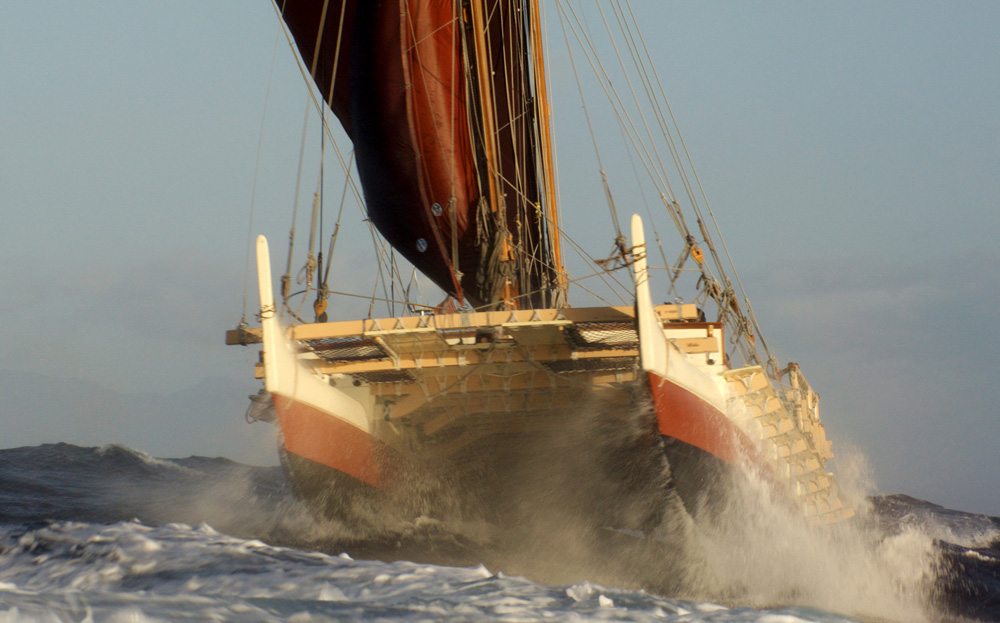

For centuries, there was nothing but stars to guide the way over the 2400 miles of ocean between Hawaii and Tahiti, making the act of navigation an art more than an exact science and as modern instruments from the most basic compasses to GPS equipment made their way into the practice, there was a deep pride amongst Polynesians who could guide their canoes to safe harbor the old way, with one generation passing down their knowledge to the next so the wisdom didn’t only pull places closer together geographically in the mind, but people emotionally with their ancestors. In “The Navigator,” it has fallen upon Nainoa Thompson, now in his seventies, to impart what he knows, just as such information was bestowed upon him by his mentor Mau Pialug years before, though when the conditions of the sea are never the same twice, there’s only so much anyone can learn except to trust their gut.
It’s a lesson that director Jordan Manley clearly takes to heart himself as he observes Thompson teaching others in an evocative profile in which the legendary navigator rarely is seen, though his influence is deeply felt. An unusual biography that takes into account how much Thompson is a product of his environment when it’s images of the shifting tides that you’ll see instead of him, it’s an appropriate one for someone for whom success always appears abstract, having to stay attuned to the sounds of the waves and the positions of constellations for the Hōkūleʻa canoe to properly make his way across the sea and keep the grand tradition alive. As one of his disciples mentions, it’s a heavy burden to carry, not only when individual voyages are hardly guaranteed to be completed, but when he alone was left to carry the torch after Mau passed on, needing to be both educational and inspirational when the tradition could so easily die out if the difficulty were considered too intimidating.
“The Navigator” has an opposite effect, inviting audiences into the relaxed rhythms of island life where the film mirrors the gentle persistence of Thompson in its own narrative drive, compelling the gradual historical heft through archival material of past voyages that make this bespoke practice too important to give up on as he finds himself more in a race against time than reaching the other end of journey in what is likely one of his last trips with a crew soaking up everything they can from him. Recently, the film itself set sail with a premiere at the Hawaii International Film Festival followed by a bow at DOC NYC this week and Manley, who has plenty of skills as a sailor as well as a filmmaker when hailing from Vancouver, spoke about how he became interested in joining Thompson on the water, being respectful of Polynesian culture and telling the story about a person and a practice that is so elusive.
 How did this come about?
Back in 2017, I read a book called “Hawaiki Rising” about about Nainoa Thompson and Mau Pialug and the traditions that they come from and navigating. I was really incredibly in awe of this tradition of how can you navigate from Hawaii to Tahiti across the Pacific Ocean with no modern instruments — no compass, no sextant, no maps. How can you just use the clues of nature and the human mind in order to do that? Several years went by and it turns out that Patagonia Films, who I’ve made films with before, had partnered up with the Polynesian Voyaging Society and they asked me to be a part of of telling the story, so I was incredibly grateful to be a part of it.
Was it intimidating entering a culture that wasn’t your own to tell this story?
Yeah, 100%. When I first read this book, “Hawaiki Rising,” I thought it would be amazing to see a film about that, but it didn’t feel like my place, so I didn’t really enter the frame until much later when I was asked to be involved. And even before I stepped foot on Hawaiian soil, I felt a huge sense of responsibility to this tradition, to the community, and to the culture. Navigation for Hawaiians is a foundational centerpiece of their culture. It’s how they they got there and it’s so important to their stories and the only reason we were able to make the film is because the Polynesian Voyaging Society and the Voyaging community really supported us through the whole thing. We couldn’t have done it with without them and we have an incredible producer, Kathy Thompson, who guided me the entire way, and she’s from there and has told stories about this culture for decades. It’s their story and it takes on a kind of life force, and she navigated this process for us.
There’s a great deal of humility in the film, which you seem to honor when Nainoa is the central figure in the film, but rarely at the center of the frame at least literally. What was it like figuring out his place in telling this story?
Nainoa didn’t want the film to be all about him, but he’s been at the center of the story for the last 50 years in terms of navigation’s revival in Hawaii. And he is a very humble person and he didn’t want the story to be all about him. For him, it’s the tradition and the knowledge that’s really important that people understand and come to know. So we had to pair that discomfort [he felt about being front and center] with this concept that he was there for so many of these important parts of the story — he knew Mau, his teacher and he’s also a teacher for many generations of students — and the reality of his responsibility in the tradition. It was tricky to parallel that together.
I think you pulled it off, and it seems like you found interesting ways to gather his inner thoughts, like on the boat, you get to hear his voice through a digital recorder he’s provided for the crew. What was it like drawing him out?
We did probably like 25 sit-down interviews with him, so we had all that material but what was what felt really important to me was that we heard from him in the moment and the last thing I’d want to do is interrupt his flow state, the headspace that he gets into on a voyage with an interview on board. I was there for the whole voyage that you see in the film, but it was pretty obvious that we needed to find a way to just have him give us his inner dialogue as he’s navigating and the navigation is very invisible, other than holding their hands up in front of them to measure latitude. It all takes place in inside the mind, so the recorder was a way to get that inner dialogue and try to understand where he’s coming from.
From what I understand, you’re a lifelong sailor as well. Did you know how you could film in an unobtrusive way on the ship?
I’ve sailed all my life, but learning about this tradition was a deeply humbling experience. Even just from reading about it, you think you know something about sailing and then all of a sudden you learn about this way of operating. As I said before, navigating is an invisible process, so it was like well, what do you film on a daily basis? It was really important to me to capture all these little details that are going on around the navigator [to capture that] as they tune into the natural world, they start developing this whole language about what is around them. So it was a matter of listening to what Nainoa was saying and capture these little clues that that he’s grabbing onto all every minute of the day and synthesizing in his mind. And I shot most everything on a tripod, trying to be observational and that came with its own challenges because it was just me on the capture team while we were out there. Everything is moving every which way and you’re trying to not have your gear fly all over the place and try to prevent the salt water from ruining your equipment constantly.
Did all the equipment survive?
Most of it. I killed a drone, but other than that, I tried to take the best care of it I could have.
Died for a good cause. Was there anything that changed your ideas of what this was or take it in a direction you didn’t expect?
There were many moments like that. What I’m surprised about in some ways is how similar the film is to what we envisioned in the beginning. We always envisioned that this film would be a bit of a hybrid between archival material and the present-day story and we fought with that for a long time to try to find that that balance, but in the end, that’s where we ended up.
Did you know of all the archival that was available from the start?
We were aware that Nat Geo had made that documentary [of the 1976 voyage, the first Nainoa made]. One of my first introductions to this whole story was watching that documentary and [being] super inspired, but then once we got into it and started peeling back the layers, we realized there was a lot more. The footage that you see of of Mau and Nainoa speaking towards the end of his life, we certainly didn’t know that was in existence until we really got into it. That footage really helped reframe how we cut the film, finding that intimate conversation between the two of them was really foundational in [thinking], even though Mau is no longer living, we can try to bring him to life in the film and make it more of a film about a teacher and a student. So we’re super grateful that wonderful archive does exist and it’s really deep.
The music really pulls you through the film as well. What was it like to work on the score?
Yeah, it was just really important that we integrated Hawaiian music into the score and keep it cinematic and that was something Matthew Cooper, the composer did so well. He spent some time in Hawaii recording with Hawaiian musicians and capturing those elements and then bringing them back to the DNA of his music.
Before heading to DOC NYC, this actually premiered in Hawaii. What were those screenings like for you?
It was very humbling. It took us about six years to make this film and I thought about that night the whole time, what it would be like for people to come and watch this movie. So many of the people in the audience were either in the film or had a hand helping and there were all sorts of different crews that helped us get to where we were. So the response we received was really beautiful. People expressed gratitude, which honestly surprised me, but we couldn’t ask for more than that. It was just so important to us that the people there in Hawaii in the voyaging community were okay with the film and it really did feel like that was the case.
“The Navigator” will screen at DOC NYC on November 19th at 6:30 pm at the Village East and will be available to watch virtually on the DOC NYC virtual platform from November 20th through 29th.