


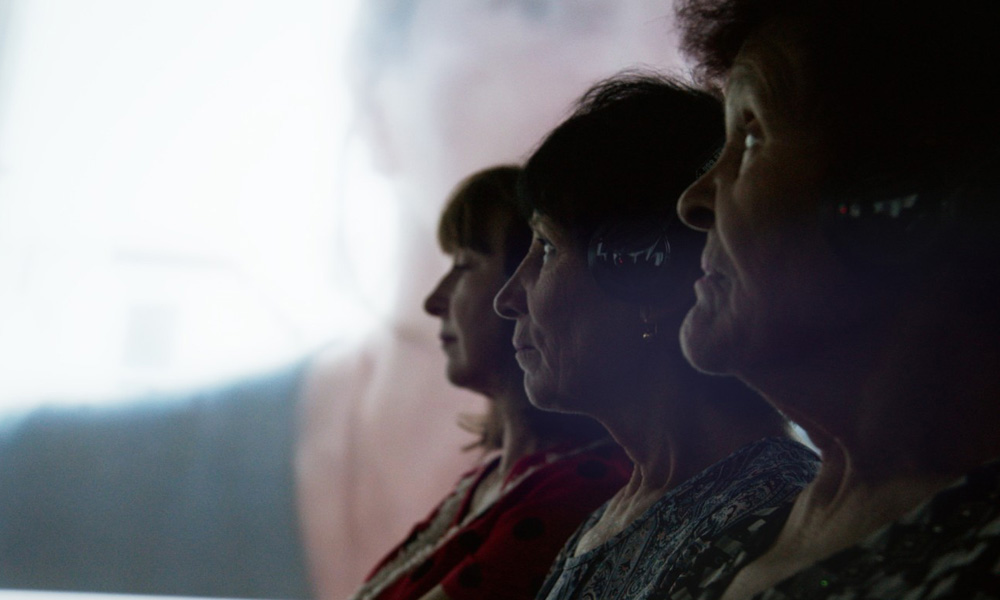

For much of the world outside of Ukraine, the full-scale Russian invasion that began in 2022 obscured the fact that the nation had already been under siege for some time with a prior attempt to seize control of Donbas in 2014 a clear sign of the impunity that would follow. In “Traces,” it is unfortunate that you feel as if you’re watching the present as Alisa Kovalenko speaks to women from Donbas, Kherson and Kyiv who roam about desolated landscapes with their homes perhaps still standing yet much of the community that once surrounded them long gone as the aggression outright destroyed their cities with bullets and bombs or dispirited residents so that the thought of rebuilding could seem impossible. Of course, across the country, some Ukrainians are only now feeling this kind of grief when attacks reach further and further geographically and psychologically during a war that looks to be without end.
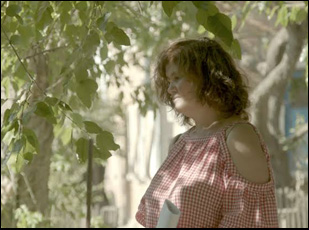
The damage done is impossible to quantify, but Kovalenko and co-director Marysia Nikitiuk manage to not only impress the impact upon audiences but does so with a remarkably delicate touch by focusing on a largely unexamined component of Russia’s warfare when their soldiers have inflicted sexual violence in the towns they’ve invaded. Kovalenko speaks with survivors of such attacks during earlier incursions, still living with the trauma of what happened as if it was just yesterday, yet firm in their resolve to hold their ground when they collectively believe that standing strong could serve as a foundation for the future. In fact, there is blossoming flora around women such as Iryna Dovhan as they describe harrowing experiences, tempered with the viewer’s knowledge that they are unburdening themselves to some degree by sharing their stories and destigmatizing a subject often mired in shame, and while they live in communities that have been broken, the women establish new bonds with one another that can give them confidence to move forward.
After premiering earlier this year at Berlinale where it won the audience award in the Panorama section, “Traces” has since been selected as Ukraine’s official entry to this year’s Oscars and with the film’s U.S. premiere at DOC NYC, Kovalenko and producer Natalia Libet, who has produced other national stunners in recent years such as Kateryna Gornostai’s “Timestamp” and Sarah McCarthy’s “After the Rain,” spoke about making a film about the unthinkable still approachable, using the testimonies as actual evidence in future trials for war crimes committed by the Russian army and aligning with the idea that nature can be healing.
 How did this come about?
Alisa Kovalenko: It actually started with my own personal experience of sexual violence in captivity in 2014. I was still a student and I went to Donbas at the beginning of Russian aggression in Ukraine. I was trying to document the events which were happening there and I was captured and interrogated and raped by a Russian officer. I was released four days after my captivity and this Russian officer said that I should be thankful that I was not executed. After that experience, I was silenced for almost two years. I couldn’t share it with the people I love, with my family. I thought that I don’t want to put this weight of trauma on their shoulders. But with trauma, I realized that it started to poison me from inside and I felt that I have to somehow start to speak out about that.
One big human rights organization in Ukraine was collecting cases of war crimes which happened in Donbas caused by Russian aggression already and I asked them after I gave my testimony if they already recorded a lot of testimonies of other women. They said, “No, you are the first” and I realized how big this wall of silence was. It was 2016, two years since the Russian aggression in Ukraine started and thanks to my testimony, one of the biggest international organizations combating sexual violence as a weapon of war globally wanted to help Ukrainian survivors to create a network to support each other and advocate for justice and for recognition. I joined this community and Iryna, [who became] the main character [in “Traces”], contacted me. I came for this meeting with other women and from the very beginning, we started to discuss what we can do together. At the time, there was no single case opened by the general prosecutor office, so it was like this crime didn’t exist But we thought that a documentary film is a unique instrument because it can preserve some memory and amplify voices and become an instrument to fight for justice.
I was scared to start to work on this film because I realized that it will be retraumatizing because I have to go back to my own past, but after I started I just felt I had to sacrifice my own feelings and step out from my fear and that’s how we started to work on this film. It was actually a collective decision from the inside of a survivors community. I’m a board member now of the First Ukrainian Survivors Organization and also this organization SEMA Ukraine and with so much support of my sisters from our community, I [thought I’ll] manage to make this film from my own experience to [become this] collective fight for justice, but at the same time, it was very important for me not to put crime and trauma at the center, but human dignity and human beauty [in the form of] solidarity and sisterhood and also to change this narrative because usually people see survivors of sexual violence in war as these invisible, silent victims and I wanted to change these narratives and present survivors as not just witnesses of atrocities but as the agents of change [where] they manage to transform the trauma into a force to fight for justice.
What was it like to even facilitate these conversations with survivors at the start?
Alisa Kovalenko: Iryna was the driver for this film. She was very much determined to have this film made from the inside our community, like nothing about us without us. And even during all these years before I really started to work on the film, she was always trying to motivate me, saying that she would support me in this process. When we started to document testimonies of newly affected women after the full-scale invasion, we had this bitter privilege [where] first we came and we said “We are survivors ourselves, representing the community of survivors and we are here to help you. We want to amplify voices of survivors, but it’s your choice to be part of this collective.” And the connection and trust was built totally different between me as a director with the protagonist of the film.
With Iryna, we are almost like a family. We worked together in in one organization for seven years, traveling together to different conferences and speaking together in different countries, so it was really filmed with a strong bond between all of the participants of this process, even with women whom at the beginning I was not sure [would be part of the film]. There was one woman that we documented her testimony, but she did not [immediately] agree to be in the film and I waited one year until she came to her decision and during this year we were also helping her become a member of our community, SEMA Ukraine. So this was a unique example when a film can be made from inside with all this delicacy, which is possible when you have the wound inside yourself and you know exactly how painful it can be when somebody touch your wounds and or bring you back in in your trauma.
Natalia, you also produced Kateryna Gornostai’s “Timestamp” and she had told me that it’s actually easier to make a film in Ukraine right now than could be expected because off how eager people are to document the atrocities. Is that actually the case in putting something like this together?
Natalia Libet: I think Kateryna is right because I remember Olga, my business partner and myself decided at the beginning of the full-scale war that we have to establish our own production company and just go ahead and document what is going on. Of course, when we have directors like Alisa Kovalenko and Kateryna Gornostai and Yegor Troyanovsky, it looks easy to make, and it’s not easy in terms of effort, but it’s easy because of this inner mission that I think every director and producer in Ukraine has this mission to tell stories about Ukraine and to document what’s happening there. It’s this passion that comes literally from our guts, not even from the heart. But when it goes out from the stomach it touches hearts too, and we have to make possible out of impossible, so I think it helps to bring together the teams. That’s why in general it feels like it’s easier, but it’s not.
From what I understand, Alisa actually requested a co-director when it got to be too much emotionally to take on. What was it like bringing on Marysia Nikitiuk?
Natalia Libet: It was very important that Alisa invited Marysia to join the team, first of all for her artistic vision and and also moral support. It was an extremely wise decision, psychologically and artistically, that Alisa made. But of course it’s a big privilege to have two great directors on board. It gave us even more security in terms of the outcome because for us, it was very important that the film was powerful, not only because of the message, but also because of the artistic vision, because of the image, because of the sound, because of the music. That’s exactly we as viewers were looking for from a film and from a director, so we were blessed to have Alisa and Marysia.
 Alisa, did the images come naturally from the testimony you were hearing?
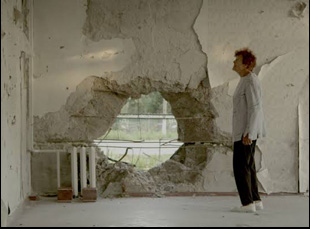
Alisa Kovalenko: Immediately in this process, we had an opportunity to receive a small grant for documenting crimes against humanity, and we went with Iryna to record testimonies in the Kherson region, which was just liberated not long ago. First, I decided that I will record testimonies only with audio because I was thinking that we need to find the visual form, that it will not be just interviews, that we can find another layer which [where it’s] not overwhelming and not just illustrative for testimonies. So mainly I was talking with the survivors, but also I was looking around a lot and when we arrived in the Kherson region, it was almost nine months in occupation and you can still feel a lot of traces of war. You can see the consequences everywhere. You can see ruined villages. You can see holes in walls and wounded nature. And you also see people like who are trying to heal this nature and for me, it became such a beautiful metaphor that people who were wounded themselves at the same time were trying to heal the nature around them and this nature is healing them in return.
I started to look very deeply in the nature and this atmosphere around to try to build another layer for the testimonies which can be a kind of metaphorical layer with this gardening and farming therapy. Like you’re coming back to your destroyed village and what you start to do is you start to plant vegetables and flowers. This is like a “fuck you” to Russians. We will plant our black tomatoes on this wounded land and we will rebuild our life
I started to really build this visual arc with a connection with people and nature — how they were healing themselves and how they were healing nature and how nature was also renewing through the seasons because there are also four stages of trauma. The second stage, after some extreme experience, you’re like a piece of ice and lots of psychologists explain this state that you cannot move and you cannot control your life. Psychologists often call it melting stage and I thought how nature renews itself is like how women were trying to recover after trauma. Step by step, it started being this mosaic of symbols and images coming together with the testimonies. And we didn’t want to just to shock people, but to see more this human dignity that triumphed over this evil in recovery after trauma. This metaphorical layer helped not to bring people [together] in shock, but take them by hand and and bring them through this traumatic experience and make them to understand trauma and also recovery.
You mentioned SEMA, for which the film is part of greater work of advocating for survivors. What’s the engagement been like so far?
Alisa Kovalenko: From the very beginning, we saw “Traces” also as this platform to advocate for survivor-centered justice. We are trying to organize a lot of different screenings with people from different sectors like prosecutors from international criminal court and human rights activists to build these bridges of connection and to bring survivors inside all of those processes. From the release of “Traces” at Berlinale, we started to work with organizations and with embassies and we use the film as one of the instruments to advocate to put Russia on the UN’s [radar as] shamelessly and systematically committing crimes of conflict-related sexual violence and we succeeded. All the time when we had screenings and discussions, we are like always trying to to advocate for this initiative from women and male survivors from Ukraine.
Then there is also an educational track what we have with the film [with] one very important initiative to bring the film as a special course for law faculties or university students. This film can help to shape this human-centered approach in the prosecution or process of investigating these crimes. So we are really trying to use the film as a key to open many doors and as a projector to put light on this very silenced and stigmatized crime and bring survivors as active participants in how the world should respond to these crimes and also fight against all possible impunity or amnesty. Because in the first peace deal Putin proposed, one point was amnesty for all crimes and we cannot accept any easy deal. If justice is a first victim of this deal, what kind of peace it can be? No punishment for this will make it a silent exception. So we continue to organize parallel activities and diplomatic screenings. It’s a lot of work, but from a long-term perspective, what we are doing now will be fundamental for future achievements.
Natalia Libet: For us, the most important thing is that our film is seen and talked about and we want to be a big film just for everyone to hear about Ukraine, about women, about their solidarity, how they support each other, how they’re healing because it’s inspiring for every woman to know that she’s not alone. Other women will support her. This is important for us.
Alisa Kovalenko: This film is empowering because after such an extreme experience, women not only found the strength to speak out but they found the strength to become a fighter and drivers for change. It’s something beautiful we need to see in our world because it’s one challenge to start to speak out, but since you start to speak out, it’s so important to see people who are listening to you, understand you, and support you. That’s why it’s so important, not only for the film, but for Ukrainian survivors to feel that their voices are heard. It will be incredibly inspiring for all Ukrainian survivors, both women and men who are struggling a lot now in such a complicated circumstances, with some of our survivors living literally on the front line. In Kyiv, the situation is horrible now — just Russian terror on civilians. They’re bombing whatever they want, so it’s incredibly important to feel that we are heard.
“Traces” will screen at DOC NYC on November 14th at IFC Center at 1:15 pm and be available on the DOC NYC online platform from November 15th through November 29th.