

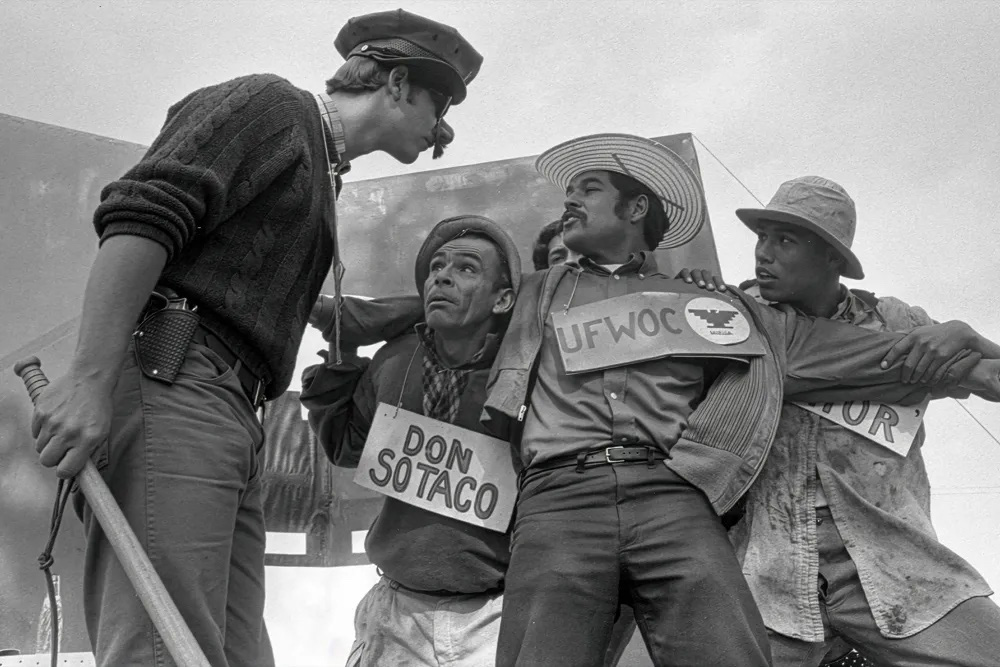

You could forgive David Alvarado for wanting to get a little theatrical with “American Pachuco: The Legend of Luis Valdez” when he could see the power in doing so from the example of his subject. It’s not typical for a documentary to have an omniscient narrator, but Alvarado couldn’t help himself when Valdez’s creation of the slippery and seductive host in his Broadway-bound “Zoot Suit,” given life by Edward James Olmos (reprising the role here), allowed him to express things that he would’ve likely held closer to the vest without such a flamboyant character and the artifice as a whole was long a lure that Valdez used to get audiences to rally around serious ideas, with “Zoot Suit” an outgrowth of his work with Teatro Campesino, the theater troupe he developed inside the United Farm Workers of America where staging plays to stir emotions were as galvanizing to the cause of living wages and safer working conditions as social protests.
When Valdez had to persuade leaders of the Chicano movement such as Cesar Chavez and Dolores Huerta that it could be valuable to commission plays and actively perform them to raise morale amongst the marginalized agricultural workers besides becoming an incredibly effective form of public outreach, “American Pachuco” becomes a convincing testament to just how powerful art can be when the playwright and director broke ground on a number of fronts and formally isn’t content to go with the status quo itself. Alvarado, who has often found a fun way to consider social progress in films such as “Bill Nye: Science Guy” and “We Are as Gods” (co-directed with Jason Sussberg), about the intrepid Whole Earth Catalog founder Stewart Brand who pushed the limits of human capability, paints a lively portrait of Valdez, not only making his most famous creation in the wily Pachuco an active participant, but reviving footage of Teatro Campesino productions that remain as vital today as when they were first produced, pulling in the likes of renowned directors such as Peter Brook and Taylor Hackford to take an interest. (Hackford’s future wife Helen Mirren became a part of Teatro Campesino’s workshops.)
To track Valdez’s rise to prominence is to chart the history of Mexican-Americans in the 20th century, giving “American Pachuco” a monumental feel as all of its most prominent figures sit down for interviews and Valdez becomes a part of collective success with both the United Farm Workers and breaking a glass ceiling as a rare Latino director on both Broadway and the big screen where “La Bamba,” his biography of Richie Valens, would become a classic. Alvarado also ends up detailing the struggle that many Mexican-Americans have felt as it delves into the estrangement between Valdez and his older brother Frank, who found success as an Air Force engineer and looked towards assimilating into what was accepted as American culture while Valdez was never shy about expressing pride in his heritage as an artist and pushed the definition of what an American is to new places. True to Valdez’s desire to keep things entertaining, “American Pachuco” shares all of its history with a smile, even the hard times Valdez endured such as the initial rejection of “Zoot Suit,” and risky moves through a half-century of work to make its impact come across as just as immediate.
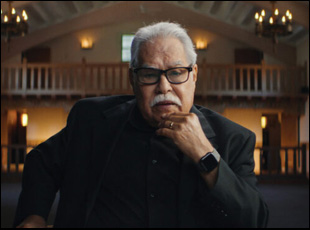
Now as the film ends the year it began at Sundance as one of the finest documentaries of the year – and as a PBS American Experience production, available to watch on YouTube — and recently making the DOC NYC Shortlist as an awards contender, Alvarado spoke about how it was incumbent upon him to bend the biographical form to tell the story of an artist who has defied convention, the difficult choices he had to make in encapsulating Valdez’s extraordinary career and how the digitization required to include clips of Teatro Campesino’s productions in the film will pay dividends for years to come.
 How did this come about?
It started in college for me. I was 21 years old and I had won a Hispanic Scholarship Fund Award, and the keynote speaker at the ceremony was Luis Valdez. And I was like, “Oh wow, he was the guy that did ‘La Bamba,’ right?” And “La Bamba” meant so much to me and my sister. We’d rent it from Blockbuster Video over and over again. It’s such an incredible movie. So I was [thought], “This is awesome, but then when he got up on the lectern and gave his speech, explaining that he was a migrant farm worker that would travel with his family from the age of seven to pick fruits and he went from there to the stages of Broadway and the studios in Hollywood, I was just blown away by it as a young Latino filmmaker.
And I’m half Mexican — my father’s from Mexico and my mother’s from Southern California — and I never really understood my own identity. My connection to my Mexican heritage was very light because my dad never taught me Spanish. I never understood why. And when I go back to Mexico and hang out with my cousins who I love, I was the outsider as the American guy. Yet when I was back home in white suburban Texas, [it was like] “Alvarado, what are you like a Mexican or something?” So [it was always this question] where do I belong? But Luis always had a strong vision of exactly what the Chicano identity is. It’s the recognition that there’s a deep connection as a Mexican American to your Mexican heritage and genetic and indigenous background with an appreciation of this being actually an American expression of that. You’re truly the American experience being Chicano in the US. He put that in all of his work, that pride, that sense of belonging, so that really inspired me and all these years later, h I was just thinking about my career [after having done] several feature document documentaries by that point, and [thought] “How come nobody’s done a film on Luis Valdez yet?” That’s really where it it all it got started.
One of the most provocative through lines in the film is how there were two lines of thought about assimilating into American culture from a Chicano background as Luis and his brother Frank, who would work in the government, took distinctly different paths. Was that something you could latch onto pretty early?
That was actually the one storyline that I didn’t really know about when I was writing [the] film, because I wrote a large treatment before we started. I knew all the pieces I wanted to cover. I knew about the early works with the union where he really got started. I knew a little bit about his family background and I wanted to include some of that migrant farmworker life I knew about, and then in the ’70s he had done a few pieces — I knew I wanted to hit “Los Vendidos” and then “Zoot Suit” and “La Bamba,” but I also knew I didn’t want to go really much farther than that because in a 90-minute film, I couldn’t just show you everything he did and [I realized] there’s a nice envelope around all this. But what I didn’t know is how much his sibling relationship with Frank was so important to his life and also helped us understand what he had done in all of his works. In “La Bamba,” the fight between the brothers becomes something now that I see as like a very personal expression of his own struggles with his brother, so that was something that I started to work with him, trying to get him to talk about it more.
Did you have any idea going in just how much archival he was sitting on?
I knew there was some archive and he mentioned it early on, [so I said] “Okay, well where is it?” And [he said] “We’ve donated maybe the first half of it to UC Santa Barbara.” So I contacted them and [they said] “We’ve got 200 reels of film here.” I’m like, “That’s great. Let me see it. And they said, “Well, no, you can’t. Some of this is 50 years old and becomes brittle over time. It’s just too dangerous to just let anybody who wants to come in and just open up a reel and hold it against the window and see what’s in there. You have to digitize it.” And they gave me a quote for around $100,000 for one of their vendors to digitize everything. And [thought], “Okay, I can’t really [do that],” but we worked with them and they ended up looking for some funding on their side and we found some funding on our side, and then we worked with George Blood, who has this giant film transfer house in Pennsylvania, and I was working with him on other projects and he gave us an incredible discount. Through all three parties, we were able to transfer the whole thing.
Then when we started getting them back in April of 2024, it was just incredible. It ended up being 80,000 feet of film and I’ve been telling people, when you’re in an airplane, you’re 40,000 feet up in the air, so this is twice that in unspooled film. And we’re making that available through through the Internet Archive and through UC Santa Barbara to anybody who wants to use it — filmmakers, researchers — so we’re really proud. We feel like we’ve rescued a piece of Chicano history, this really important cultural product that we’re now making available to the future.
With all that footage, did it allow for the maximalist approach you take with split screens and lots of edits to match Luis’ zesty personality?
When we started to realize how much footage we had, I [thought] I actually have the ability to show more on screen at the same time. We tried to deploy it in the right areas, either you’re in the Chicano Moratorium and you feel like you’re seeing different parts of the same event or you’re showing contrasting ideas like there’s Luis’s plays, “Soldado Razo” and then actual footage from the Vietnam War, so there’s different ways that we deploy it, but it just felt like in a film with so much archival and most of my work in the past has been contemporary observational verite, I just enjoyed so much being in other people’s footage and and trying to maximize its use where it makes sense.
How much were the interviews informed by the archival and vice versa?
It goes both ways because in in some sense, I had written the the treatment and made a structure for what I thought the film should be early on, but then you shape it so that it feels right in the moment and use different things to solve problems as you go. The [story with] Frank actually wasn’t just talking to him that made me see how important that was. It was finding that footage of that conversation at the end of the film when [he and Luis are] sitting at the table talking and Frank is being perfectly clear that “Wow, yeah, I’ve been essentially betraying my identity because I’ve been trying to portray myself as a successful American and that’s at the expense of my identity as a Chicano.” When I saw that, I [thought], “That’s just got to be in there.But what do I need to build up to that point so that we understand all the complexities to get to that moment?” So the archive sometimes leads the way and other times, archives are in service of the current plan.
An early nitpick I had with the film I’ve come to view as one of its strengths, which is that you don’t cover the production of “Zoot Suit” as a movie, which had to be notable as Valdez’s first film, but you use clips of it to illustrate the Broadway production, which saves you plenty of time. How did that savvy decision come about?
Most people view this film not having seen “Zoot Suit” the film. You have, so you saw the construction there.and what an opportunity it was in a film to show a cinematic version of a play on stage when you’re talking about a play on stage. Not everybody gets that. And we tried for a little bit in the edit [to include the production of the film] and there’s so much more than just “Zoot Suit” that was done in that time, and and unfortunately, a 93-minute documentary is meant to entertain and enlighten and get people interested in the subject so that maybe they can go and find out more. There’s a two or three times in this movie where we jump forward seven to 10 years, going at lightning speed through Luis’s life because sometimes when you’re in the time machine of storytelling, it’s just hit the gas and go. We went basically from the failure of “Zoot Suit” on Broadway and what that meant to him about how he should retain his not just his own pride and who he is as a Chicano, but also his connection to his indigenous roots and what that means to the rest of his work. We go from that fever nightmare to “La Bamba,” which is a giant leap in time.
But [during that “Zoot Suit” sequence] most people see this and rightly aren’t questioning everything, they’re going, “Oh, there’s the Pachuco?” Luis is talking about how he wrote the character of the Pachuco and and how that writing helped him you know take control of the story or express these ideas in this way where there’s an interloper like in Shakespeare that can then interact with the audience and control the narrative. So he’s talking about his writing process, but we’re using the film “Zoot Suit” to illustrate what he had done for the play and still expresses the idea of what of the character that Luis had created.
What was it like deciding that Pachuco should be the narrator of your film as well?
It was an idea early on, but my confidence level of it was low. I just knew I wanted to try it. If you think about it, it’s a pretty weird idea that there’s a fictional narrator in a nonfiction film about a person and the fictional narrator comes out of that person’s life. It’s a creation of the subject of the documentary who’s now aware of the documentary and is commenting on it. But that’s also what the Pachuco did in the play. He had control of the story. He could freeze time. I [thought] “Well, there’s nothing about it that doesn’t make sense formally, so it’s just a matter of execution.”
I knew at least two things could go wrong one — I’m not Luis Valdez. I’m the writer of this [documentary] and therefore the narration, so could I possibly write [Pachuco as] Luis did? Can I emulate that character in an authentic way that works? And that was daunting enough. But then also we didn’t have Edward James’ agreement until much later in the project, [much] deeper into the edit when we were already using these scratch tracks where it was my voice being the Pachuco. And I’m a terrible Pachuco. My poor editor had to work with my voice as the Pachuco, and we’d show to the [film to] the broadcast partners, and they were like, “I get why it’s theatrical, but are you sure this is going to work?” But the second that we got Edward James to read the thing in a studio and we laid the tracks out, everybody [said], “oh my God, this is great. This works.”
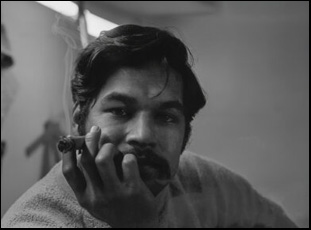 That may have been it, but was there anything that changed your ideas of what this was or added a dimension to the story you didn’t expect?
The film was always supposed to be a film about belonging in America, but about November of of 2025, as we were approaching the Sundance Festival, which is in January, it became clear that these questions of who belongs in America were becoming politically and horribly relevant. People were marching through the streets, profiling people for the way they looked in Los Angeles, ripping them out of parks and and putting them in cars and taking them away. It felt like the Zoot Suit riots all all over again, so to have a film that was showing you somebody who was born in America, whose parents were born in America — [Luis’] grandparents came over when America was still Mexico and then it became America — and to feel like they don’t belong here, what an important time for a story like this to come out.
The film touches on all these things — what is America, who belongs here, who gets to decide that and what is this whole enterprise of America really supposed to be about? — in an entertaining way that is about the arts. It’s about the love of family and the joy of artistic creation. So I think that’s why people have been responding to it so well. Every time I watch this, I get choked up, but I didn’t know if other people would feel the same way. And then when we got to Sundance, we won not only the US Audience Award for documentary, but also the Festival Favorite Award, meaning it was everybody’s top pick out of the whole festival. That just went to prove to me this story is so much bigger than what people usually try to [box in as] a Latino story.
What’s it been like to see Luis get the appreciation he deserves as he’s traveled with you with this?
It’s been amazing. He’s taken his wife Lupe with him everywhere he goes. They’ve lived their lives together, they’ve created art together, they have children together, and during the course of the release of this film, they had their first grandchild, which has been fantastic And Luis loves a crowd and to get people excited. He’s a great orator and I’m always blown away with how excited people are to be in the room with him. It’s really time for him to get his flowers. He’s in his mid-eighties and he got kicked out of Broadway and never got any kind of Oscar recognition for “La Bamba” and he’s had trouble finding more work in Hollywood since “La Bamba.” I can’t put that together. So this is our opportunity to sort of celebrate him while this great American artist is still with us and I’m proud to have played a small role in getting him in front of people on these stages, so that 50 years from now, some of those people who come to this movie can say, “Oh yeah, I met Luis Valdez back at a time when Luis Valdez roamed the earth.”
“American Pachuco: The Legend of Luis Valez” is now available to watch on YouTube as part of PBS’ American Experience. Special screenings of the film include November 15th in New York at 2:15 pm at the IFC Center as part of DOC NYC, December 5th at the Roxie Theatre in San Francisco.