



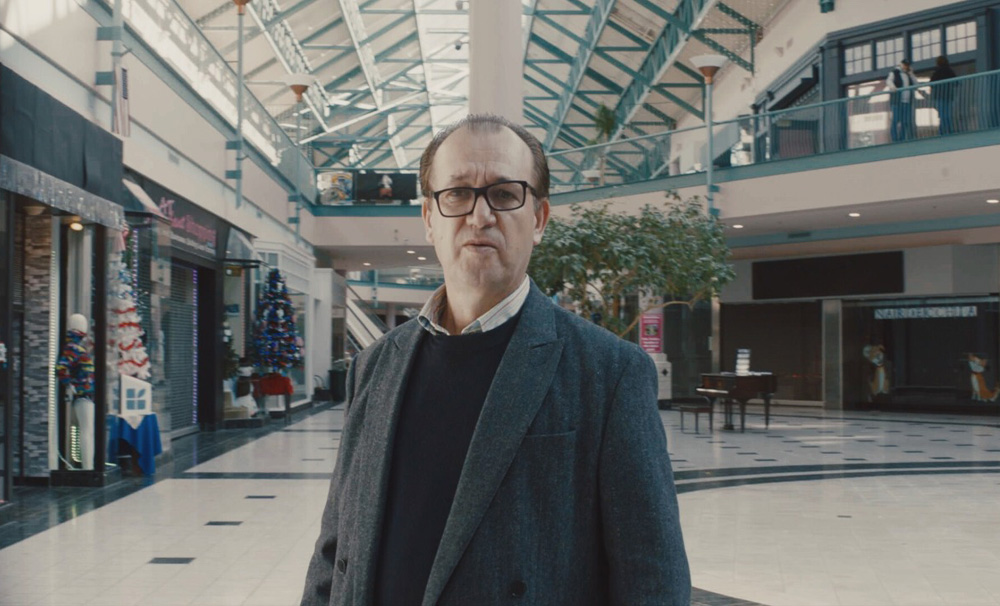

It’s apparent early on in “Mall Country” that Leo Karruli didn’t know what exactly he was buying when he won an auction to purchase the Johnstown Galleria in a small Western Pennsylvania. Scouring the internet for real estate investments after becoming a successful restauranteur in Florida, achieving the American dream when he worked his way up from being a dishwasher from Albania to ultimately having an Italian place of his own, he couldn’t pass up the opportunity to buy a fully functional shopping center for just $1.4 million, though as his wife Irene notes, there wasn’t much wiggle room to back out when he made an impulsive bid, only to learn there were no other interested buyers.
Still, as director Brian Becker makes clear in placing Karruli in the grander context of the rise and fall of malls as an urban hub over time in America, if Victor Gruen, the architect behind the Southdale Center in Edina, Minnesota that would become a template for many other malls to follow, had a dream candidate to run one of his operations, that person would look a lot like Karruli when the goal wasn’t entirely rooted in commercial interests, but social ones. What looks like a foolish financial investment on Karruli’s part starts to reveal less obvious rewards in the endearing doc where trying to bring the glory days of the 1990s back as a bustling enclave of big box retailers may be futile, but the dream of giving people the third space they desperately crave nowadays isn’t something that should be abandoned.
Curiously and perhaps to its benefit, “Mall Country” doesn’t ever bring up the advent of e-commerce or the internet at all as a reason why there are now plenty of real estate listings just like the one Karruli found that seemed too good to be true until realizing foot traffic at such places is at an all-time low. In the case of Johnstown, there simply isn’t much of a population there to begin with when the factory that once provided much of the employment in town shut down and most of the people at the Galleria seem to fall into two groups – the retirees that still gather in the food court to get a morning coffee and those who biding their time to get a better paying job elsewhere when they can afford to move.
Although the film probably could stand to be a bit more community-oriented itself when a secondary narrative throughline never fully manifests to compliment Karruli’s quixotic attempts to build a business – the closest it comes is a new arcade owner who splits his time between the mall and the buffet he runs across town, all to pay for his sister’s college education – “Mall Country” does disabuse audiences of an idea that malls are faceless corporate endeavors, even foundationally when it refers to archival interviews with Gruen and Edgardo Contini, one of his disciples, describing their initial intent with malls and an increasing disillusionment with what they became when a certain uniformity and stagnation set in rather than becoming a reflection of their region.
That’s what Karruli gets right as he plots a comeback for the Galleria, even if it looks like he may get everything else wrong as he takes on every responsibility from mopping the floors to recruiting new businesses to fill all the empty storefronts, eventually overwhelmed by having to take over the management of an Italian restaurant on the premises. While limited demand surely prevents him from raising rents or attracting name brand stores, he appears genuinely encouraging of mom-and-pop shops and providing unused space to local organizations that he’s unlikely to see much of a return from, perhaps resulting in the silly sight of knights and maidens milling around an empty Bon Ton after ceding half the mall to a medieval fencing competition, but getting people out and together any way he can.
Becker, who previously co-directed the remarkable all-archival “Time Bomb Y2K,” once again resurfaces incredible footage from the heyday of malls between news reports and surreptitiously shot amateur video, building a strong case that things were healthier culturally when there was more of a centralized town square. (It’s forgivable that to keep a tight 84 minute runtime, the film elides mention of the downtowns that many of these malls drained in the first place.) It can’t help but bring a smile when the film ultimately tells the story of Karruli seizing opportunity, just not exactly the one he probably imagined as he has to give up ideas about restoring the Galleria to what it was and embrace how organically it starts to be shaped by other people and when Becker’s own films have a charming handmade quality, admirably resisting too fine a polish on things, it becomes easier to see what the full potential for such places are as “Mall Country” ends up reaching its own.
“Mall Country” will screen again at DOC NYC on November 15th at the Village East at 11:20 am and will be available online on the DOC NYC online platform from November 13th through November 29th.