

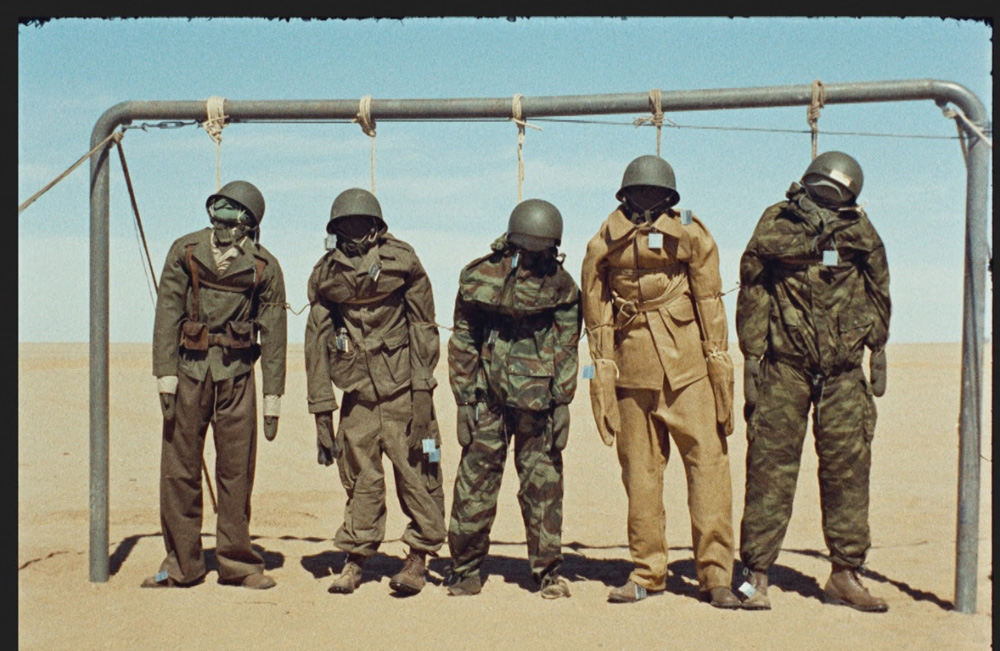

There’s a sign warning “National Defense – No Photography” tucked into the vast desert of Tanezrouft in Algeria, making it seem like a miracle that there was any footage at all for Rachid Bouchareb to make “Boomerang Atomic,” then again, it has always seemed as if the filmmaker has delivering forbidden images to the screen as he’s spent much of his career bringing to light the ongoing marginalization of Algerians after its time as a French colony. Long devoted to elevating the struggle for true freedom even after his home country won its independence in 1962 to an appropriately epic scale with grand historical dramas such as “Days of Glory” and “Outside the Law,” Bouchareb has made an unexpected first foray into nonfiction with a powerful short unearthing recordings made around France’s bid to join the nuclear arms race in the late 1950s, withdrawing from NATO under Prime Minister Charles de Gaulle to determine their own military destiny and searching for an isolated area to conduct tests as Americans had in Nevada.
Predictably, French officials set their sights on the Sahara Desert where the impact of radiation would be more limited, but it also wouldn’t seem to matter to the country who had to live with the consequences when it would be Algerians that were most in harm’s way. As Bouchareb comes to cheekily point out from news reports at the time, few civilians in France actually knew that there were nuclear tests occurring in the region even as government officials were making the case that such armament was a necessary defense. With footage of the Gerbloise Bleue test from 1960 and subsequent trials leading to the catastrophic Béryl incident in 1962 that would be later cited as the cause of a number of leukemia cases in the region, “Boomerang Atomic” shows just how reckless and destructive even preparations for war can be, all the more chilling when it’s under the most controlled circumstances imaginable. But in only presenting Algerians at the beginning of the film and its end, Bouchareb also slyly depicts how they were sidelined from having any say in the matter and were ultimately doomed to live with the repercussions, which persist to this day when the land compared at the time to the surface of the moon in its desolation still may not be free of the radioactive dust left behind by the atom bomb.
Since premiering at last year’s Venice Film Festival, “Boomerang Atomic” has unsettled audiences around the world and as it’s about to make its U.S. debut at DOC NYC, Bouchareb graciously answered a few questions, assisted with translation from his son Bilal, about how the short came about and how he’s already at work on a larger narrative feature about this era, as well as telling a story exclusively from the archival materials that were available.
How did this come about?
I was doing research for a full-length feature film, *Raggan,” and throughout that process of discovery of various archives, I wanted to make a short, though I couldn’t access all the records as some are simply off-limits. But I gathered enough material to write the screenplay for *Raggan,” [which] is currently in pre-production, with filming set to begin [next year] and since I had all these archives at my disposal, collected from the Ministry of Defense and various private television networks, I realized that, given how little this history is known globally, and especially in France, where almost no one is aware of the story of these nuclear tests, it was worth sharing. It’s somewhat similar to my earlier film, *Days of Glory.*
It was also incredibly useful to be able to show these archives to the film’s prospective partners, including the Ministry of Culture in Algeria, as well as partners from the U.S. and Japan. I felt it was valuable to provide not just the screenplay, but also this collection of archival material, so that everyone involved — from the actors to the entire artistic and technical crew — would have more context to work with than just the script alone.
Was limiting yourself to only the archival material as a storyteller an exciting challenge?
It was new for me, and I simply let the material guide me toward an organizational structure that emerged quite naturally. A chronological order was established, along with the inclusion of voices from that era. Everything you hear in the film dates back to 1959 and 1960, the time of the first atomic bomb tests. There is no modern-day commentary; all of it is over 65 years old. Some of it comes from the military — personnel working for the army who were filming the first atomic explosions — while other parts come from French television broadcasts of the period. It was important to me to structure the film around this narrative, which is woven throughout the footage.
I was particularly struck by the footage of the “man on the street” interviews conducted by a TV station asking French citizens if they were aware that an atomic bomb had gone off within their own country. What was it like to find that and in general, convey how shrouded in secrecy these tests were?
Yes, it was a real discovery to find that, filmed in the heart of Paris just hours after the explosion in the Sahara [where] people learn from a journalist on the sidewalk that France has carried out its first nuclear test and is now joining the global “atomic club.”
Was there anything that changed your ideas of what this was as you really started to dig into the history?
The reality of the situation is truly distressing. It was a profound shock to realize that, in the end, a portion of the Sahara has been left contaminated for 24,000 years. I was also deeply struck, though I chose not to include some of the more harrowing images, such as those of infants, by the fact that the local populations have been affected for two generations. This tragedy continues to this day, even though the French government has never acknowledged it. And the French state still refuses to provide the Algerian government with the maps showing where nuclear waste was buried. The waste remains on-site, interred in the ground, yet the French military continues to withhold those documents. There were several atomic sites where these explosions took place. In Algeria, there were 17 of them. Then, in 1965, the testing moved to the Pacific, because Algeria had gained its independence, they were relocated to the Pacific where tragedy unfolded as well. When the film was screened at the 40th anniversary commemoration in Hiroshima, it was quite significant. It brought together Polynesians and Japanese survivors.
What’s it been like so far sharing this film internationally?
It’s making its way around the world, and there’s so much to discuss. it premiered in Venice, and was also at the Clermont-Ferrand short film festival, as well as in Tunisia. In Paris, it was featured at a festival focused on nuclear issues and ecology and it traveled to Poland for a major documentary festival and the U.N. and Tokyo. It’s been great to see the response from the public.
“Boomerang Atomic” will screen at DOC NYC on November 11th at the IFC Center and will be available on the DOC NYC online platform from November 11th through November 29th.