



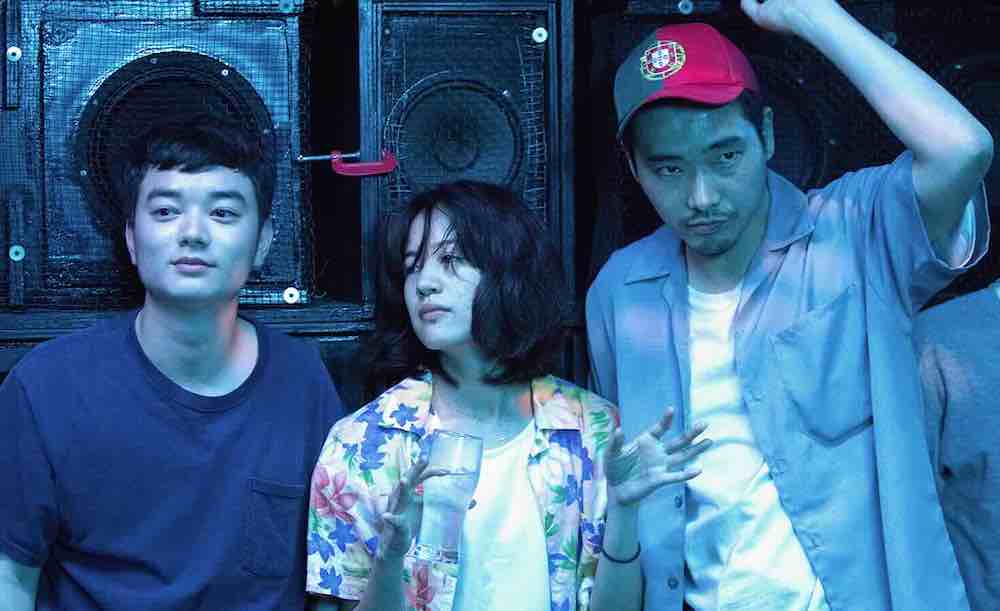

It wasn’t by design, but you sense that Sho Miyake wouldn’t have it any other way than to have a major retrospective of his work seem to come out of nowhere when the writer/director often tracks those who often feel as if they’re on the fringes before someone extends a hand to bring them in. 2026 began with such an invitation when the Locarno Golden Leopard-winning “Two Seasons, Two Strangers” became his widest U.S. release to date, courtesy of the intrepid New York-based distributor Several Futures, and audiences couldn’t help but be disarmed by the inspired tale of a screenwriter trying to reconcile the version of her script that was helmed by someone else and how she would’ve helmed it as Miyake was working out himself how to adapt the two Yoshiharu Tsuge manga it was based on, brilliantly fusing together ideas of having an aligned vision in terms of intention versus execution as an artist and between two people simply trying to make a connection in spite of different backgrounds as the characters from the film within a film were.
Miyake is the kind of filmmaker where once such a connection is made, it’s intense, which is why the first opportunity to enjoy a survey of his work so far in North America, beginning this week at the Metrograph before heading out west to Los Angeles on November 13th, is such an exciting event, offering excursions to rarely visited corners of his native Japan that tend towards the rapturous. After first showing a playful streak early in his career with the black-and-white 2012 fantasy “Playback,” in which an actor approaching his forties finds himself thrust back into his high school days, and 2015 comedy “The Cockpit” where a pair of hip-hop artists chase the perfect beat in their cramped apartment, the films have become more elegant and refined while their sense of adventure hasn’t diminished as Miyake has followed characters who may fear they have no place in the world but makes that world come alive and capable of change as much as any one person. (The environments have a way of being as memorable and enigmatic as the unforgettable figures at their centers in Miyake’s careful compositions like the deaf boxer at the center of 2022’s “Small, Slow But Steady” who has less issues in the ring than outside of it as she trains in the midst of the pandemic and the twentysomethings of “All the Long Nights,” both well-aware of their mortality as they suffer from debilitating conditions and come to find strength in one another.)
The generosity that Miyake shows to the characters in his films extends to the retrospective when at its various stops, he’s saluting other filmmakers from rare screenings of David Elfick’s “Crystal Voyager” and Shinji Aoyama’s “Sad Vacation” in New York to King Vidor’s “The Patsy” and Tony Scott’s “Deja Vu” during the L.A. series at the American Cinematheque and Jacques Demy’s “Bay of Angels” in Toronto. As extensive as the “Unspoken Gestures” series is in illuminating the work and influences of a very special filmmaker who appears to only be entering his prime now, the travel plans are even more so as he plans to accompany the retrospective nearly everywhere in person as it moves through North America and will cross the Atlantic to Paris, Toulouse, Rome, Turin, Madrid, Zurich, Cologne, London and Derby through early 2027. During his stay in New York where he’ll hold court for the next week, the director recently hailed by Ryusuke Hamaguchi as a “young master” graciously took a moment to talk about getting the chance to reflect on his previous work, why the creative process is always a rich subject for him to mine on screen and the film he wants everyone to see in the series, which isn’t his own.
 Your films have generally concerned people your own age, but one of your earlier “Playback” actually is centered on an actor turning 40, a milestone you recently passed yourself. Is it interesting to look back on that one?
I made that film when I was 26 and at the time 40 felt like an age that was so much older than me. Now about 15 years later, something that I realized is my age has changed, but my mind hasn’t.
How much do you actually build a character with the actor? From what I understand, on “Slow, Small But Steady,” you actually learned the sport of boxing together with your lead.
I do that because I think it’s fun. I don’t want to just enjoy the results of filmmaking. I want to really enjoy the process, so I work with actors on building the character, but I also with my staff make sure to trade a lot of opinions and have [collaborative] discussions. Filmmaking of course is something that is only possible through the work of lots of different people, so we try to enjoy that together.
 An especially enjoyable part of looking at your filmography in total is observing the progression of how the atmosphere has become more of a presence in the films. Has anything changed about your ideas about what to leave in the frame or how to use the frame?
Initially, I was interested in how to follow and keep up with things like changing weather, all these uncontrollable elements and trying to keep up with them by, for instance, moving the camera or chasing it. In that sense, it was a very busy process. Sometimes it would be successful and then I’d be able to capture something. And although we can’t completely and accurately predict the weather, we can think of things like what kind of terrain allows for wind to blow very easily or what specific area is known for beautiful sunsets, for instance. So there are certain elements that we can predict and I think that I’ve learned that as long as you prepare a lot beforehand, even the things that you aren’t able to control for, there’s a higher likelihood of being able to capture it.
And then there were also many things that I wasn’t able to capture. Later on in my filmmaking, I think I started to focus more on what stillness can capture by keeping the camera in one place and we’re still able to see the small movements that we otherwise wouldn’t notice.
It’s interesting also to compare a film like “Cockpit,” about a group of rappers, and “Two Seasons, Two Strangers,” which shows a writer struggling with adaptation, as reflections on the creative process. What was it like to find the right expression for that at different points in your career?
First of all, I rarely hear people connect “Cockpit” and “Two Seasons, Two Strangers,” and I think that that is central to my interests. I want to think about how art forms like movies or music are needed by society or for us in life and I think that the idea of necessity maybe is a little bit difficult, but I want to think about the process of my art making as something that gives us a lot of enjoyment as people. That’s something that I want to also share with people.
 In this retrospective, you’re not only sharing the joy of your own films, but in the Metrograph series, what look to be two rare gems in “Crystal Voyager” and “Sad Vacation.” Why were they important to include?
I was asked to choose one American film and one Japanese film, and despite that, “Crystal Voyager” is actually an Australian film. However, it encapsulates a lot of what I love about American films. My first encounters with American films were with movies like “Home Alone” or “Apollo 13” and I think both those films involve people trying to change their circumstances or surroundings with just what they have. For instance, with “Apollo 13,” there’s this incredible scene where the astronauts in the spaceship are trying to fill a circular shape with square and rectangular things. I’m really interested in those moments where people are just driven to use their knowledge and problem solve creatively. It’s very DIY and I find that to be very important to American films.
Even though it’s a surfing film, “Crystal Voyager” contains a lot of those elements. and this act of surfing, it’s less about DIY and more about how people are confronting this natural phenomena of waves, something that you can’t control and seeing if they can ride through it or be completely overwhelmed by it but still continue to survive. There are many American films that contain these ideas too — that there are going to be many things that you can’t control and then you can’t through sheer problem-solving and that oftentimes you will be at the whims of fate and history. In that sense, you have to ride the wave, so to speak, and that’s why I wanted to choose a surfing movie.
And then “Sad Vacation.” Shinji Aoyama is the filmmaker that I I respect most amongst Japanese filmmakers and although I want people to come see my films too at the retrospective, if you’re only able to see one film, I actually want you to go see “Sad Vacation.” That’s how much I respect and adore this film.
As part of this tour generally, you’re also conducting a number of master classes at educational institutions. Is that something you enjoy?
Yes, I’m very excited for the workshops. Of course making films is all about encounters with other people and I think that this retrospective is possible because of my encounters and meetings with people from the Japan Foundation as well as people from all over America, so I’m very grateful for these encounters that I’ve had. Even yesterday I did a presentation at Columbia University and the discussion that I had there was so stimulating. And to get the opportunity to go to a place like Oklahoma, which I’ve never been to, is really exciting. It’s so unknown and I’m excited to see what kind of people I meet there and the discussions that I’ll have. A person like me, not that I’ve never surfed before — and maybe it’s not very cool of me to make all these surfing metaphors [laughs] — but like I said earlier, I’m just excited to ride the wave.
“Unspoken Gestures: The Cinema of Sho Miyake” will screen in New York at the Metrograph with screenings of “Two Seasons, Two Strangers” on November 7th, “Crystal Voyager” on November 8th and 13th and “Sad Vacation” on November 8th, “Playback” on November 13th, “And Your Bird Can Sing” on November 14th, “All the Long Nights” on November 14th and “The Cockpit” on November 15th. It will also screen in Los Angeles at the Los Feliz 3 with screenings of “Two Seasons, Two Strangers” on November 14th, “Deja Vu” on November 14th, “The Patsy” on November 15th, “All the Long Nights” on November 15th as well as a screening of “Small, Slow But Steady” at the Japan Foundation on November 14th. And in Toronto, screenings will commence on November 17th of “Small, Slow But Steady” at the TIFF Lightbox, “Two Seasons, Two Strangers” at the Fox Theatre on November 18th, “Good for Nothing” and “Bay of Angels” on November 19th at the Paradise Theatre.