



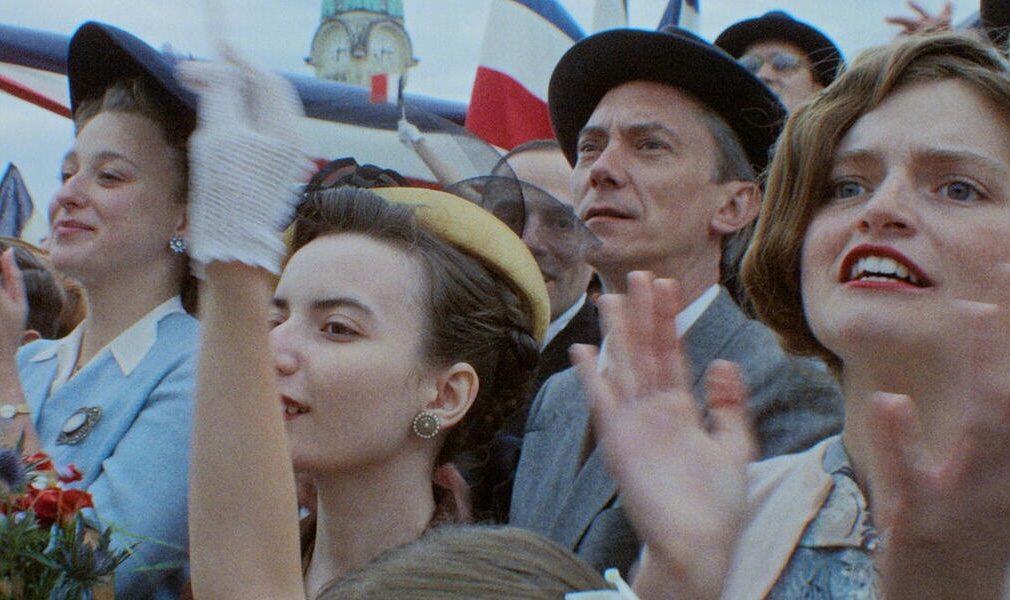

It likely wasn’t an influence, but the 1940s-set “A Man of His Time” can start to look a lot like it shares a visual parlance in line with the handheld camerawork of “The Office” just after Henri (Swann Arlaud) receives a letter from his dear wife Paulette (Sandrine Blancke), who calls their marriage an unmitigated disaster. Acting like a bit of a record scratch even though Paulette’s tone doesn’t change much from the pleasant tenor that the start of her letter began with, the acknowledgement that anything could be wrong upends the polite period piece that you might imagine Emmanuel Marre’s latest bemusement to be, which even at a swollen two-and-a-half hour runtime and costumes galore has unexpectedly much in common with his previous film, the sly, postmodern Adele Exarchopoulous comedy “Zero Fucks Given” co-directed with Julie Lecoustre (still credited as a co-writer here) where to chronicle the misadventures of an aimless flight attendant meant waging war on the tyranny of a narrative structure in anarchic ways. Inspired by letters passed between his own great-grandparents during World War II, Marre’s unexpectedly playful chronicle of Henri, a deceptively ruthless social climber who finds opportunity in a divided France, leaving his wife behind at least temporarily to head to Limoges where the Vichy regime was attempting to set up a lasting government under Nazi occupation, comes alive in the present moment.
The mere presence of Paulette, at first just a voice and then manifesting physically once Henri establishes himself as a proper apparatchik, is novel enough to give the film currency, with a critical perspective of his rise subverting the traditional hero’s journey, but then again Henri really is exposed as one of history’s great villains, the kind that is lost to the margins of any official record yet was complicit in carrying out evil policies. Consequences other than to any that will directly affect himself are clearly not what he thinks about when besides Paulette’s letters of longing for him to take some responsibility for the family he left behind, he has no firm principles to speak of, trying out various stances at the party where he’s first introduced, slowly sneaking his way into conversations after mostly standing off to the side. As one fellow partygoer who works for the new head of state tells him after being a bit too emphatic with his praise for the new leadership he should strive to avoid looking sycophantic, a lesson he takes out the door with him when he’s unaccompanied otherwise and unlikely to make any new friends due to his temperament even if he espouses the same beliefs.
When the soiree is filmed with blazing white hot lamp casting a spotlight on whoever is in front of the camera like Mark Romanek’s notorious video for Fiona Apple’s “Criminal,” Henri can’t escape the harsh light after the party ends, even if the film itself settles into a more traditional relating of the past where he can often blend into the background. As one superior sums him up, Henri’s got a talent for asserting himself and has a habit of getting in the right rooms, no matter how unusual those places may be, whether it’s a bathhouse where he gets his first gig setting up guidelines for a secondary school from an administrator getting a massage or a concert hall where the prospect of a promotion comes up in between auditions for singers for a government gala. Despite fronting for fascism, these are not serious people to go by their activities, which makes Henri’s sense of purpose stand out, making slightly savvier choices than others while sharing their self-interest, hardly putting up a fight when he doesn’t get a desired top job when he knows it’s someone else who will be singled out for blame and getting a secretary who is too simple-minded to tell him anything but the truth.
Marre occasionally gives away the game he’s playing — Opus’ irresistible 1978 anthem “Life is Life” explodes anachronistically over archival scenes of the country being held in sway by the Vichy regime at the height of Marshal Philippe Pétain’s reign – but when Henri goes about his work without calling attention to himself, the film largely follows in his footsteps with an ultra dry, relatively uneventful narrative approach. However, just as he isn’t to be underestimated, It would be a mistake not to think anything is going on in “A Man of His Time” where both the sly humor that emerges from his various machinations to improve his standing and the greater sense that the joke may be on all of us as the number of dispassionate bad actors that have found positions of power within bureaucracies to solely serve themselves throughout history and ultimately changing the course of it has been unabated and while following someone who flies under the radar, it’s impossible not to take notice of this inspired and engaging study in the banality of evil.
“A Man of His Time” will be released by 1-2 Special in 2026.