



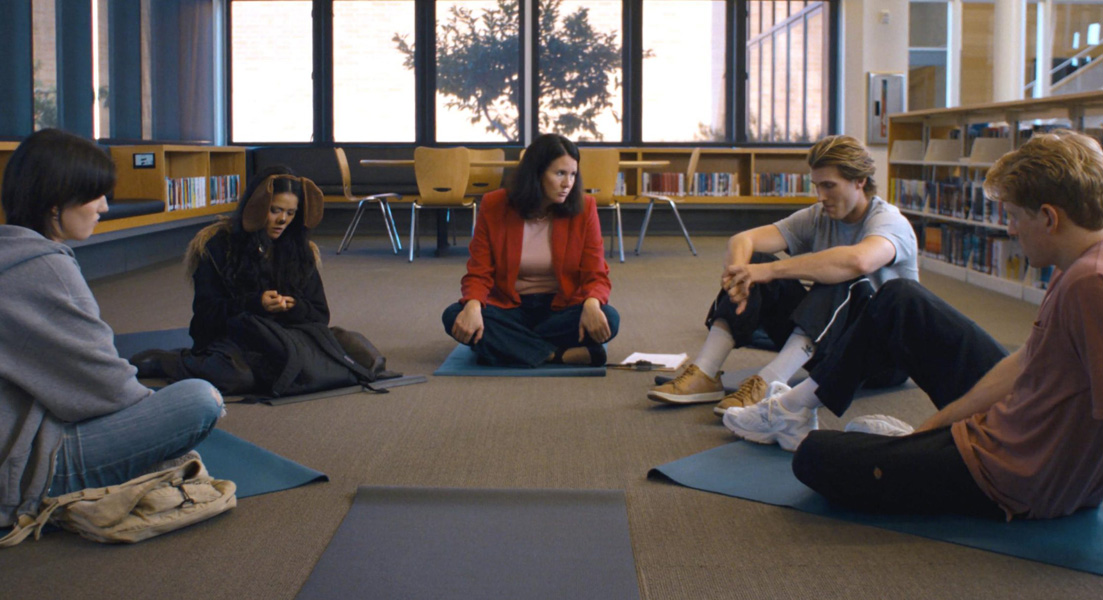

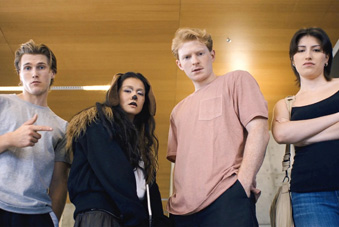
“Wait, all of you guys are in detention?” a young woman asks of the quartet of Corey (Ricky Spaulding), Eden (Bianca Mariani), Nash (Ian S. Peterson) and Mary Beth (Anna Mulia) that are sitting at a local cafe in the comedy “Detention,” surprised to find that they have gotten in trouble in the first place, but even more so that they somehow aren’t serving out their sentence in the school library as one might reasonably assume.
That simply wasn’t going to be the case as filmmakers Emma and Mark Cameron found themselves enchanted with their new surroundings in Bainbridge Island after moving up north from Los Angeles and were inspired to make a film, yet to do so on a manageable scale when it would be a labor of love. If the two felt as if they had gotten a new lease on life in their new digs, it wasn’t so unexpected that teen movies about being on the verge of a new stage in general came to mind and “The Breakfast Club” in particular, where little more might be required than a young cast and high school library. Still, the Camerons think outside the box for the comedy, not only having the teens hit the town after eluding the well-meaning student counselor Dr. Messerschmitt (Emma Cameron) who makes them spend their Saturday with her when she is prone to taking naps, overhwhelmed by her pregnancy, but probing the issues that led to their punishment in the first place with therapeutical concepts that weren’t around in the 1980s when Dr. Messerschmitt has them participate in trust exercises while she’s awake.
The film shows off the natural charms of Bainbridge where being a ferry ride away from the city has created an idyllic small town, yet trains its lens on other organic beauty as Corey has to contend with an overbearing father, Eden has essentially been thrust into the role of being a mother before her time when her own has cancer and she’s left to take care of both her and her younger brother, Nash is uncomfortable with the way he’s been perceived by others and Mary Beth has never shown such concerns at all, dressed up as a puppy to go to school and shies away from ever using her human voice. Getting any of them to speak up at all is a challenge that is gradually overcome by spending time outside of the cliques (or lack thereof in Mary Beth’s case) that have shaped their identity and as they hop around the island, they find they’re less isolated than they imagined. The film itself is breaking out after enjoying a local theatrical run earlier this fall, and now available far and wide on VOD, Emma Cameron took the time to talk about how it felt like fate at times to bring together her newfound community in the Pacific Northwest to make a movie, finding ways to update “The Breakfast Club” to feel true to today, and how she gave people a reason to get out of their house after wanting the same for herself with the film.
 How did this come about?
A lot of different things were happening in my life at the same time that influenced it. I moved to Bainbridge Island before the pandemic and the Pacific Northwest is so beautiful. I looked around, having come from L.A., which has its own beauty and I love it in different ways, but driving around the island and seeing the sunlight through the trees and sparkling on the water, I was falling in love with this magical place and thinking, “Oh, I’ve got to make a movie here.” I started meditating on what was shot in the area and what’s inspired me, but then coming at it from a producer point of view, I put my business hat on and go, “Alright. Nobody’s going to give me investment money. How much money do I actually want to make a movie? Because I’m a first-time writer/director. What do I have access to for free? How can I make this movie with the bare bones? And I was driving past the high school, going, “Wow, look at this beautiful high school,” just being fascinated with what’s happening right now in high school with regard to teen mental health, [and I thought of] “The Breakfast Club” as this great movie all in one room, [as well as] taking this idea of the ’80s stereotypes and examining those.
I had students. I used to teach in Hollywood at various acting institutions and I taught some improv classes here on the island and just being here and getting to know the students, [I learned] what was really happening at school and about like the cliques and the different um the people who hang out with different people. They would tell me about the sporty guys and how you’ve got the water polo players who do not mingle with the football players and all these different kind of categories that are very different from the 1980s [or at least] the nuances are different. So just asking questions and learning was super fun and this idea of social emotional learning in schools is a big thing now. It’s almost like a just a mental health check-in with the kids, with different programs doing different things. Therapy interests me — and obviously comedy, so the whole thing came together.
When the story is built around therapy exercises, did you actually have any in mind to drive the narrative?
Yeah, the whole exercise thing was super fun because my mother-in-law is a therapist and she actually was one of creators of NLP, which is neuralistic programming, and she did a lot of group therapy as well, so I called her up. I said, “Listen, this is a sleep-deprived therapist who’s obviously overqualified, but at the same time she’s getting things wrong.” I really explained to her the dynamic and she would tell me all these different exercises. And I said, “What about if two people [in the group] are attracted to each other? What type of exercise could we do now here?” It was just a lot of fun. We just brainstormed all of the different exercises and the inappropriate things that she dealt with as a therapist. She would have students come to her to say. “This therapist who’s working with this therapy group is actually overstepping, and we’re trying to protect this one girl in the group who doesn’t feel like sharing.” My mother-in-law had to step in and help that situation. So she told me about these little inappropriate things that would happen and with that came the therapy sessions, [where] sometimes the exercise worked well, especially when the therapist is asleep and the kids get to do it on their own. And sometimes they’re a little bit random, like, how is that helping?
You square a circle here when true to “The Breakfast Club,” this is set during a day of detention, yet you get to show off all of Bainbridge Island and take advantage of all that beautiful scenery. How did you reconcile those things?
Yeah, I start writing the script and halfway through, I get cabin fever. [laughs] I feel like they’re all in this library and they want to get out and I just felt as I’m writing I really want to get out and explore the island. I also really love to explore backstories. I’d love to really know who the families are, why the kids are troubled, and what’s really going on with all the different things they’re all going through and just give a glimpse into their family life so people can say, “Okay, now I have a little bit more empathy for them.” So I was really interested in that and going a bit further in exploring the [students’] family life, but at the same time exploring the island and having those driving shots in between locations. It’s fun to have that that beauty.
What was it like to find the right actors for this?
I knew I didn’t want to do one day of filming until I had made sure that the four kids were cast were the best they could possibly be for these characters. If I didn’t have great, believable actors, then there’s no point, so I spent seven months looking at everyone. I think I watched hundreds and hundreds of audition tapes. I knew I needed to get the boys’ dynamic right because if they’re not funny or familiar with each other, then I don’t have a movie. That was one of the most important things to get right. I always find with comedic improv actors that if they have that ability to make you laugh, then they can also make you cry. Finding Ian S. Peterson for Nash, he just made me laugh in the audition and Ricky Spaulding, who plays Corey, and the two of them got together and hit it off. They were just dynamite on set. They’ve got that easy [rapport] of two kids who have grown up with each other, teasing each other. You just get that relaxed vibe. Making someone laugh is way more difficult than making someone cry, so from a casting point of view, if I’m ever casting comedy, if I audition a hundred people for a role, I might find three people that made me laugh. whereas with drama, I could probably give the role to 15 people, so it’s just a little bit easier to find people who can do drama and pull it off and they completely pulled it off.
You probably knew this in advance, but you’ve got Elizabeth Mitchell in your own backyard, as well as all these talented crew members in general. What’s it like to just find yourself in a new place and then realize all this talent is right there around you?
It was pretty amazing. I always thought L.A. is where everyone is and there are a lot of crew members and amazing cinematographers and actors there. I wasn’t confident that we were going to get as many people as we did from Bainbridge and Seattle, but it was great to have Elizabeth on board. For her to play the part of Grace was a real gift and she just brings another level. She makes her performance completely nuanced and you’re feeling all of these different things. It’s not two-dimensional. So it was just a dream to work with her and the people on the island who have worked on movies, I feel like I’m really good at chatting to people and finding out what people do. During pre-production, I talked to so many people in coffee shops and or this mom at drop off and finding out all about who knows who or “Oh your daughter’s at film school? Brilliant. Maybe she wants to be a PA?” or “So-and-so is an editor? Oh crazy. Let me go meet him.” So I was buzzing around the island, trying to meet as many people and going, “What? This is crazy. This person just did a hundred million dollar movie and he’s on my doorstep and he’s a producer and wants to help me.” Just a lot of a lot of surprises.
From what I understand, the soundtrack also was sourced locally and gives the film a lot of energy. What was it like to put music on this?
I’m so happy with the music. It was the most difficult part of movie making because I was in the post-production and I kept hearing these words from various mentors of mine that music can make or break your movie. You’ve got to get it right. I interviewed so many composers and there were five that wanted to do the movie for the budget that we had, which was low. Some of them had won Emmys. They were doing this because they saw the rough cut, and they happened to have a break of their schedule, and they said, “Yeah, all right, we’ll do a cute little indie movie,” and they were way overqualified. But I kept coming back to Bill Wandell, who ticks all the boxes of being technically a genius and a absolutely brilliant musician, but on another level, when he works on a movie, there’s no piece of music that is not a 100% keeping with the vibe of the movie. There’s nothing overdone. He’s not drawing attention to his music. So we ended up going with Bill, which was the best decision I made on the movie. He just blew me away.
Then with the sourced music, the actual songs, I didn’t have the money for a music lawyer, but I did have Matt Eccles, a friend who’s a music lawyer who’s awesome and helped me understand contracts and stuff like that. Really I had to music supervise, which I was way over ambitious, but I’m so glad I was because [we got] Arcy Drive, who are really becoming quite big now, but up and coming [when we first contacted them]. I just loved this ’90s alt-rock throwback vibe that they had. I actually reached out to them on Instagram for about three months, [saying] “Please message me back. Please watch the trailer.” And finally the manager e-mails me from the tour a tour bus to say, “We’re on a tour bus in the UK. We finally got around to watching the trailer and we’ve got two words for you. And then in capital letters, ‘FUCKING AWESOME. You can have what you want. We just want to be a part of this.’ So that was Arcy Drive and their manager Lou, who is all heart, and he’s not a your typical businessman. He’s a wonderful human being, but he also has the band’s best interests at heart as well.
Then Tiger La Flor was such a coincidence. I love Tiger’s music, and if you listen, it’s like a movie soundtrack. It’s so just yummy, nostalgic and delicious and I realized she’s from Seattle, which is a coincidence, but what was really weird is when I did a little screening for her in L.A., she watched it and said it was a little bit of a full circle moment because “I went to school with the people who were dancing in the library and on top of that, that song that you chose of mine, ‘Super 8,’ when they’re all dancing in the library was the only song that I’d ever written from that particular time of my life at high school and I’m watching my song with these kids from my school who were always acting in the drama department and I was in the music department, so to see it is just so freaking full circle.’ I was just [thought] “Whoa.” Then we have Winehouse from Seattle and they were awesome. I really wanted to keep it local and authentic, so when people watch the movie, they get a little glimpse into this world.
It really does feel that way. What’s it been like sharing it with everyone outside of it so far?
I don’t like to get emotional. Because I’m British, we like to keep things [close to the vest], but it’s really epic for me. It blows my mind that it’s all happening. The theatrical run over the summer was just insane, just the people crying and laughing in the audience and coming up to me and telling me who resonated with them. It was really beautiful and surpassed any expectations because I didn’t think about what people would think [when I was writing it]. I was just trying to tap into what I thought and felt and if I’m crying with them or laughing then other people might too, so to hear other people’s reactions has been really amazing. And just getting it out there now on Amazon Prime and Apple TV and Fandango, I’m like, whoa. This is exciting. I love all the stages of it. I love the learning of it and connecting with people. I feel like it’s dropping a giant love bomb into the world.
“Detention” is now available on VOD.