



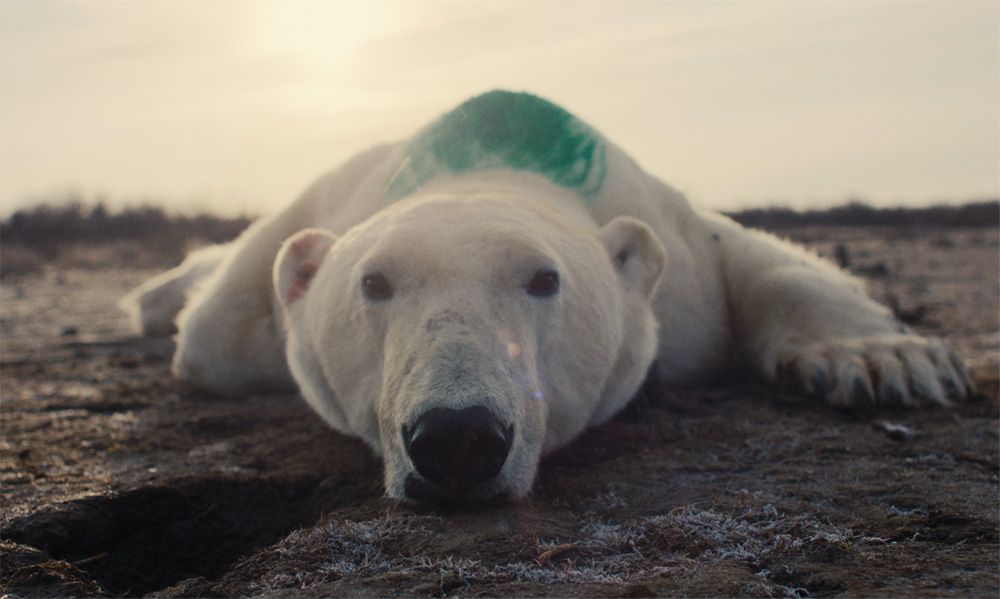

Jack Weisman and Gabriela Osio Vanden wouldn’t have embarked on traveling to Manitoba during the most bitter part of winter if they hadn’t thought they’d be able to bring something rewarding back. Still, it wasn’t until the Sundance premiere of “Nuisance Bear” that the totality of what they had captured fully set in.
“That was the first time we actually saw it with an audience, so we watched it with them, even though we’d seen it so many times at that point, and when everyone erupted into applause, it was thrilling because it’s like, ‘Wow, they really feel it,’” recalled Osio Vanden. “And we get people at the end in tears, so It feels good that we made something that people feel as they watch it.”
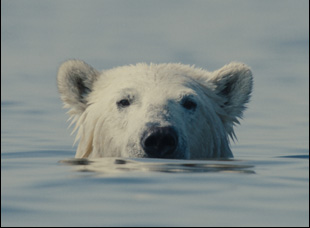
The filmmakers set out quite a challenge for themselves in that regard when it isn’t humans who get center stage in their entertaining doc, but rather a polar bear making its way through the arctic north in search of safe harbor. The migration occurs every winter, so Weisman and Osio Vanden had an idea of where to set up their cameras, but it was pointed in a very different direction than most that come up to Churchill and its neighboring community Arviat that sits along Hudson Bay during the season that has become a tourist event for many who want to see a bear live and in person. Although they keep their distance when the wild animals have been known to attack, Osio Vanden and Weisman consider whether the humans have exceeded their space when the bear scrambling for safety that they all enjoy as entertainment becomes a more troubling reflection of how little room there is to coexist. That conundrum becomes even more fraught when the bear crosses over onto indigenous territory in Arviat where the locals can relate to the bear as they know how it feels to be pushed off their land themselves, with tribal elder Mike Gibbons sounding as if he’s speaking for the bear when describing his own experience in the film’s one central interview.
Rooting for the bear’s survival leads to a most unusual crowdpleaser as it comes with far more energy than a traditional nature film, given further thrust with a boisterous and playful score from “White Lotus” composer Cristóbal Tapia de Veer and the film’s inspired cinematography where all manner of cameras are employed to give a unique lay of the land, with both directors having a background in cinematography before taking the helm of their first feature. After becoming a word-of-mouth sensation at Sundance where it won the Grand Jury Prize for documentary, one of this year’s biggest festival favorites is now about to enter its general release and Weisman and Osio Vanden graciously took the time to talk about building on the success of their acclaimed 2020 short of the same name, making budget-conscious decisions that could actually improve the production that often required them to be in two places at once and making a film compelling enough to lure one of the hottest composers around to score it.
 What sparked your interest in this in the first place?
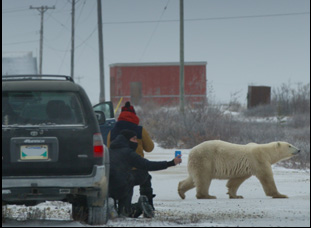
Gabriela Osio Vanden: This has been a really long journey for Jack and I. We were still in film school the first time we went up to Churchill in 2015, and because we were still fresh, we were thinking about the gaze. When you go to a place like Churchill, that’s really fascinating because you’re expecting bears out in the wilderness, which is what it is, but the circus around them — the tourism, the photography, everyone is lined up for the same photograph, which is looking at a bear [and there’s] no human infrastructure, no power lines or houses, but if you just pan over [from the traditional photo], you have a lineup of cameras and you have houses and you have power lines, you have vehicles. So we were just struck by that image and we thought if you just pull out [with the camera], there’s so much more here. It just snowballed from there and became more and more interesting the more we looked into it.
Notably, the short is set in Churchill, but the feature picks up in Arviat, which culturally is a bit different with the indigenous community that resides there. Was the larger story always in mind?
Jack Weisman: Yeah, from the very beginning, we wanted to make a feature that included both communities that live on the other sides of this border and have very different beliefs about how to coexist with the animal. [The idea] was so logistically and emotionally complicated and dangerous that trying to tackle a 90-minute feature, our first, without doing some kind of research, the short film was an unintended but necessary step to make this. But there was a mauling in one of the communities that really affected people very deeply and that event actually influenced us to focus on just Churchill, Manitoba, and make the short film there [as the other community was in mourning].
What it was like getting to know the communities?
Jack Weisman: Yeah, there’s the community in Churchill, Manitoba, and Arviat at Nunavut, and they both have separate processes to getting permits to film polar bears. In Churchill, you can apply for a permit, and as long as you have a letter of recommendation that you’re a legitimate filmmaker, you can get a permit quite easily. However, in Arviat, ecotourism has been outlawed. It’s not something that the community wants, so in order to get a permit there, you need to come before a council of elders — the most experienced hunters and trappers of the town — and make your case about why you should be making a film about polar bears. That year that we proposed our movie, they had rejected a Netflix show. There was another filmmaker whose film was rejected. So we were really nervous that we wouldn’t be given permission. But because of the story that we chose to tell, because it included Arviat’s perspective around the polar bears, which historically had been omitted, the council was really enthusiastic, and that was the first step to building a community-wide partnership with Arviat in order to make this film.
 When it was the gaze that initially piqued your interest, how did you develop the right visual language for this?
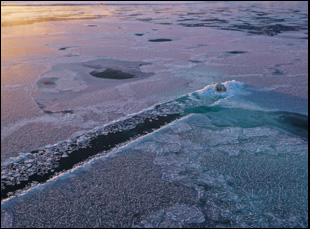
Gabriela Osio Vanden: That’s another reason why doing a short film first was so necessary — to be able to develop our visual style and then communicate it when we did have a full crew for the feature film. But like a lot of people, I love the [behind the scenes] of the hunt and that type of wildlife filmmaking where they take these robust stabilizers and were originally they made for helicopters, but they started putting them on vehicles, elephants, and other things. So we thought we can be mobile with our vehicle and have our camera on the front of the car and be able to control everything from inside — one that keeps us safe and the bears safe. And it also allows for a really cinematic visual ability to move around and dolly, but also with wildlife, if you roll up and have to pull your tripod out of the car and get it all set up, you’re going to miss a lot of the moments, so having that mobility was essential. We did our poor man’s version with the short, which was an exposed three-axis gimbal that could give us problems, but when we finally got funding to do the feature film, we got the full robust, encased six-axis gimbal, which allowed us to have a 50 to 1000 millimeter lens, which is super-important for wildlife because you can get close-ups while still being really far away. That’s what we built production around.
From what I understand, you actually had enough crew to film in two places at once. What was it like coordinating the shoot?
Jack Weisman: It was almost like shooting two feature films side by side because both communities are at the heart of the film and it’s about a bear that goes between them, so we needed Gabby and myself to be shooting with independent units simultaneously during bear season, which is every October and November for about six to eight weeks. Each season, we would go up in these two teams and just cover it together. And we couldn’t have only done it in one place and jumped to the other. There was too much happening, so there were a lot of people.
Gabriela Osio Vanden: And then we each had our own team, but we couldn’t really afford to have the full team that whole time, so we would start off with one other person and then as the season got to its peak, we’d balloon out with more people and then we’d lose them and keep shooting. What was really necessary for us for this film in particular was to have the max amount of time to shoot because so many things can happen in the season. So often when you’re with a strict budget and the production company has their shot list, you just go in and you try to get those things and you leave. That’s historically what happens and we knew we weren’t making those kind of films and we couldn’t force things to happen. We had to just follow what was happening, so maximizing our time there was essential.
But it was also figuring things out. One of our additional [directors of photography] Ian Kerr is a very successful sought-after DP, so we couldn’t really afford his rate, but we negotiated with him to bring his children out with him and his adult children helped him and got to have that experience, so we did that kind of thing and it was a family affair.
 That’s incredible. What was it like carving out the time during the shoot to actually spend away from the bears and with the community?
Jack Weisman: It was incredibly difficult. There’s 260 days of filming. We had 700 hours of material. We followed all sorts of human characters that didn’t make the final cut because it was a very exploratory process. We didn’t know exactly who we would be following through the film other than the bear character and that bear intersects with different people along the journey. But ultimately Mike Gibbons, the narrator of the film, emerged to us late in the process and it became clear that his story and his relationship with the bear was so powerful that it reduced everything else. He became the voice of the film.
That may have been it, but was there anything happened that really changed your ideas of what this was or took it in a direction you didn’t expect?
Jack Weisman: We spent so much time filming the bears that we realized in the edit the auditory perspective of the animal, especially with the bears losing their hearing. This became really important to the emotional experience of the bear. But it’s very difficult to record sounds of polar bears, much more difficult to get the sounds of them than to film them. You can’t put a lav mic on them. So you have to do all these creative little traps where you leave a microphone in a specific spot hoping that it’ll come by. Gabby actually managed to record some of the best bear sounds for the film inside the polar bear holding facility. One of the officers took a microphone inside and said, “I don’t think you want this because this bear hates me. And Gabby was like, “No, of course I do. This is going to be amazing.” And it’s fantastic.
Gabriela Osio Vanden: Polar bears hiss and a lot of people don’t know that because not all bears hiss. So if the bear doesn’t like him, I knew it was going to hiss and that was great. We had that those sounds that we could use diegetically, but then also we gave them to Cristobal Tapia De Veer, our incredible composer. He has this style of using voice almost as percussion. so we have a song in there that he’s edited in those sounds. It was thrilling to get to work with music in that way since we held back from that with the short.
Given how in demand Cristobal Tapia De Veer has been since his work on “The White Lotus,” what was it like to get him on board?
Jack Weisman: It was such a gift to work with Cristo. We had no expectation we were going to get to work with a composer of that caliber. He had given that interview in the New York Times about “The White Lotus” [where he said] that he wouldn’t be coming back, so one of our clever producers was like, “But he’s available all of a sudden.” So we immediately sent him a love letter and a sample of the of the film and and he responded almost instantly. The next day, we were meeting on Zoom and he was telling us how moved he was and how personal the project felt and how he would be humbled to be the composer for the film.
Gabriela Osio Vanden: We didn’t realize when we reached out to him that it’s very clear that animals and nature are a big influence for him in his work. Now that we know him better, he’s always just filming crows and he loves animal videos, so we’re like, he turned out to be the perfect person to collaborate with. Honestly, it was the easiest part of the whole process because this was a very challenging film to make. But he instinctually understood what we were trying to do. Our only note, which we offered up when we met with him, was that we don’t want to over-sentimentalize because I think there is a tendency for that in what we know with natural history [being accompanied by] big orchestral. We didn’t want that, so what he made for us was just so unique and strange. It was just such a gift.
 I may be putting too much on this, but something that was moving to me was how much the bear’s journey could seem to reflect a lot about migration in general and displacement. Was what’s going on in the world in terms of immigration in mind as you were making this?
Jack Weisman: No, the bears’ migration path has always been along this coastline for centuries, and then human settlements were placed directly in the path, so that [fact] was always on our minds [in terms of] the bears were there first, but this parallel between the interruption of the migration or the relocation of people, the relocation of our narrator and the relocation of our bear and the parallels that they shared, that was a discovery that we made together with Mike Gibbons, the narrator of the film.
It was obvious looking back that there’s so many shared experiences and shared traumas. But it wasn’t like the intention in the beginning to make a film with that being such a big theme. That’s the magic of documentary filmmaking. Our initial starting condition for us was to follow a bear, no matter where it went. We wanted to make a film from the pieces that were left on the edit editing room floor typically and the story that took shape was the story that happened to us while we were making the film.
What’s it been like sharing it with audiences so far?
Gabriela Osio Vanden: It’s pretty surreal. We dedicated a lot of time and energy to this and you don’t make it for releasing it, you make it because you have to. So it feels so nice to be at this point sharing it with people because it’s been in our lives and in our heads for so long. That people are coming out to the theater at these festivals to see this film and are responding to it, we’re just so deeply grateful.
“Nuisance Bear” opens on November 6th in Los Angeles at the Laemmle Glendale and December 4th in New York at the IFC Center.