


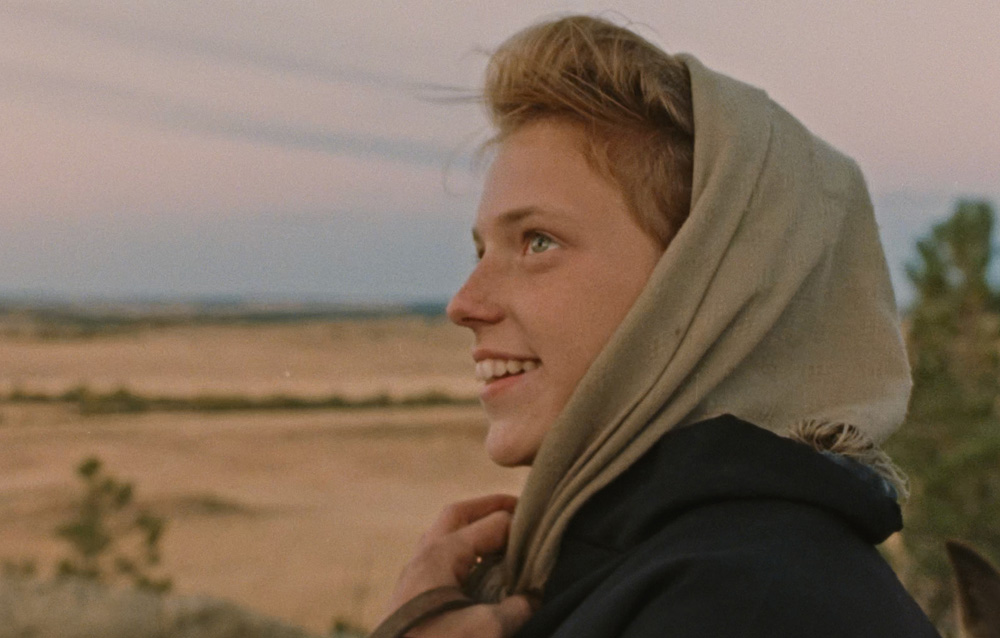

“Most people think of Ashland as a small town,” Bekah, a 19-year-old who lives in the remote Montana burgh from which Wyatt Maw’s debut feature takes its name, though it has proven plenty big for her as the place where she feels “comforted, sheltered and protected.” She’s referring to a general serenity she feels in the region where there are less than a thousand residents but those that live there have deep roots, an intersection between the Cheyenne that maintains a reservation and the Amish that have made a home there as well when they can live unbothered. Bekah’s words grow more surprising as the film wears on for a number of reasons — it is gradually revealed that the house that she shared with 11 siblings burned down, which has hardly shaken her faith in feeling most comfortable in Ashland, but also that it’s a place seemingly removed from time where people live in the present rather than be concerned with either the past or the future and as a young woman, you’d suspect she’d have her eyes on additional horizons than the glorious sunsets that occur so far north.
If there is rebellion in “Ashland,” it’s the idea that runs counter to most narratives about rural communities that there’s a desperation to get out and the cozy confines of the environment extend to the literal dimensions of Maw’s film, which in spite of lacking any strong central narrative holds you in thrall by simply roaming about the land, catching interesting characters resistant to change. With the sprockets exposed of the 16mm film that it was captured on and the speckles of dirt on the celluloid evident throughout, it feels as if time really has been caught in a bottle, though Maw apparently had his camera rolling for eight years and while no one ages in front of the lens, a whole collection of residents young and old seem to thrive away from the tyranny of modern life in a metropolis, not having a clock to answer to and using horses for transportation across open plains rather than cars and streets.
The suggestion is that there isn’t just an open range, but an open mind as there’s an unusual level of contentment amongst the populace with few seeming to desire more than what they have in front of them, insisting that family has become all the more important to them to lean on when there aren’t many others around. The film gently offers some pushback as it follows an older woman who was recently widowed and remarks how she didn’t realize how much her husband actually did until she had to pick up his chores. (Clearly, she lived a resourceful life beforehand when she was working on having enough to supplies to last her and her husband for the next couple years when he passed, yet still can’t fully absorb the loss.) Still, by and large, when hailing from communities that have had no other choice but to be self-reliant, the residents to a person demonstrate a rare determination to live off the land and within their means, deciding for themselves what their level of personal satisfaction is rather than have others as a yardstick.
The liberation from a traditional narrative structure only feels natural in this regard as Maw works with a murderer’s row of editors – “Pahokee” co-director Ivete Lucas and “Sanctuary” editor Lance Edmands joining James Carson – to create a bit of a thematic baton pass from person to person with some shared interest or experience on the frontier to speak of and knowing that major events such as a powwow and a rodeo could provide something approximating a climax at the end. The effect of wandering around, peeking into people’s lives, can feel almost physical as different doors are cracked open, though it’d be understandable to see it as a bit aimless as well if Ashland isn’t a place you’d want to be in the first place. However, Maw employs the camera as a portal to a simpler way of life, requiring some degree of surrender but also inspiring it as well.
“Ashland” is available on the DOC NYC virtual platform through November 29th.