


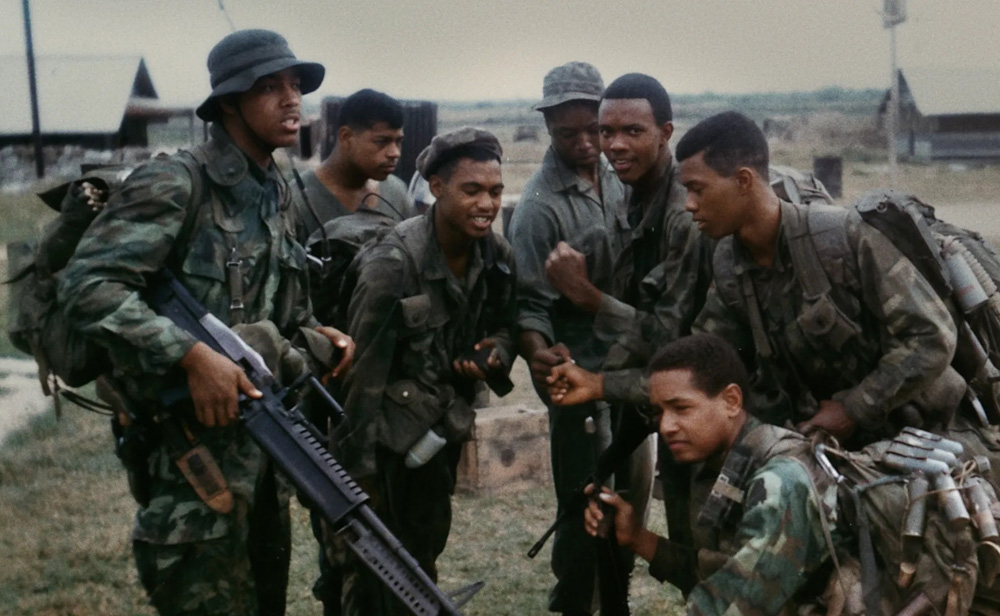

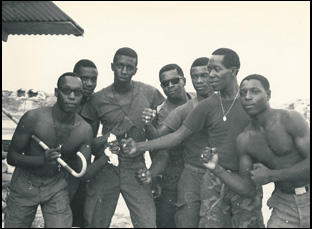
To hear it from Ed Emanuel, enlisting in the army to fight in the Vietnam War was all but predestined, raised as the son of a sergeant and feeling as if any time spent in school where even in Compton, California, he felt he was going to war every day as a Black student. He would join Company F, the 51st Infantry, a squadron that became better known as the “Soul Patrol,” since they “were all brothas” Emanuel explains in J.M. Harper’s revelatory portrait of the soldiers who survived against all odds, reuniting 50 years after their tour of Southeast Asia, grappling with the fact that they had somehow made it when so many others hadn’t.
Of course, the term “survival” under those circumstances is a relative one as Harper suggests by first introducing Emanuel in a grocery store where he’s revisited by visions of his younger self when there’s nowhere he’s safe from the memories of brutal combat. “Soul Patrol” comes to consider it in a historical sense as well when the story of Emanuel and his six-man unit was also threatened to be lost to time when African-Americans played a vital role on the frontlines of a war that many were led to believe was the key to stop the spread of communism across Asia, yet are rarely noted for their heroism and were all but forgotten upon their return home. In a race against a clock, Harper sits in on the reunion of the veterans where the war can be described vividly as if it happened days earlier and others support Emanuel as they once did on the battlefield in raising their voices about how their part in the war is to be neglected at the peril of society as a whole, with their erasure from the official record not only denying an acknowledgement of their sacrifice but making it easier for the powers that be to send in more troops after them without considering the cost.
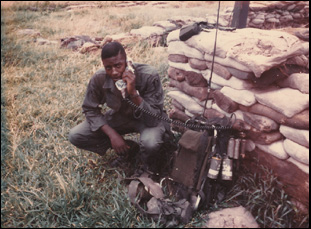
While countless documentaries have been made about the conflict in Vietnam, none look quite like “Soul Patrol” where Harper is able to draw on Super 8 film shot by the soldiers themselves in addition to surreal recreations set in the present to reflect an experience that never goes away and oft-said platitudes such as “No man left behind” take on a whole different meaning, with the men embark on a mission in civilian life to keep each other safe – in particular, looking after Lawton Mackey, a member of the team who became homeless and beyond ensuring he lived out his final years in comfort, his presence is very much felt at the reunion. The result is undeniable and “Soul Patrol” was recognized upon its premiere at Sundance earlier this year with a Best Director award for Harper, and now with the film rolling out into theaters — most notably, special screenings across the country on Veterans Day on November 11th — he and Emanuel generously took the time to talk about bringing this hidden history to light, what Emanuel could only discover about his own time in combat after the fact and a most momentous day of filming.
 Jason, what made you want to take this on in the first place?
J.M. Harper: I read the book about a year before I called Ed, and clearly, there was a connection between Ed and I that hadn’t even yet begun, but intuitively by hearing Ed’s voice in the book, I understood that there were many layers below the book. It was just working on me in a way that I didn’t really understand. The book is basically a play-by-play of what happened from day one of his tour to to the last day, but the bracket of what happened before that led him in into the war and then what happened in the half-century after was an entire story. So the years that we spent on the phone speaking with each other was an exploration of what that incredible story was. And what really made the film possible is just getting to know each other and me trying to understand From Ed what he had experienced over there and afterwards.
Ed, from what I understand, the very first thing you said to Jason when he approached you about making a film was that you asked him what a team was. Why was that what immediately came to mind?
Ed Emanuel: Because most people, even in Hollywood, don’t know how to operate as a team. That’s one of the things that I missed when I got back from Vietnam. Everybody was out for themselves, but not realizing when you work as a team you work in cohesive [fashion] with the problem and the problem is solved much easier. That’s one of the first things they teach us as rangers — to work as a team — and that’s how you survive. So me and Jason talked about it in numerous times. That’s what got me through Vietnam and that’s what hopefully will get us through this endeavor.
How did the reunion that’s central to the film come about?
J.M. Harper: Ed, over the course of almost a decade, had been meeting with the guys at reunions. The reunion that we filmed had never happened before. Those guys hadn’t all been together in one room in 50 years and they understood that was going to be the final reunion. They called that their final mission. But Ed had fortunately had [already] been collecting stories of some of the guys who are no longer with us and some of the audio from those guys — Maddox, for example, who’s on the “Mission from Hell,” Ed had recorded his voice before he passed many years previous. We lost [Lawton] Mackey two weeks before the reunion and Mackey is the spiritual center of the film in many ways. Fortunately, I had interviewed him and Thad two years before the reunion, but Ed had also recorded an additional interview with Mackey from years previous.
It was actually in that interview that Ed did with Mackey where I heard Ed off camera saying a line that to me was the very core of the film in reference to the “Mission from Hell” when they were out there alone with no cover. Off-mic, Ed said to Mackey, “They showed us mercy and instead of killing us by showing us mercy, they destroyed us for the rest of our lives.” I remember hearing that and it was moments like that that made me really grateful that Ed had been working for so long to try to get the story told. When I came there, it was just my job to help in the way that I could because he had been on the journey for a while and and when I arrived and earned his trust, we started to make it together.
Ed, even though this was your experience, were there things you could only understand about it from the process of making a film?
Ed Emanuel: Yeah, a lot because after all the information that I researched for my book, I realized I didn’t know anything about Vietnam, except for my experience. And writing the book, I got a lot of information from the Pentagon [where] I have friends that made me open my eyes to what happened. During the writing of the book, I learned that the Black soldier in Vietnam – they just thumbed their nose at us and from what I understood we weren’t even there. We were one-third of the fighting force in Vietnam, but that never came out anywhere except in my book, because I got that information. And I wanted the world to know that these guys, even during the civil rights era, put their lives on the line and a lot of them died. But no one knows their story.
We didn’t have a voice when we got back home. Our voices were shunned. We were just part of a cog in the wheel but never recognized. And when they did learn that we were being recognized for the Soul Patrol Group, then they start coming out of the woodwork and trying to tell their story. Some of them did, some of them did not. The main people, like my team leader, Jerry Brock, he died two years after getting home from Vietnam, and he died because of Vietnam. The mission that we went on — the “Mission from Hell” — I think it killed everybody in our team, even though we didn’t die that day, but mentally and physically we died apart from each other. Even in the documentary, I say “Not one shot was fired, but it still killed these guys.” It killed them through PTSD, through Agent Orange that they encountered over there and the malaria. But I think it just took their soul. I know it did me and I felt like I was the stronger one of the group.
I realized after getting home that this mission that we went on, we encountered all of these NVAs [North Vietnamese Army members] — 500-plus. I actually sat there and counted them because I was set up on a trail watching them with my machine gun, getting ready to mow them down. My team leader Brock emphatically told me, “No, don’t fire.” Because he knew something that we didn’t. He knew it was a large force out there, but they put us in there to actually see that force. But a lot of them were like ostriches with their heads in the sand. They didn’t want to see it. I sat there and watched them because my cousin had died in Vietnam about three months earlier. And I knew seeing that force marching by us, calling cadence, I knew we weren’t going to get out of there alive. And I was saying to myself, if I die, I want to tell my cousin Ricky how I died in Vietnam and why.
Thank God, we survived that mission and I called that mission the “Mission from Hell,” but I renamed it “Divine Providence” because I honestly believe God had his hand on us while we were there on that mission. I felt the angels just came and and hugged us and and protected us from from death and still, we don’t know what happened on that mission.
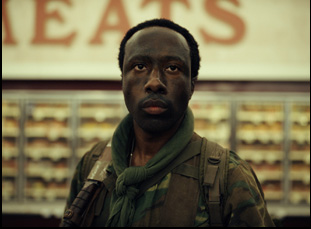 Jason, did the fact you were telling a different story about Vietnam than a lot of other history allow you to push things stylistically in another direction? You include Nietzsche quotes and surreal scenes inside a supermarket where soldiers are still haunted by their past in the present.
J.M. Harper: My experience with Ed was all happening in the present tense. I could see Ed working through — as he still is now, even in this conversation — this process of what happened out there. And that’s not a history lesson. That’s a real-time, present-tense experience that not just Ed, but the other guys who were there up had that they were working through with Mackey. It was this ambush that happened and the scenes in the film that Ed wrote about where something breaks, something changes and then they spend a great deal of the rest of their lives trying to figure that out. So all of those scenes at the grocery store, the formal changes were just a way of trying to figure out how do we make that clear that for many of them, they’re still in Vietnam. There’s still a 19-year-old who’s experiencing that even if they’re 77 years old.
Some part of their being, as Mackey put it, was still in the jungle whereas Thad put it, “I was out of Vietnam but Vietnam was not out of me.” [And I thought] what does that mean? How does that look in a grocery store or restaurant where their bodies physically are, even if their mind or some part of their spirit was left there in the jungle? So those formal methods were made to try in some way to pull this story into the present where it really lives, so that it couldn’t be written off as just something that happened in the past.
From what I’ve heard, the police actually showed up at the supermarket shoot since there were mock guns. Was that a crazy day of filming?
J.M. Harper: Hopefully Ed was isolated from some of that. [laughs] The police arrived and were really gracious. But what was even more remarkable than that [with] the producer explaining to them what the story was and then the 180 that happened there when they were going to shut us down and then they gave us the whole grocery store, was that Ed, on the way there from the airport, there was a group of four or five rangers that surrounded him…
Ed Emanuel: That was very interesting because when we arrived in Atlanta airport, walking through the terminals and wearing this jacket [with military epaulets], these rangers who were training at Fort Benning came behind me and [someone] said, “Welcome home” or “Airborne” or those words are triggers for Vietnam veterans, so I turned around. I even have pictures. And when I turned around, I saw these five or six rangers surrounding me and it was like they’re protecting me. I don’t want to get emotional, but [the moment] was for me and I told him why I was there and to look for our documentary in the future. Then when I got to the Piggly Wiggly [for the supermarket scene in the film], Jason had already set that up for me, but he didn’t know anything about the airport, so that particular scene that he did in the documentary reflected what we experienced at the airport. So I stopped wondering why are we here at Piggly Wiggly with these people. I said, “Okay, I get it. Maybe others will.”
J.M. Harper: I didn’t really understand why we were doing that [scene] in the moment, but it continues to give meaning and we’re thankful for that. And to your first question around what a team meant, reading Ed’s book about when your team surrounds you or you’re in formation or how they move through the jungle on patrol, everyone in that line from the point man to the man watching the rear, everyone has their job, which is essentially to watch each other’s backs, so you’re not worried about what’s behind you because you know that you’re depending on this person to watch your six. And If someone doesn’t do their job, you’re likely to die, so you’re putting your life in their hands and they’re putting their life in your hands. You’re saying together we live or together we die. So that scene of all these guys surrounding Ed as he stares down his 19-year-old self in the grocery store was a way of trying to portray that — together we live, together we die, but that’s what a team is. And all these reflections and parallels, whether it was in the airport or in the grocery store, just emerged. Some of it we only understood as time goes on.
It’s a powerful part of the film. And another I had to bring up is the decision to spend time with the solders’ partners at the reunion. How did that become a part of the shoot?
J.M. Harper: It was Ed’s original idea that we hear from the wives. He was insistent that we had to figure out a way to do it.
Ed Emanuel: And he even let me direct it. Almost.
What does that mean, “almost”?
J.M. Harper: The time we had at the reunion, we had one day [for] the dinner and the other day was the group interview. And in that amount of time, we had to divide and conquer.
Ed Emanuel: Yeah, one of the reasons why I wanted that was because I’ve never seen any Vietnam story where they actually interview the wives, and I figured, “Well, this will be extremely different from anything else that is out there.” We’re going to interview these wives because they were there every reunion that we had — and it was five or six reunions that we had prior to the one that Jason filmed, they were calling on it, “Why won’t you guys let us tell our story?” And I heard them even before they said that because I wanted these ladies to tell their story about the guys that came home and and started families with them. To me, that was one of the most powerful parts of the documentary because it was definitely needed. We got it and now we’re able to show it.
 What has it been like to share the film with audiences so far?
J.M. Harper: Yeah, I’ve been fortunate to go to all the screenings across the country and the response has been overwhelming because everybody has a connection to Vietnam. They have a brother, an uncle, a grandfather who was there and didn’t speak about it. A lot of Black folks have people who went over there and came back and said nothing. Brock, who Ed spoke about, his ex-wife and son handwrote a letter to Ed and sent it to him after the movie came out and said, “We heard about ‘Soul Patrol,’ and now for the first time we understand what Brock was dealing with before he died.” That meant a lot obviously to Ed, to me, and to the actor who was portraying Brock [in the recreations].
I hear a lot from people who protested the war too. There’s a woman who approached me and said, “I was one of the people who spit on the soldiers and I’ve carried this weight since that day and for the first time I’m able to release it by hearing the stories of these guys who went over.” She had been carrying that grief with her at having done what she did and of course, Ed’s the first one to tell you in the book that he realized as he was over there, he was over there for a big lie that the politicians had said. You see JFK talking about the domino effect and if Vietnam falls then every Southeast Asian country on down to Australia will be soon to follow. It wasn’t just that they were misunderstanding the situation, but they sent these guys into harm’s way and they survived and came back with with a story to tell. So it’s been remarkable for people to see that full spectrum — what was happening in the U.S. and the civil rights movement at its height and then to be back and forth in Vietnam and then also experiencing the news of what’s happening back at home and then thrown right into it and not welcomed home. People have been really moved by that and that has been one of the most special parts of the experience is just hearing directly from the folks who have who have come out to see it and how changed they are as we were changed by making it.
Ed Emanuel: Yeah, hopefully people will understand what we’re trying to put out there. I want people to know who Lerps and Vietnam rangers were and their missions over there. I had a conversation with a two-star general when we went back to our old company in Fort Bragg. I saw what they they were doing with the new LRRPs, they’re now LRS — Long Range Surveillance — and he told me that our mission was different from everybody else in Vietnam. I didn’t know that until I did my research. Our job was not only to bring back information, but to make contact and that within itself is killing the enemy and then putting the bodies on the chopper and flying them back to our command post. We did a lot of that. But over there, I thought we were just there to do surveillance. But we were there to do a lot of different things — sniping, going after prime targets, meaning generals and people like that. Our job was different from anybody else in Vietnam because not only we were LRRPs, but we were Second Field Force LRRPs. And that’s why they stuck our asses out there. I firmly believe we were not supposed to come back. And I’m not the only one who says that. I have interviews that these guys are saying the same thing.
But we did make it back and that’s really the part of the story that I wanted to tell and try to clear it up in my head before I die. What happened? Why did they not kill us? They saw me setting up my machine gun to mow these guys down and they ran down the road. I still don’t understand why. They had the opportunity and we were prime targets. Why’d they just march by us, showing off their force? They were 100% ready for battle. They had brand new equipment. They knew something, and I think they were showing off their elite group to us, [like] “All right, we didn’t kill you, but we’re going to show you who we are.” But they screwed us up. I I know they got me. So I still wake up every morning trying to figure out what happened and that’s probably the cause of my PTSD too, seeing this every single day. But we made it home.
“Soul Patrol” opens on November 5th in New York at the IFC Center, with special one-night screenings on November 11th in Austin at the AFS Cinema, San Diego at the Digital Gym Cinema, Los Angeles at the Monica Film Center, Cincinnati at the Mariemont Theatre, Scottsbluff, Nebraska at the Midwest Theatre, Minneapolis at the MSP Film Society, Santa Barbara at the SBIFF Film Center and Milwaukee at the UWM Union Cinema before expanding on November 13th in Los Angeles at the Laemmle Glendale, Atlanta at the Tara Theatre, Hudson, and New York at Time & Space Limited. A full list of theaters and dates is here.