



“If you think about boxes, this movie will always cheat you,” György Pálfi says of his latest film “Hen.” “Film critics will say, ‘Oh, I see this is an adventure movie of a chicken, but it’s 20 minutes later, they realize, ‘No, this is not.’ [Or] this is a movie with a friendship of a human and a chicken, but after 20 minutes, they realize this is not. Oh then this is [about a] political social movement. No, no, maybe this is a comedy — oh no, this is a tragedy. And they cannot find the right box [to put it in] because the movie is always cheating.”
Still, one never would feel cheated by “Hen,” which really is unlike anything you’ve ever seen, though that’s been true of all the films in Palfi’s singular career, ever since the director first invited audiences into a quiet village in his native Hungary where what might be dismissed as charming small-town eccentricities could hide something more sinister going on. In the years since, along with his partner in all respects Zsófia Ruttkay, he has looked at legacy through the eyes of a taxidermist who looks back on the strange contortions the men in his family made towards the political climate of their era in his work with the body in “Taxidermia” and a loose adaptation of Stanislaw Lem’s “His Master’s Voice” where a journalist’s discovery of his father in a documentary after years of state-induced exile corresponds with the separate revelations of murmurings of voices beyond the borders of earth.
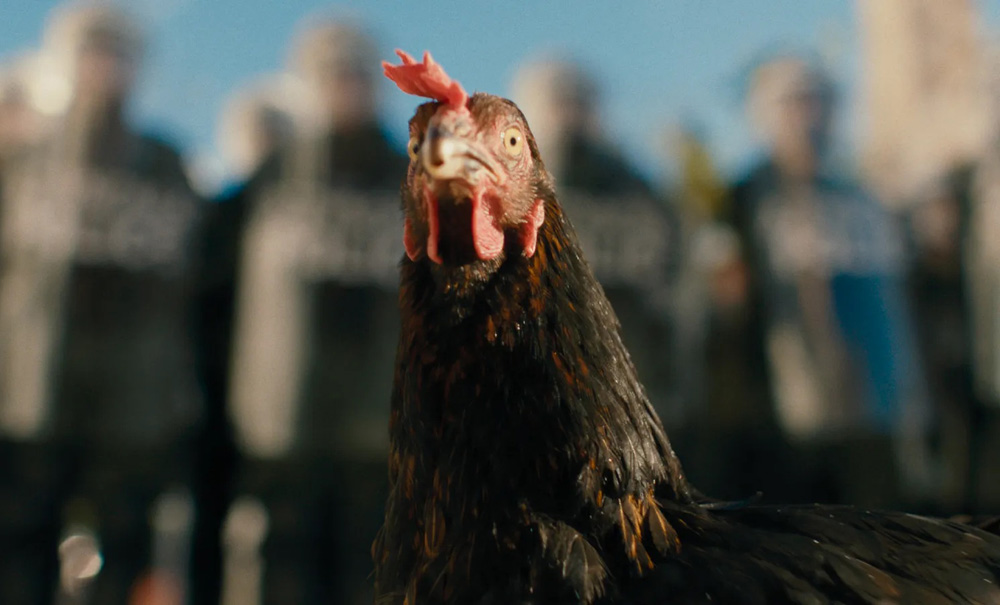
A wicked sense of humor has always been as much a product of the absurdism as a distinctly different way of looking at the world and in what may be his funniest film to date, he recruits a most unusual lead in a black hen who finds itself unexpectedly caught up in a criminal conspiracy. With a stamp of approval from executive producer Ari Aster, Pálfi lets the bird run wild from a farm where its destiny seems to lie in contributing to soup broth before hitching a ride with various truckers in the hopes of finding safety somewhere in Greece. It would seem a hillside taverna might be a comfortable resting spot with a chicken coop on the premises to lay eggs, yet Pálfi has other ideas when it isn’t a mere restaurant that the hen has walked into, but a place of other business that largely operates under the table. Although what unfolds is indescribable as Pálfi keeps the camera on the ground to remain at eye level with his plucky lead, the film has plenty of lift as a tale of migration and an unexpected action film as the bird must survive a literal trial by fire and dodge bullets.
A year after it premiered at the Toronto Film Festival where it was a major crowdpleaser, “Hen” is now spreading its wings to reach U.S. cinemas and Pálfi generously took the time to talk about how he found a kindred spirit in a feathered protagonist, the practicality of working with the animal in a conscientious way and finding a proper home for the wild story in Greece.
 How did you end up with a hen as the lead of your latest film?
Yes, I needed to choose this way mostly because I couldn’t shoot in my country. That was a political reason and I needed to find a main hero who could live anywhere on earth because I couldn’t I couldn’t know where I could shoot this film. So I needed to find the character which lives everywhere and also also I like to change the perspective of the world. So those lines [of thought] go together and I chose the hen because usually I don’t know how a Brazilian teenager or an Italian waiter, or a Scandinavian writer lives. Maybe I can learn something from the culture, but I don’t know what they watched in their childhood or what they read in university, but I realized I can travel with the chicken because a chicken here in my country and chicken in America, in Brazil, in Scandinavia, or Italy, it’s the same. I just need to find some people there and I’m watching them through the chicken’s eyes and this is how I can travel with the storytelling.
You actually filmed in Greece. Did the locations inform the story?
Yes, I had a script when a producer told me if I’m shooting in Greece he could [build] the budget and then we went to Greece and tried to find a big sociopolitical problem, which the chicken can meet. The hottest problem was illegal immigration and human trafficking, so after finding this was the case, it was very easy to find how a chicken can be involved in this crime.
And Greece has a lot of beautiful places. We needed to find a [central] location no further than one hour from Athens, the capital of Greece and that kind of location was very hard to find. So approximately half a year we we looked for it. We traveled a lot around Athens and we were surprised to find a location which was similar as to what we wrote in the script. But you can imagine it. We wrote the chicken needed to turn right and go into the house and [when we entered ourselves] really the chicken coop was [already] there, so everything was perfect. But it took half-a-year to find it.
Did you need to reimagine your entire visual style when you were filming so low to the ground to be at eye level with the chicken?
The visual language was based on the chicken’s behavior. A director could choose a lot of different styles for storytelling, but I couldn’t choose a choreographed 10-minute long one-shot scene because a chicken can cannot do it. But the classical Hollywood style of telling a story shot by shot, still, panning and craning images like in the ‘40s, ‘50s and 60s, working with a camera and shot by shot telling a story, this is what the chicken perfectly can do. So what you see is 100% real chicken and we collect these small shots and after we edited. It was also very important we [viewed] our main hero as a classical Hollywood movie would, using the superstars like Marilyn Monroe or Sophia Loren and we try to shoot a chicken from the same perspective as Hollywood movies do.
You’ve worked with animals before, though not to the extent of having one as a central performer. Did you know how you could get the best performance from it in terms of editing and otherwise?
The main [work] was in the pre-production period. We had eight chickens in the movie [to play one chicken] — and these chickens are very young chickens, [which] was a plan because in the movie they become a mother, so this is the first egg coming in, these eight chickens [we had] started to raise eggs in the shooting period. But before the shoot, for one-and-a-half or two months, they lived together with the animal trainers and the animal trainers gave them tasks, like a camp where the chicken learned something every day. They also got good food and a very friendly environment. The animal trainers were very kind with them, so they socialized very fast with these animal trainers and became human-friendly animals. When they arrived to the shoot, they were very cooperative with whatever the animal trainers asked and somehow the animal trainers found a way to whisper with the chicken, so I saw many miracles during the shoot.
When we tried to [film] the chicken’s face through a small hole in a box, the chicken face is moving very fast. You couldn’t follow with the camera, so I [said to] the animal trainer, this is a problem. I want to shoot just the eyes of the chicken through the hole, but this chicken is always moving with her hand and the head. And the animal trainer said, “Wait a minute” and he started whispering with the chicken, and somehow the chicken was in the frame and she didn’t move, just watching, and we could shoot easily. So I think the animal trainer found a very friendly way to get the chickens to cooperate. And believe me, the chicken had much more better life in the shoot than the human crew had. They had better accommodation, better food, and much more sleep time than us. They were the princess of the production.
You’re able to give the hen real character with the music as well. What was it like to find the right composer for this?
Yes, the music was made by Szabolcs Szõke, a Hungarian composer, and also Gryllus Árbris, who made the digitalized instrumental tools and also Suzana Peric from New York helped me a lot with the music editing. But we worked a lot to find the good solution for the music. In the editing, I tried a lot of different samples for the movie and it didn’t fit. I used classical music and film soundtracks, and then I tried modern music and I try to use my favorite composer’s music and I couldn’t find the right one. So I was in big trouble. But I figured out I didn’t need to find the music, I needed to find a good character. So I started casting for the right person for this job [of composer], as if you are choosing an actor for a character or a cinematographer. This is not just talking about the images, we are talking about the personalities. And Szabolcs Szõke is a very, very old Hungarian dramatic music mind. He worked a lot in the theater and he is playing a lot of different instruments but his character was the closest for this movie. So I asked [him], let’s make the music for a film and he couldn’t show me any music before he went to the studio and recorded it. And this is a big risk for a producer, because the producer needed to pay for the studio and maybe nothing will come of it, but Szabolcs Szõke made a perfect fit musically for the chicken.
“Hen” opens on November 6th in New York at the Quad Cinema, November 13th at Jengo’s Playhouse in Wilmington, North Carolina and Los Angeles at the Laemmle Glendale, November 20th in St. Louis at the Arkadin Cinema & Bar, Tacoma at the Grand Cinema, Charlotte at the Independent Picture House and Vancouver, Washington at the Kiggins Theatre, November 27th in Seattle at SIFF Cinema and Albuquerque at the Guild Cinema, December 2nd in Nashville at the Belcourt and December 3rd in Rochester at the Dryden Theatre.