

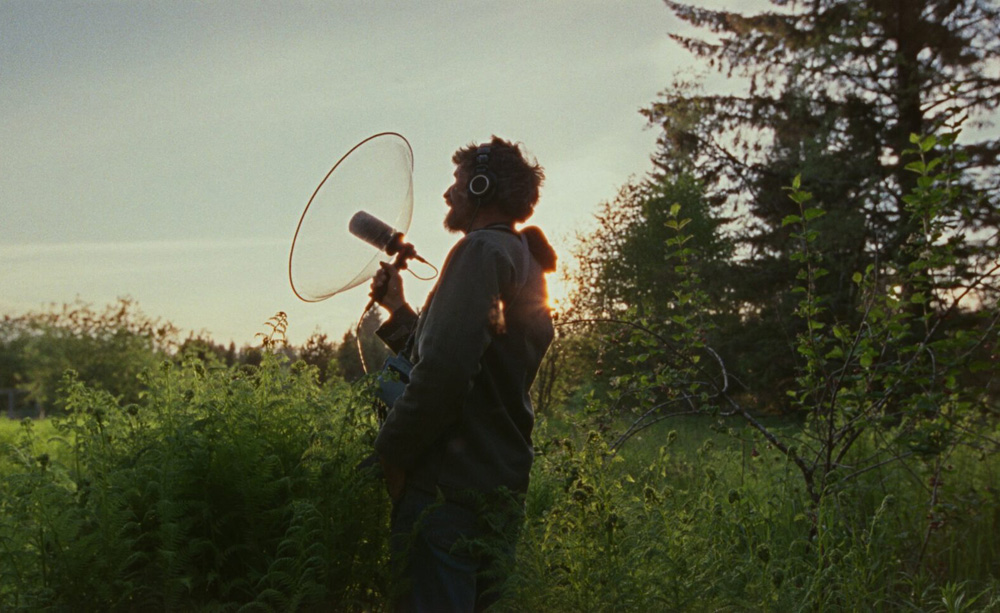

The land around Hank Lentfer’s home in the Alaskan wilderness might be considered by most too calm and tranquil to believe that there is much going on, the kind of place where people would go to clear their head when there’s such a sense of peace. Yet Lentfer seeks out adventure in the area, carrying around a waterproof mic and a dish as if it was a shovel to dig for treasure as he unearths the deep guttural sounds of the earth beneath his feet. The aches of tectonic plates shifting, the stirring of seemingly still waters in the local river and the flapping of birds’ wings — the mic is sensitive enough to recognize that fewer pass by during migration than they used to – all give Lentfer insight into a world that comes alive only by keeping an ear to the ground.
In “Listen,” it can not only be heard but seen by everyone as director Taliesin Black-Brown joins Lentfer on his sojourns into nature and returns with the profound when the sound recordist also has the responsibility of caring for his mother Mary, who suffers from dementia as she ages. The outdoor excursions may bring relief to Lentfer as an escape, but they provide comfort in a much more unexpected way when like his mother, who now often sits before him catatonic, he can understand from tapping into the murmurs of the earth that there’s much more going on beneath the surface with his own flesh and blood. Produced by recent Oscar winner Sam Davis (“The Singers”) and filmed with considerable splendor by cinematographer Mack Fisher, the film becomes a true experience as it captures Lentfer moving between both spaces without seeing a border between them, finding that the familiar sounds he can get his mother to listen to can occasionally draw out a response and extends cinematically their reverberant power to express what may not be articulated in any other way.
After becoming a hit earlier this year at DC/DOX and Tribeca, where it won the prize for Best Documentary Short, “Listen” will be on screens of all sizes this week as it screens at DOC NYC and premieres online soon as a New York Times OpDoc and recently, Black-Brown, Davis and Lentfer spoke about fashioning such a transcendent film, how it now honors the memory of Lentfer’s late mother and why despite being all about sound, the sweetest one to hear at the end is silence.
How did this come about?
Taliesin Black-Brown: I was working on another film about a floating sauna being built on a remote island in Alaska and Hank happened to be a carpenter, among others, who came into this. We’re talking really remote islands, so Hank and I got to talking in the in the evenings afterwards, playing music, and he was telling me about his work [as a sound recordist]. I already had an interest myself in listening and he was telling me about this dish that he liked to walk around with through the Alaskan wilderness and the visual got stuck in my head, because this place is just so strikingly beautiful [with] 50-mile long glaciers coming down into old growth forests full of bears and salmon spawning, thicker than I’ve ever seen them, [and there’s] this guy with this dish walking through these incredible landscapes. [I thought] “Wow, there’s something there.” Making documentaries, you don’t know where it’s going to go in the very end, but like detective work, you get these clues and the deep and honest dialogues that Hank and I had around listening and connection um and then just that visual [idea made me think] “Okay, we’ve got to follow this.”
Hank Lentfer: Yeah, Tally and I hit it off very quickly. He’s a very open, approachable guy, which is what makes him a great doc filmmaker and I have 20 years worth of recordings sitting on a hard drive and they’re not doing any work in the world, just sitting silently on a hard drive. So I have long been looking for ways to package and offer these sounds out into the wider world, so I was immediately receptive to the idea of let’s see if we can find a story in which to embed these sounds.
Sam, how did you get involved in this?
Sam Davis: Tal and I connected after “Long Line of Ladies” came out because he had seen some of the work that I was doing specifically in the documentaries on film niche. And we hit it off over our shared interest in in making documentaries with really elevated craft and with narrative tools. Originally, we talked about me shooting the film and the schedule didn’t align for that — the film was shot by an amazing DP named Mac Fisher, but Tal and I got to continue the conversation over the course of a year, especially during the edit and this phase of shepherding the finished film out into the world. It’s just been a huge honor to be able to be a part of this one and I told them the first time I saw the roughest cut that I really believed in it.
As Sam alludes to, the visual language of this really is special and seems tied to the idea of sound. What was it like to find the right look?
Taliesin Black-Brown: Yeah, one of the things that we realized through the process is that if you see an animal making a sound or what it is that’s making the sound that sometimes our visual sense actually dominates the auditory, so it can actually stop or get in the way of us to our ability to really listen. So in this film, cinematography-wise, you’ll notice you hardly see the animal that’s actually making the sound, so it leaves the the mind in a curious place. [You wonder] What is this? And it’s our ears that have to do that work. So it’s really using that visual that suspends knowing and invites us into curiosity with our ears, thereby we can really highlight [it] through cinematography. It’s a little magic trick to highlight the power of sound.
Sam Davis: Similarly, the way the voiceover and dialogue in the film is edited is so sparse. It allows you to stop thinking for a lot of the film and just take it in like Hank is in the moment. It’s a really minimalist approach, but I think it rings really true when you see the film.
Hank, does this feel it like it reflects what you’re feeling as you go out on these expeditions?
Hank Lentfer: It seems like it is. When I’m recording on my best days, I get totally lost in the sounds. There’s something beautiful pouring through my headphones and it’s just a precious moment that is going to end. The bird’s going to fly away, the wind’s going to come up. Something’s going to end this beautiful session. But there’s a preciousness.that shuts down the chatter in my mind. And it seems like we’ve achieved some version of that in this film. We’ve often heard when the film ends, people go, “Oh, we want more.” That’s a key aspect in recording for me. I always want more. I always want to listen to more beauty. So we manage to create some immersive experience and get people to drop in just 15 minutes, which is deeply gratifying.
What was it like doing the sound mix on this creating the spatiality for audiences?
Taliesin Black-Brown: Hank was pretty involved in it and I was down there for some of it. It was a total treat, working with these recordings that Hank had made. They just made me feel something, like the sound of these whales trumpeting, it’s a sound I’d never heard before. I thought whales just blew oxygen at the top, but they’ll make what sounds like a foghorn sound in that region in Alaska and Cornell was indicating that it was the largest biological sound on earth and it echoes through the fjords of Alaska. Then there’s some recordings where Hank is in his boat and those sounds are echoing across the the fjords, so just pulling these sounds into the edit made our work really easy.
Taliesin, did you immediately seize onto the idea that the scenes in nature could relate to the scenes with Mary, Hank’s mother?
Taliesin Black-Brown: We didn’t know that we were going to film with Hank’s mother from the outset of this film. On our first shoot, we captured these incredible visuals of of Hank making these recordings, but we felt the film needed some kind of engine. It needed some structure. It also needed some some intimacy. There’s something austere to some of the footage of Hank in these wide landscapes and with this being an environmental film at its core, it’s really trying to tap us into our connection with the natural world. But how do we do that in a way that’s very personal and human and not that the human is outside of the natural world, but deeply a part of it. So that’s what I’m trying to bring in these tender scenes of the mother and point out that that deep human connection with our family is parallel to our connection with the natural world.
Hank Lentfer: We were doing the final edits in the weeks right after mom died and I’ve sat in theaters and seen my mom smile bigger than life on screens. Just a couple days ago, this film won a prize at the BANFF Film Festival and it’s going to join a world tour, going to 600 cities and 40 countries and to think of my mom’s smile taking that journey around the world is surreal.
Taliesin, what’s it been like for you sharing it with audiences?
Taliesin Black-Brown: One piece that we’ve been giggling about recently is that sometimes audiences won’t clap afterwards and what we’re finding is that that’s actually the biggest complement to this film. To have really dropped people into a place of listening and reverence at the very end. Normally with films, it’d be a major insult to not receive a a round of applause at the end, but to really have left people in that place of listening at the end [means] we can look at ourselves now and think, “Oh yeah, I think the film’s working.”
“Listen” will screen at DOC NYC as part of the Shorts List shorts program on November 12th at 1:50 pm at IFC Center and will be available to watch online on the DOC NYC online platform from November 11th through November 29th.