



As fast as Emanuel Ax’s fingers can move across a piano keyboard, it can appear in “All the Music in the World” that there’s no slowing down elsewhere in his life on the eve of turning 75 with a calendar as packed with public performances as ever. He makes time for both his family and his students, taking seriously a commitment to Julliard to help train the next generation of classical pianists, but time flies by when besides the concerts that fill his schedule, he carries on work on major projects, from volunteering to perform an original concerto composed by John Williams, recording “Beethoven for Three” with longtime friends Yo-Yo Ma and Leonidas Kavakos which will cover that composer’s entire oeuvre, and ultimately preparing for an anniversary show at Carnegie Hall where he’ll celebrate 50 years of taking the stage across the street on which he grew up in New York in 2024.
Both Ax’s stamina and enthusiasm are remarkable, but what is likely to be surprising about Joseph Levy’s sprightly portrait of the legendary pianist is how often it all feels like Ax is doing something for the first time, seen before concerts nervously pacing around and downplaying any notion that he’s a virtuoso when he has to prove himself every time out, even with other modern masters such as Williams, Ma and Itzhak Perlman insisting he is. Then again when they are likely even more eager to praise the good-natured person he is, both humble and eager to have a good laugh, it is fitting that Levy’s disarming and tender profile of Ax brings the famed pianist down to earth, caught in a curious moment in his career when he still very much has the talent and energy to do as much as he does but has to wonder what responsibility there is to others to keep as busy as he currently is and when he might risk letting down everyone including himself if he continues at such a rigorous clip.
Levy, who previously considered a work-life balance amongst those at the top of their field by offering a table at high-end restaurants in “Spinning Plates,” allows for a deep appreciation for the enormity of the artist’s gifts as Ax plays Liszt and Mozart like no other, but faces the stress that his reputation could come crashing down if he somehow plays one night off-key. It’s a fear that he has admirably pushed away just enough for five decades not to interfere with steadily building a storied career, but one in being acknowledged as ever-present in the film only adds to the personality infused into each note he plays as being uniquely his when you understand all he has invested in any one performance. Beyond the music, Ax is simply good company as his generosity of spirit radiates off the screen and “All the Music in the World” is bound to pull audiences to feel close to him in theaters as can be expected in concert halls, starting with its premiere tonight at DOC NYC. Recently, Levy graciously took the time to talk about how the project was a personal one to him when he thought music rather than movies would be his way forward in the arts and why it was important for him to present the reality of what keeping up a career looks like even for someone as accomplished as Ax.
How did this come about?
I was a cellist in a previous life. I was a music major and when I would learn any cello and piano sonata, invariably I would buy the recording of Yo-Yo Ma and Emanuel Ax, so they were superstars to me. We had a big classical house and I told Manny the first time I met him, he was like our family pianist. When I was 13, I got their autograph outside Lincoln Center and I have known that I wanted to do a classical music project for a while. But I wanted to do one that was something more than simple biography that really pulled back the curtain and let you into the world. I used to play in a professional orchestra when I was in high school in Corpus Christi, Texas, but I still couldn’t answer the question, what does it look like when one of the world’s greatest soloists is 10 minutes out from a concert? What are they doing? Are they toasting champagne with everybody backstage? No, the answer is as demonstrated in the beginning of this film. In Manny’s case, he’s having a little bit of a panic attack in a storage room playing music that he’s playing next week to keep his mind off what he’s playing in 10 minutes.
So I was drawn to Manny very much because he is an incredibly humble person. To this day, he doesn’t understand why anybody would want to make or see a film about him. But he’s also just filled with all these paradoxes, like he still has stage fright after 50 years. He really has to wrestle it. It’s an internal process for him. But he avidly pursues that which makes him uncomfortable and anxious — the thing he loves most gives him the most anxiety in life. When we were filming, he was on his way to turning 75, still touring, still maybe doing a hundred concerts a year and it’s really interesting to look at somebody who does that.
It turns out to be quite a momentous year. Did you at least have some idea of what this time would bring?
I knew that he was turning 75. I did not know he was celebrating the 50th year of performing or commemorating that at Carnegie Hall. As soon as I heard that, I immediately had an idea for how that was going to play into the film. I suspected there would be an album recording sometime as we were filming, especially because they were on their Beethoven for Three project — all of the Beethoven symphonies — which they’re still recording. I knew that I wanted to follow him as he got this John Williams concerto and worked towards this Carnegie concert and recorded this album because I really wanted to see what this life is like and let us step into it versus just hear an account of what his life had been up to this point.
To that point, I had an idea how I wanted how I wanted the film to be, but when you’re making these films, you get what you get and there’s constant existential dilemma along the way where you’re saying, “What am I filming? Is it interesting?” And there was this one moment where I was inventorying everything and I had to send it to my assistant editor. I made a list of everything and [I thought] “That’s interesting. If I just rearrange this…” And within about 30 minutes, I had the structure of the film.
Did anything change your ideas about it once you were in the thick of it?
Obviously, when you make a film like this, you want to have more than simply music making. You want to get into the person’s life. The challenge is when you’re dealing with someone whose life is 80% music making. Most weeks of every month, he is either traveling to a different city or getting ready to travel to a different city. He is someone who practices constantly, three hours a day. And I remember the first time I sat down with him, I said, just to get an idea of who I might have in his world in the film, who are your friends and when do you see them? And the answer was striking because he said he really saw most of his friends when he was on the road and happened to have a schedule intersection with them. Like “I’ll see Michael Tilson Thomas in Florida when I’m playing with him in February.” It’s not like a normal life, right? So the surprising part was it took a lot to get to reach outside of music world because most of his personal world is still musical. But I thought there would be parties and social things and dinners [where you’d get to know him] and he’s a music maker.
Was there anything that surprised you after probably having an idea in your head about this legend?
I’ve never met someone like Manny. He’s known for being a very humble person. There was an article written in the Columbia University magazine on him a while back called “The Reluctant Virtuoso,” which is the perfect title. He has so much angst about a lot of stuff and I inherited some of that angst because I want to make sure I wasn’t giving him more angst. But I even feel sometimes uncomfortable making him sit and watch the film because I know it makes him uncomfortable to be celebrated in a room when he understands why people appreciate the music he makes, but he can’t understand why somebody would want to see a film on him. So that degree of humility was something I wasn’t expecting.
One of the beautiful parts of this film is hearing him expound on the pieces he’s playing in these interstitial scenes. How did that come into the mix?
I think that was idea number one as I was putting the movie together because I knew that I wanted something to break out of standard chronological biography, I wanted to take us into his mind. And I knew that I wanted to go there a few times and use it as structural pillars for the film to create a mood because there is this dichotomy [for] a lot of artists, I think, where it’s that pull between are you making music for yourself or for the audience? And in those moments, we’re seeing him make music for himself and we’re seeing his direct relation with music and learning about his life. It’s also a thematic introduction to what we’re going to be seeing for the next 10 to 20 minutes in the film and once I found out we were going to be filming the 50th anniversary of his Carnegie Hall debut recital, I knew what I wanted to do at the end of the film with that.
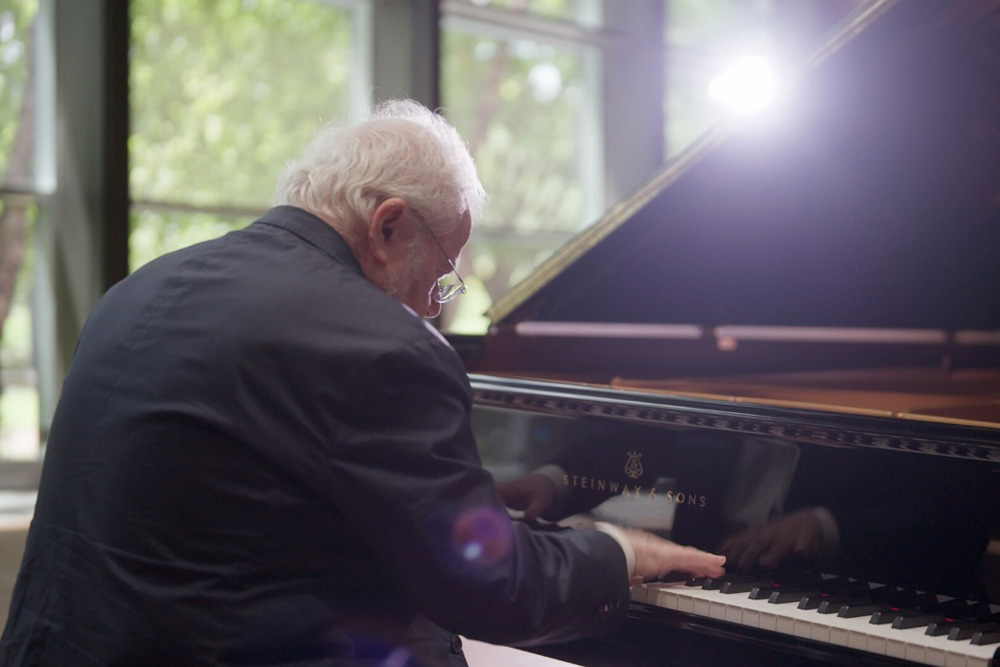
Finding the location to do that shoot was difficult because you have so much music happening on concert stages, you need a stark contrast in the look of everything. But I also didn’t want to make it a black box or to look like a dream sequence, so we found this beautiful performance space at Skidmore College that has just the wall of windows.
I wouldn’t want to spoil the end of the film, but when Yo-Yo Ma suggests you should have Emanuel listen to some of his old concerts, was what you’re seeing on camera actually him helping along what becomes the final note?
A hundred percent no. And that’s what was so amazing about it. We had already recorded that moment and we had to do months and months of planning to get WNYC to pull out [the recording of Emanuel Ax’s first concert at Carnegie Hall]. They unarchived a reel-to-reel for us. They found they had to bake it to transfer it. So this process was in the works and I knew for a long time we were going to have him listen to his first concert there, but I didn’t know how it was going to read. I did not have that confidence when we shot it. But it was only after that that, I was going through Yo-Yo’s interview and remembered Yo-Yo went off on a tangent at one point and started talking about that — it wasn’t one of the questions I asked. And there was that moment where I [thought], Oh my God. Also, for me, it’s a moment that’s really revealing in terms of their relationship because Yo-Yo knows him so well and it makes that moment so much more poignant.
It’s really quite moving. What’s it like to get to this moment with the film where you’re about to share it with audiences?
It’s incredible. I’m someone who really takes in a lot from the audience. As I edit the film, I need to be incredibly receptive to outside opinion on the film because I can’t just make something that I’m going to enjoy and nobody else in the world will. So when you finally get to that moment where you’re playing it in front of an audience and you get to see how the world reacts to it, especially a world that is made up of both classical and non-classical music fans, it’s a very rewarding moment in the process.
“All the Music in the World” will screen again at DOC NYC on November 14th at 4:10 pm at the Village East and it will be available to watch online on the DOC NYC virtual platform between November 14th through November 29th.