


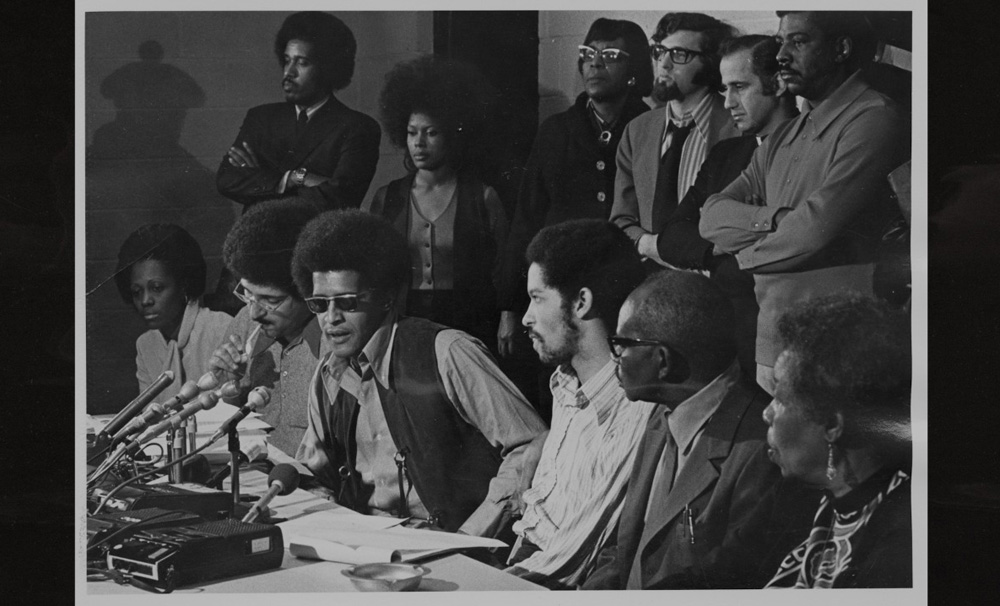

“There’s something working outside of all of this that I feel like a very powerful source of energy,” Christopher “Zoz” Gruse tells me shortly ahead the premiere of “Kenny: The Marxist Who Would Be Mayor” at DOC NYC, a week after a triumphant midterm elections for Democrats that even the most optimist prognosticators couldn’t see coming. Gruse, however, had spent the past decade bearing witness to a similar surge of enthusiasm for political change and while the exact results may have been a surprise, the idea it was possible wasn’t as he put together a biography of Ken Cockrel, who found a way as a defense attorney to ensure those in Detroit who felt left behind in the system would get their day in court and was instrumental in a number of community organizations ready to put the city on the path to peace and prosperity as a member of the city council where broad social reforms didn’t look radical in the face of the rampant racism within the municipal police department that led to the 1967 Uprising and later, the unsubstantiated manhunt of activist Hayward Brown by a special unit known as STRESS.
Cockrel would defend Brown during his trial, ultimately drawing a clear line against the city’s powerful police chief John Nichols, and success made him a favorite to eventually take the top job in the city, if not for a unexpected and fatal heart attack at age 50. Still, as Gruse shows in his galvanizing doc, Cockrel’s inspiration continued on as Detroit may have lost a born leader, but beyond his immediate family – wife Sheila, who joined the City Council herself in 1994, and son Ken Jr., also a city council member from 1997-2008 – the fiery attorney provided a blueprint for other peers such as Coleman Young, the first Black mayor of Detroit, to push the envelope for a fairer metropolis. As the film presents Cockrel not mincing words in public forums as he fights against police overreach and looks beyond the mainstream for policies that would ease the burden on marginalized communities — someone notes before Samuel L. Jackson, he was most associated with the proper pronunciation of a certain swear word — it can provide a blueprint for coalition building and seizing opportunity to make progress.
The film not only honors his spirit as so many in Detroit speak to his influence, but would seem to carry it as well when “Kenny: The Marxist Who Would Be Mayor” feels as if it can move people to action and with the film making its bow in New York, Gruse spoke about the patience required to get it right when the film features a copious amount of archival footage that really revives Cockrel’s memory, capturing history as it was happening with so many legendary interviewees, and releasing the film at a moment when it couldn’t be more relevant.
How did this come about?
I’ve been working on this for 10 years. I had a production company here in Detroit, and maybe a year before, I just finished Jeffrey Eugenides’ “Middlesex” and there’s a section in there about the ’67 Rebellion and the 50th year anniversary was coming up. My sister was actually born during the rebellion and I was talking to my parents about it a little bit and going down the path of making something [centered on] ’67. At the same time, Katy Cockrel, Ken’s daughter, who is a good friend, was on vacation with my wife at the time and she [said], “Hey, I’m thinking about possibly making a doc about my dad.” A lot of the people that I was already going to talk to about ’67 were already involved in Ken’s life and then Kathryn Bigelow ended up making “Detroit,” which focused on ’67.
I was aware of Ken and the work that the League of Black Revolutionary Workers were doing back in the late ’60s [because] my dad was a union welder at Rouge Steel, so I had an idea of who Ken was, but then I started reading about him and I did an interview with Sheila, Katie’s mom and Ken’s widow and it was like the floodgates started opening. Initially, the film was centered more around policing, focused more on the STRESS unit, and a lot of that was because there was a lot of footage of Ken that you see now that I didn’t have at the time. But it was more about policing and the socioeconomic nature of Detroit and racism. Finally, my wife Erin, who’s a producer on this film, and I found this box in the Reuther Library that had these 16 millimeter reels, like B-roll of Ken driving in Bell Isle, so we started microfiching through it. My wife cut a lot of these and made its own reel. We shipped off [the footage] to DC and got it digitized and that essentially changed the whole landscape of the film.
I knew it was a good film beforehand, but it was never the film that I set out to make. I wanted to make a biopic on Ken. There’s a lot of films done on policing , but there’s not a lot of films out there on black powerful men like Ken who were able to affect change, who was also a socialist, who’s also a Marxist lefty and I was way more interested in telling his story and how people can affect change through courts and through organization. We’re currently seeing that with Abdul El-Sayed getting elected here, which to me wasn’t much of a surprise, but to a lot of people outside of Michigan it may have been. But there’s been these revolutionaries in Detroit who have made massive impacts on culture, not just countrywide but globally, and to me, Ken to me is at the forefront of all of that.
The archival footage you mention doesn’t look like news crew footage. Was it part of another documentary from the period?
Oddly enough, Ken went viral on TikTok and Twitter two years ago for this appearance he made on “Tony Brown’s Journal” and the one clip was essentially a five-minute clip of Ken just talking about U.S. imperialism. That was what I wanted this film to be. It had a couple million views and that’s when it was like, “How do we get this footage [of this full show]?” Brandon McClure at Hungry Man was able to track down that footage through Tony Brown’s Journal and you see a lot of of Ken on that panel. The Cockrel family did not know that existed. We don’t have a team of archivists working on this. It’s really just been my wife and I. and then prior to that, there was some footage from “Taking Back Detroit,” which is an incredible doc that was made in the late ’60s, but also a lot of the other footage that you see in there has not been in anything that was shot by Stephen Lighthill, who is currently the president of ASC. He was trying to make a documentary more about Ken’s organizing and it kind of fell apart. But when you see Ken on the couch in that blue shirt, that’s Stephen Lighthill footage and the majority of [the footage] has not been seen by anybody except people that were there when it was being filmed.
Something interesting about the film is how it’s structured – STRESS remains quite literally at the center as an inciting event for Ken, but when he comes onto the case, he isn’t actively a part of what happened until it reaches the court. What was it like to figure out a structure when he would be absent in the middle of it?
That is something that I’ve been banging my head against the wall for five-plus years on, setting up essentially the tactics that STRESS was using. If you’re a little bit older than I am, everybody has a story about STRESS and knew somebody that was either executed or beaten up by the STRESS unit. It’s the equivalent to ICE and these 70 to 100 cops, a lot of them were from the South, recruited specifically because they had experienced combat in Vietnam. And I needed to tell the story of STRESS, but for certain parts, Ken could not be in that.
A lot of what Cam Neely, the editor and I, were looking at was the way Ezra Edelman set up “O.J.: Made in America.” O.J. is obviously a way more prominent figure than Ken was, but O.J. goes in and out of that documentary quite a bit for lengths of time and I talked to quite a few people, one being T.J. Martin, who’s a a great documentarian [about] how can we keep Ken present in there and not let him go away? Because like every time he’s on screen, it’s just like lightning and you don’t want to go away from that. But I needed to to tell the story of what was happening with policing post ‘67 into the STRESS unit, [which] essentially precipitated how we essentially elected our first Black mayor in a predominantly Black city. A lot of that was because Ken told Coleman Young, “This is the ticket you need to run on, and there’s 70 to 100 guys that at that point who could an election of 1.4 million people,” [because] we were the fourth largest city in the US at the time. So it was always a balance of how can we tell that STRESS and policing story without diverting so much from Ken.
Was there anything that changed your ideas of what this was as you were working through it?
We go back to this symposium that he was on in Philadelphia where he’s talking a lot about socialism and he drove up in a Corvette and there’s this large belief that If you’re a socialist, you can’t make money. With him, there was this socialism part that I wanted in there. We just didn’t have the footage that we needed. There’s also the section of Sheila and Ken and talking about their time on city council, but also like when Sheila [says], “Our mystique is that we won, and it doesn’t make sense to run somebody if you can’t win.” There’s a big part of that that was never something that I really had in mind, like what it takes to win and at what cost and and being honest about it too. She [noted] Ken was an executive figure. He was not a legislative personality and there’s an honesty to it, but also like what I was talking about when we first started talking is [this idea of] how can you affect change and be honest with yourself about what it takes to win? That part to me is like now incredibly important.
It’s almost at the end of the second act before we get into the third [where it’s like] This is how you do it and this is what it takes. Sure, it does help to be handsome and incredibly articulate, somebody that speaks like Muhammad Ali. But there’s also things that I’m hoping to impart to viewers where you know it doesn’t matter if you’re in politics or you’re a lawyer, but just in your day-to-day life of the sacrifices, what it takes to win and what that means.
You have John Conyers on camera before he passed, among others. What was it like actually knowing you were a witness to history with some of these interviews?
One of the main reasons why we have Martin Luther King Day is John Conyers, one of the longest serving congressmen in the history of this country, so there there’s people in there that are incredibly important. There’s a couple people that I interviewed that I think altered my life. Mary Jarrett [Jackson] is one of them. She was in other iterations of the film much more. She was the first to run a forensics department of the police and the first female Black police chief, just an incredible woman. Mike Hamlin was another one growing up I just had the utmost respect and and admiration for. He was one of the founders of the League of Black Revolutionary Workers, Even when I first started working in Detroit many years ago, Dennis Archer worked in the same building [as I did] and we’d go up in the elevator sometimes together and talk about the outfit that I had on or whatever. He was always just this really genial guy and it was great to reconnect with him. For a long period of time, I also lived next door to Ken Cockrel Jr. when he was the mayor of the city, so there was a reconnection with that.
And Sheila [Cockrel], to this day, is such an incredibly powerful woman. Every time I hang out with her, the stories that she tells, she’s still just this badass woman that’s still doing her thing and I feel like this is one of those stories where once it gets out there, people will understand what was happening in Detroit. I think a lot of our history has been forgotten in many ways because what happened in this city, and it’s so incredibly important that people understand the work that was being done here.
What’s it like to get to the point of premiering it after working on it for so long?
There’s a light at the end of the tunnel and it’s like no longer a train coming at me. Screening this at DOC NYC, it’s a film festival that I’ve followed throughout my career and being able to premiere it in New York is incredibly important. A lot of times in documentary filmmaking it’s like the zeitgeist of what’s happening culturally and I think right now this film could not be put out at a better time. The momentum that’s happening within this country is the reality of what Ken was talking about 50-plus years ago and I’m not saying if Ken weren’t to have passed away at this incredibly young age, things would be different, but there’s a sliding doors effect when somebody that powerful passes away that young, it leaves a big hole in the fabric of society here and also nationally. So getting this out right now in the wake of these midterms, out of all the times that this could have this could have come out, I think it is the moment for this to be out into the world.
“Kenny: The Marxist Who Would Be Mayor” will screen at DOC NYC at the Village East at 11 am on November 14th and November 15th and available online from November 15th through November 29th.