



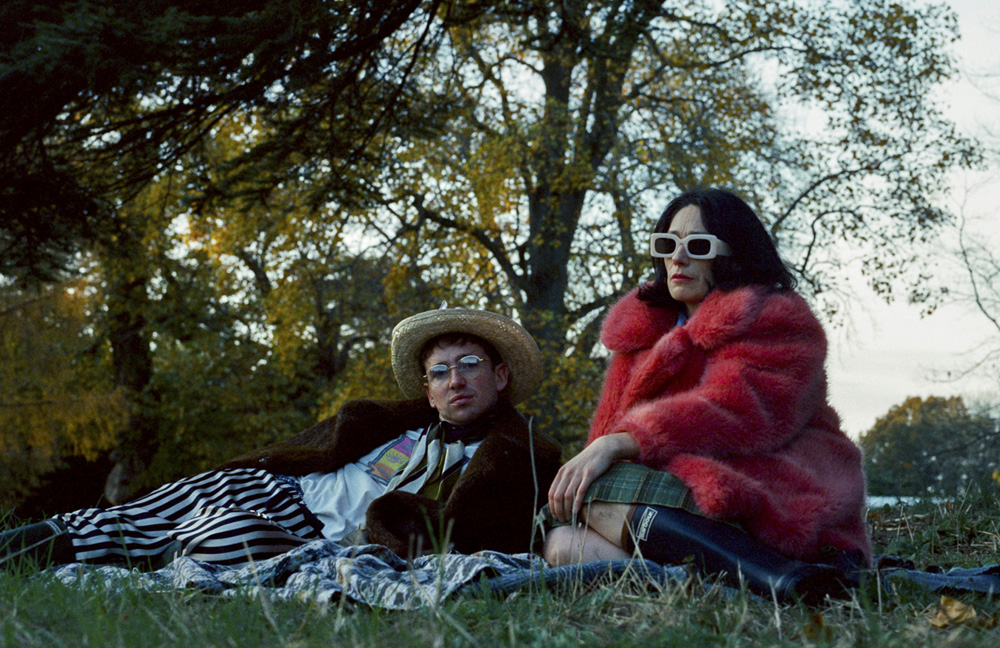

“If you leave, who’s going to film me?” Lady Isabella (Sian Clifford) pleads in “Lady,” fearing she may have scared away Sam (Laurie Kynaston), the filmmaker that has been lured to her palatial estate by the promise of a potential Netflix series. There’s a bit of “Sunset Boulevard” in the far reaches of the United Kingdom when Lady Isabella seemingly has it all on the endless property – a garden maze outside to get lost in and a fine china collection inside that would make it possible for her never to have to wash a plate again, yet what she truly craves is attention, which sadly is in short supply when she may have royal blood but no family to speak of – or at least speaks to her. She feels compelled to put on a show whether an audience is there or not with outrageous behavior and equally loud outfits, but like a tree falling in the woods with no one there to hear it, she has to wonder if she’s actually making any sound.
Although Sam hardly knows what he’s getting into by accepting the gig which he may or may not abandon halfway through, director Samuel Abrahams – who cheekily names the on-screen filmmaker after himself – shows significantly more savvy in the merciless mockumentary in which Lady Isabella is presented as a lion to be tamed, leading Sam around the premises so ferociously that he struggles to keep his camera in focus as she indulges one whim after another. Yet what does come into sharp relief is that while she’s desperate to express herself, it’s the fact that Sam is too that keeps him from walking out the door, less so in a financial sense when surely he wouldn’t have accepting the gig if he were making the kinds of films he really wanted to, but he does see something in Lady Isabella that he believes of himself, ironically just as the lady of the manor fears she’s not only becoming invisible in a figurative sense, but also a literal one as well.
With the “Fleabag” scene-stealer Clifford making the most of a proper lead, it simply isn’t possible to look away from “Lady,” but Abrahams and co-writer Miranda Campbell Bowling invest the film with as much pathos as comedy when all that painful humor does emerge from a deep desire to be noticed and the film becomes undeniable in that regard. After premiering around this time last year at the London Film Festival and charming audiences around the world, “Lady” is now arriving in the U.S. to being its theatrical run and Abrahams kindly took the time to talk about how he was able to deliver on the promise of a scrappy production built on the power of two strong actors at its center and heck of a central location, finding sly ways to accentuate the main ideas of the film in its score and camerawork and the rewards of an experience that ensure he’ll be back at it again soon enough.
 From what I understand, you were doing some trawling on YouTube and found a would-be influencer of interest, but how did this take shape as a story?
Once I found this real life person who was “chucking out the content” [as she said in one of her YouTube videos], it wasn’t great. It was possibly the worst video of all time that been uploaded to YouTube, but [I thought] this is a very interesting character to me, someone who wants the world to see her, but she can’t see herself. And it was that thing that I held on to and thought, “Okay, well, what can I do with this character?” It felt like what she wanted wasn’t too dissimilar to my experience of things in that I want to make films, I want to put them out there and want on a big screen. I want people to enjoy it and I thought that’s interesting because I’m more cowardly what I’m doing. I want to hide behind the work, so what if you brought this actor, Lady Isabella, who lives in this gorgeous, stately home but alone and isolated there and she invites the film crew in to document her every move, with a director who also wants to be heard, but doesn’t necessarily know yet what he wants to say.
Once you saw Sian and Laurie together in that dynamic, did it change your ideas of it?
Once we had Sian in place, then you’re looking at shaping the film around her and her talents and finding the right person to play Sam, the director, was the next big thing on our list. We had seen a lot of tapes, and within about five seconds of Laurie’s tape, I knew, “Oh, this is the guy. He was just dialed into the right frequency of the tone and when you’re in that space, everything is funny and everything works. So then it was a question of “Well, how are they going to fit together? But it turned out that Sian and Laurie had worked together on a big BBC drama, so there was this trust there and making your first feature, it’s small and you don’t have all the resources or loads of rehearsal time, so knowing that there was this trust between them was huge. Just the fact there was a relationship there meant we could just hit the ground running and how it affected the actual dynamic, every day you’re exploring that and discovering it together. I’m sure it’s if you have a different director or you have a different cinematographer or different actor, it’s a wildly different film, but I feel very lucky that I got to work with Sian and Laurie.
How did you figure out how the camera would relate to them when the film has this frantic visual style? It still must be very intentional.
It is very intentional, but the intention is to make it look like there’s no intent. It’s chaotic and observed with a very curious camera that’s always looking and listening for the story, and spying and overstepping the mark, really sometimes exploiting the subjects and Korsshan [Schlauer, our] excellent DP was just such a perfect fit for all of us. He immediately got the concept of it and I remember the first meeting with him. He came in and was talking about not the camera as a character, but essentially him, the operator and the DP, as a character. And I [thought], “Yes, this person gets it. You often say, “Well, the camera is another character in a story,” and sure, but in this one, the DP is a character who, at some points, makes some very key decisions that affect how the story plays out, so we were very deliberate in charting where the camera operator is in the story and what is acceptable for them to look at and observe. It’s designed chaos.
 The house is obviously a major character in the film as well. How did you find the right location?
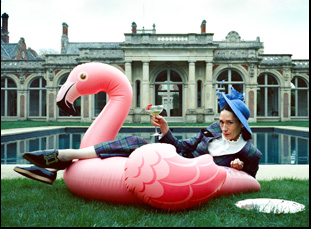
To be honest, I wrote the film for that location. I had been there a few times and when you’re making something very small, [it’s about] as much stuff as you can beg, borrow and steal — and I didn’t steal the house, but I had an in there that I felt like we might be able to make this work. It also meant that because I knew the layout of it, I could shape the story around the space in the script. And that was huge. You could really feel it when we’re blocking scenes out that a lot of that work has been done in the writing of it and how they’re racing through rooms. That was all charted out in the script. Anyone who is setting out to go make a small indie movie should just think long and hard [when you’ve got] two actors, one location and the better you know that location, the more value you’re going to get from it.
I’ve heard you were also staying on the premises during the off-hours of the shoot. What kind of atmosphere does that create when you’re in a cocoon like that?
It’s just one hell of a playground for Isabella and Sam. You can see once their their relationship evolves, you can see that it becomes this fun, dressing up box for Isabella. She’s constantly in different clothes and then they go on these adventures. There’s a maze garden or they meet these pigs and there’s the raven. It’s a playground, and we had a very small crew and cast and we all lived on the estate — not actually in the house, but on the estate, which is quite large — and it’s a cliche, but we had a real family spirit. We had no big location moves and we were constantly shooting, all together as a team and it felt very intimate. We shot over 15 days and those were the best 15 days of my life. It was just incredible.
Is it true there were some 30-minute takes on this? Were there any scenes that started in one place and ended up in another you could get excited by?
Yeah, I really enjoyed doing those really long takes. I don’t know if we get 30 minutes, but some of those scenes where you’re racing around from the library, up the stairs, into the bathrooms, it was designed in the script to have that journey through the house, but the actors were so game for it. That really meant we could get so much in a long time, like 20 minutes or whatever as a take, and within that, you do that three or four times and you’ve got a whole sequence. So if you’re breaking it down [into different pieces to shoot], it’s going to take an awful lot more time and sometimes you can lose a bit of the energy, especially for a film like this, which is so reliant on that energy and the feeling and the tone. So I would often just give a little bit of looseness and there’ll be times in between something [where it was like] “Well, they’ve got to come from this bathroom out to this next bathroom and in between there, I don’t want the story to evolve. There’s a line that they need to end on and then another line they need to start on. But in between, I still want them to riff on something, but not move the plot forward. So there would be lots of fun like that and new jokes or ideas that would appear. It was a really fun way of working.
What it was like to put music on this? It’s a really fun, chameleonic score.
It was incredible. I’ve directed shorts and a lot of commercials, but as my first feature, everything was new to me on this scale and editing a feature-length story with Josh Mallalieu, who was an incredible collaborator, he had great instincts for music as well, like when and where a cue would work, so if I was getting nervous and [say] “Well, we just need music,” he’d say, “No, no, you got this, the audience doesn’t need it here.” It was a really interesting process because we had to temp [score] this edit, so you’re editing with other people’s music from other people’s films and it just never really feels like it’s your film. Then once I got the luxury of spending time with Jonny [Woodley], our composer, and started laying down all his ideas, suddenly you’re like, “Oh, it’s arriving.” Like this thing that’s been inside of me and all my collaborators for a long time, now it’s coming into focus and you can really feel it’s got its own identity. It was just an incredible part of the process to see and feel that coming together. It was a score I’m very proud of, reflective of the different shades of Isabella’s character where there’s all the bombast and the blunt, in-your-face sounds, but then there’s the vulnerability that’s hidden beneath.
As you say, it is your first feature. What’s it been like seeing it get out into the world?
It’s the best, just getting to see the film with an audience. The first time I saw it with an audience, it was like the day after I’d finished it or really, it was wrestled from me. But our premiere was at the London Film Festival last October and I still hadn’t really seen it, so we’re watching it with 350 people the first time, and you’re thinking, I don’t know what this is. But the best part of a year doing the festival circuit, seeing the film with lots of different audiences from around the world, is that I have this really amazing relationship with the film. I’m really proud of it. I love getting to see it with audiences and it just reminds me why I want to do this and why I’m addicted to it.
“Lady” opens on October 9th in theaters across the U.S. including New York at the Regal Union Square, Los Angeles at the Laemmle Monica and the Look Cinemas in Glendale, Houston at the River Oaks Theatre, Seattle at SIFF Cinema, Portland, Oregon at the Regal Fox Tower, Santa Barbara at the SBIFF Film Center, Denver at the SIE Film Center and will expand in the weeks to come to Palm Springs on October 16th at the Festival Theatres, San Francisco on October 23rd at the Roxie, Cleveland on October 29th and 30th at the Cleveland Cinematheque and Atlanta on October 30th at the Plaza Theatre.