



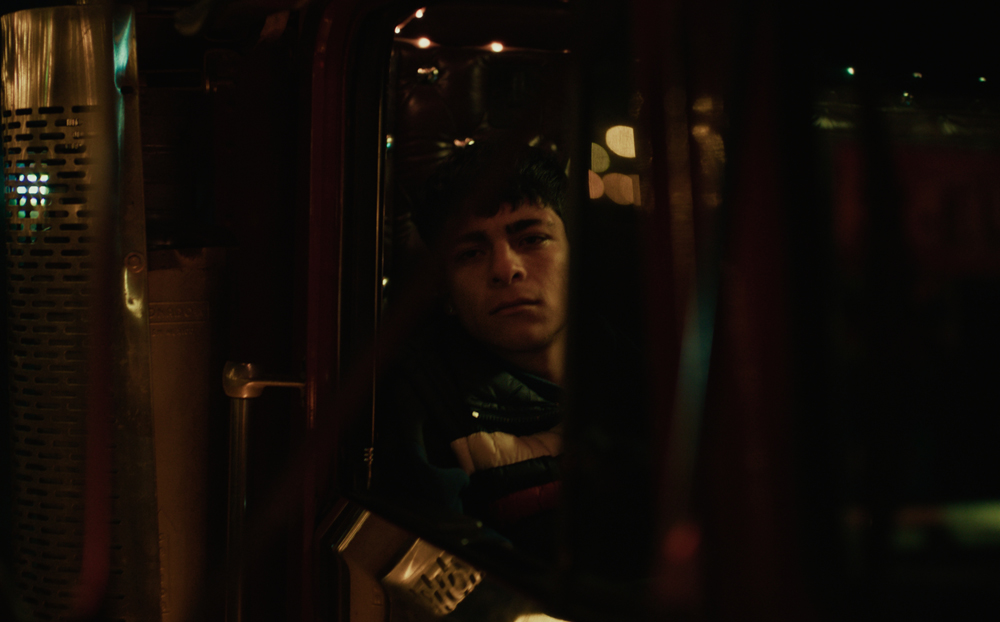

“The most fucked up things happen on the road between 2 a.m. and 5 a.m.,” Muñeco (Osvaldo Sanchez) tells Veneno (Victor Prieto Simental), the younger man he’s picked up in his big rig in “On the Road,” describing the fornication that he’s seen in the shadows just off the highway or even the dead bodies that aren’t as unusual sight as one would guess. Sometimes he could be hallucinating when the job in long-haul trucking prevents him from getting much sleep, making Veneno a little more welcome into his cab after some initial resistance when he brings with him some bags of coke that could keep him awake as he drives around the desert in Mexico, but much of what he sees ends up being so relatable he can’t escape it.
It’s a transfixing feeling that comes to pervade David Pablos’ swoony romantic drama in which Veneno gets more than he bargains for when he hitches a ride with Muñeco, seemingly having exhausted all other options to leave the middle of nowhere when they meet each other at a truck stop. Veneno has gotten by on his good looks and his modest supply of drugs to sell when besides being a place to shower and get a quick meal, the truck stops are well-known by local drivers as a reprieve from the road where they can lose any inhibitions, but it takes time for him to get Muñeco to let his guard down around him, in part because what drives him is a desire to get sober for his kids as he works unimaginable hours trying to support his family back home. Still, he can’t help but feel he has something in common with Veneno, who was abandoned by his father upon learning he was gay, and the two may not initially have much of a connection – at least at first – yet can see in one another as they cruise around the outskirts of cities in the dead of night that they both have lived on the margins without any obvious way in.
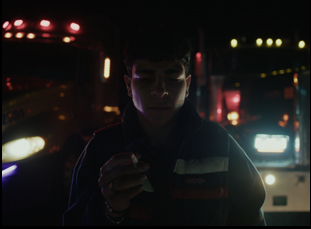
If such an experience could dull their passion for life, Pablos suggests the opposite is true when both are pleasure seekers wherever they can find it and the writer/director delivers plenty of it on his own as “On the Road” dips into a lurid underground to find genuine heat between Muñeco and Veneno, who eventually find themselves on the run when the latter has an illicit encounter go awry. Amidst junkyards and long, lonely stretches of asphalt, Pablos finds the beauty in the relationship that develops between the pair, amplified by the array of colorful lights that eke inside the big rig as they pass through towns sometimes too small to make it onto maps. Sensational in a variety of ways besides being seductive, the X-rated adventure was recently selected as Mexico’s official entry to the Oscars after a celebrated run on the festival circuit following its premiere at the Venice Film Festival last year and now starting its theatrical run in the States, Pablos generously took the time to talk about the unconventional approach that led to the casting of his strong lead actors, the details he could glean from his own time on the road and seeing the story unexpected reach so many.
 How did you get interested in this world in general?
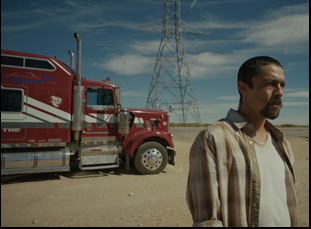
It was 13 years ago when I was doing some research in Oaxaca. This is where I discovered the world of truck drivers and it was the first time that I got inside a truck. I was on the road with with a trucker. He took me to a road restaurant and started telling me some of his life story. And he was a very good narrator. Because of him, I started to get access to more and more truckers and I thought that there was a possibility to create a very interesting story inside this world. But many years had to pass until I finally decided because for some reason, I felt a lot of fear about writing this story. There are some stories that you connect with personally very deeply and this was one of them. I’ve said many times that with this film, I felt like it was my first because of how invested I am in the story and how personal it is in spite of not being this film about my life at all.
I let the project wait for ten years, but when I finally decided to to bring it out, it very easily came through. It was written very quickly. I met this trucker 13 years ago, but then I had to know much more about this world because the reality of this world would give me all the answers on how this story could develop. First, I read as much as I could about the trucker’s life in Mexico. Then I met a reporter who wrote a very interesting book called “Children of the Road” and then I was able to interview this man who also did a documentary on truckers in Mexico, but focused on female truckers and it was very helpful. It was very useful also to understand the different dynamics from the north and the south of Mexico. I started to go to these places and I met a trucker who told me his life and then took me to many road restaurants. He introduced me to more people because it was also very important for me to see the dynamics of these places and how people interact in these road restaurants, to see the faces and to get a sense of the atmosphere. All of this was vital and it was so easy to write this film because just being there and observing, it started coming to me immediately.
One of the things that struck me was how you’re able to speak to a generational cycle in regards to abandonment and the longing for a father, but speak almost exclusively to the present moment. Was that tricky?
What got me interested in in telling this story is it is about a young man who sleeps with other men at truck stops and his father was a trucker and he is metaphorically looking for his father in this place. There’s something for me very powerful in this sentence and fatherhood, even though there are many layers [to the story], this is what got me interested in telling the story. It’s a search for the father and coming to terms with with the father figure because if you analyze Veneno’s character, that is his wound and he’s constantly looking for a father and of course, there’s a father figure in (Megko,), but also in this mysterious man with a cowboy hat. And this is what crosses him as a person, this wound.
Geographically, this may not match up in reality, but did the locations give this a certain narrative structure in your mind?
Originally, I thought about the film taking place in many states of Mexico, but I realized that I had to be much more concise. So I decided also for personal reasons to set this film in the north of Mexico, on the border in Juárez and Chihuahua, and I did this because I realized that the desert was a perfect landscape. It had this quality — and this is not so much intellectual. You just feel things and you know that these landscapes feel right for the film. But also Juárez is a city that has a lot of truck life because it’s a border city and it’s very unique as a city in the desert with no trees with huge truck stops. It’s not a pretty city, but I found it beautiful and it’s fascinating. My cinematographer would say, “No matter where you place a camera, you will have a very rich frame” because Juarez is a city with a lot of texture. Someone from my crew said Juarez looks as if it survived the apocalypse, and I don’t mean this in a pejorative way. It is visually very rich, very strange and very unique.
So most of the time we stayed in Juarez, but we also went to these small towns to the west, three hours away and I was very interested in the north because I connect to the north very much. I was raised in Tijuana, but the the faces of Juarez are very special and this is also why why I wanted to cast from Juarez, because I knew that I was going to have the personalities, the faces. I always pay so much attention to every single face in the film. Even the people who are in the background, I cast them as if I was going to do a close-up because I think the faces are very much a landscape and they set a tone. They give you information about this world that you’re experiencing. These faces tell a story.
 From what I understand, your casting process is a bit unconventional. What was it like to find Osvaldo and Victor and did working with them ahead of the shoot actually change your ideas about the characters?
As a director, you always have to be flexible. You always have to allow life to permeate your vision because otherwise, you will lose so many possibilities to improve your original ideas. So even when I’m casting, people throw ideas or do or say things that I find Interesting and I start either adding things to the screenplay or changing the way in which something is written when the actor is doing something different and also Juarez, it’s so alive that I would even rewrite parts of the screenplay to say this should take place in this bar that I just discovered that is unique.
Usually my casting processes are long – it takes six or seven months because my casting director also works as a fixer in Mexico. He knew Juarez well, but he didn’t understand how how far away everything is and because we were mostly casting in the outskirts of Ciudad Juárez, it took a lot of time for him to be able to access many of these places because you cannot just go there. You need to have people who know people who can open the doors for you in a way that it’s safe. He was very frustrated at first because he said, “I’ve been here for a month and I have nothing.” Also this profile he was looking for, especially Veneno, was very difficult to find. It’s not easy to find young, openly gay men in these parts of Juarez because it’s very dangerous. These are areas that are marked by violence and insecurity. So what would happen is that even though [my casting director] found someone great who was gay, he was in the closet and not only did the closest people to him didn’t know he was gay, but it was impossible for him to imagine doing a film where he would be exposing himself like this. So it took a month for my casting director and his assistant to be able to establish connections in all of these places and to start knowing people and the doors started opening.
But it was complicated and besides going to these strategic places in Juarez, we discovered that downtown Juarez is very gay. I had no idea it would be like this, but there’s a lot of gay life in the center of in downtown Juarez, so I suggested that he start placing posters in the gay bars, just this poster saying “We’re looking for people without experience for a film. This is the age range. He also went on Grindr and posted information for the casting. And Victor came to the casting I think in the third month and my casting director wanted to throw himself out the window because he was desperate. And Victor’s boyfriend, now-husband, saw the poster in a bar and said to Victor, “I want to go” and Victor went with him to the casting. This is a very common story in film – Victor’s husband was not cast, but Victor was. And Victor was not [initially] interested. My casting director had to insist, and I was immediately drawn by Victor because of his inner world, because of his maturity and the profundity of his ideas and his understanding of people. He’s very smart. And I knew that he had all the elements necessary to portray Veneno.
It was a long process for Victor. Even though I was fascinated by him, it was very hard for him to open himself emotionally at the beginning – to not only speak out loud, but also to show vulnerability. I had four phases of casting because I wanted to see how much he would be able to go there, but what kept me going is that in every stage of the casting I would see Victor opening up more. I would see him more relaxed. I would see him enjoy the process more. And there is a very specific moment that confirmed that he could do it on the last stage of casting. I already gave people scenes from the screenplay because all the previous stages were only improvisations and acting exercises, but I gave them three scenes to memorize and we would work on these scenes. I gave Victor a specific indication, which is not to react immediately. The other person would say a [line] and Victor would react immediately, so I said, “Victor, wait. Let this person say his dialogue and take a pause and process what that means.” So we did the take and it was beautiful to see Victor because he made a pass longer, way longer than I thought. It was like a 30-second pause. It felt eternal, but in the best possible way because in this pause, I saw how things started happening inside. I always tell all the actors you cannot lie to the camera because the camera brings out everything that is inside and I saw what happened in those 30 seconds with Victor and when he finished the scene, I knew it was him because of that pause because he had the possibility of expressing deeply what came from inside.
 Originally, I also wanted to do a film only with non-actors and I had cast someone else before Osvaldo, but this other person I believe was an amazing potential actor and he was thrown to jail because he robbed a store. And then I found another person who also disappeared, so finally I said I think it’s time to call an actor and the only [professional] actor we cast was Osvaldo. I met him many years ago and I never saw him after that, but his face remained with me. My casting director and my acting coach knew him, and we all knew he was a good actor. And I needed someone who would take this process very seriously and be willing to give himself entirely to the process. And when I cast an actor, I like to ask him or her to tell me, “What is the story of your life? Tell me whatever you want to tell me. Take as long as you want.” So Osvaldo told me his story and I already saw that he connected very much emotionally to Muñeco.
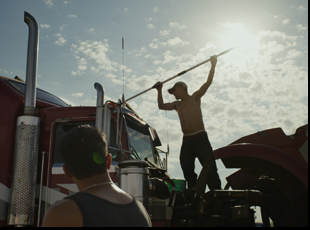
He also has a very personal, very complex story with his daughter and he separated from his mother as well and through this conversation, I saw Osvaldo’s inner world. And what I’m extremely grateful about is that both Victor and Osvaldo were so generous, and I don’t think many trained actors like Osvaldo are willing to do what he did and go as far as he as he went. He basically became a trucker – he got his trucker ‘s license. He drove a truck in Mexico for a few weeks and he slept in the truck and then didn’t sleep for a week to understand what happens to your body when you don’t sleep. This is where he immediately realized who this character is because he says it fucks your mind completely and your perception. You are constantly jumpy and you react extremely to everything because you’re not sleeping.
Did having a trained actors mixing with a largely nonprofessional cast give this an interesting dynamic?
Yeah, many things were achieved in the film because of Osvaldo because he knew also he would help me contain not only Victor, but the rest of the cast who were all unknown actors. The most important thing is that we had a two-month rehearsal period before going to the shoot and for the first two weeks, everything that we did was only to focus on Victor, to make him feel safe, to give him tools, and to make him trust us and without Osvaldo, we wouldn’t have done it. So Osvaldo was extremely generous and it’s always a dialogue and one is able to do what he does because of the other. Osvaldo is the one who contained and who pushed [Victor] all the time.
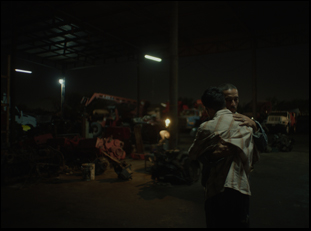
We had this beautiful moment at the Morella Film Festival. They have an award for best actor and usually give it to just one person, but last year, they gave it to both my actors and I was very happy about this because the jury recognized that it’s both of them working so that the other one can do what he does. They became so connected that it was very easy for me to do anything, also because they trusted me. A lot of people ask me about the sex scenes and I say it was very easy because not only they knew what they had to do – I explained the scenes very carefully to them – but they were already connected. They already let themselves go and they had this trust. I was very calm and very trustful of the process [in general] because in the acting workshop and the rehearsals, I had already seen everything that I needed to see for the film. They were there already and I knew they were going to arrive to the place that I needed.
 What’s it like getting to this place now where it’s coming out across the world and you’ve been selected as Mexico’s entry to the Oscars?
Something beautiful has happened with this film. When I was making it, I remember saying to my cinematographer, “I don’t know who will see this film. I don’t know if anyone will connect with this film, but this is a film that I really want to do. I really want to see this film.” So what has been surprising me nonstop since we premiered the film in Venice is to see how this film has opened its own path for itself. It’s gone places and achieved things that I never expected. For example, I never expected this film to do as well with the audience as it did in Mexico. I’m not even talking about the awards, but how the film has connected with people. This is something that I feel very grateful for. And I didn’t know who would be interested in seeing this film, but not only has the LGBTQ community embraced it, but in Mexico it didn’t just become a niche film. All type of audiences want to see the film. In Mexico, we premiered in HBO Max and it went to number one. So I am constantly surprised by what this film has achieved.
“On the Road” opens on October 28th in New York at the IFC Center and November 20th in Los Angeles at the Laemmle Glendale.