


After the recent premiere of “My Undesirable Friends Part II: Exile” at the New York Film Festival, Ksenia Mironova described the presence of Julia Loktev as a much-needed pillar of stability when everything else was changing so rapidly around her, having to flee her native Russia in February 2022 when Putin began the invasion of Ukraine and as part of the crew at TV Rain, one of the last remaining independent sources of journalism in the country, she was deemed a “foreign agent” and “undesirable.” When Mironova’s colleagues scattered across Europe, finding shelter in places that would still honor their visas such as Tsibili, Georgia and Latvia, Loktev remarkably kept filming after she had set out to capture how TV Rain and a few other intrepid outlets kept reporting on the Putin regime in an increasingly hostile environment in “My Undesirable Friends Part 1: Last Air in Moscow,” yet the filmmaker is quick to dismiss the idea that there was any added benefit to her being there, whether it was to provide comfort or to help keep a network connected, other than to capture what was happening.
“Everyone’s all friends with each other and to different degrees,” says Loktev. “I’ve become friends with them. And I think that’s really important that this is a film about not one person fighting evil as it’s sometimes depicted in movies, which we find a little bit cringe, but it takes a group of people continuing to work together as a community, each doing what they can that day.”
In fact, the collective experience of “My Undesirable Friends,” both in terms of the generosity of the fearless journalists Loktev followed to allow cameras in at their most vulnerable and the time the director affords to them in her new five-chapter film, is undeniably powerful, but not —as one might think given either its tragic subject matter or runtime — intimidating when the worst of times can be seen as bringing out the best in the journalists. As admirable as Loktev’s commitment to following the story wherever it leads, equally commendable is the disarmingly warm lens she brings to observing Mironova and colleagues Anna Nemzer, Irina Dolinina and Alesya Marokhovskaya, who could be seen in Part I already scrambling to break news against all odds, potentially robbed of a sense of purpose when it really does become nearly impossible as their energy is required simply to reacclimate in cultures completely foreign to them and the teams they previously worked with struggle to stay in touch.
Yet while despair is inevitable, it is hardly the default position for the dogged reporters who approach their lives with black humor and are bracingly frank with each other when simply to speak with honesty is a form of resistance from a government that wants them silent. In addition to the original quartet that carry over from the first installment, Loktev expands the screen to focus on Lena Kostyucheko, an anchor at the reconstituted TV Rain, Lera Ratnikova, a revered longform writer who resettles in Latvia with her partner Yana by way of Turkey, and Natalka and Petya, a couple of shared beliefs but different nationalities that complicates their travel when she’s of Ukrainian birthright and he was born in Russia.
Loktev understands the key to bringing audiences closer to the history that’s unfolding is to connect to the intimate human drama, which is plentiful as everyone in front of the camera contends with the disillusionment of seeing the place that shaped their identity so much dissolve before their eyes and close relatives may not only become impossible to see but distant in other ways when their only source of information is state propaganda. However heartbreaking the disconnects are, the exchanges between those who are made to feel alone and find strength in a common cause can be galvanizing, losing nothing in translation as Loktev brings them to the screen. While “Last Air in Moscow” was riveting in depicting a world crumbling around the young women, “Exile” becomes an enthralling testament to their resolve, even as they become aware that the same threats they faced in Russia are cropping up wherever they may go including America. Fresh off recent bows in Venice and New York, “My Undesirable Friends Part II: Exile” is shaping up to be one of the theatrical events of the fall and the director graciously took the time to talk about how being true to life yielded such a compulsory and engaging cinematic experience.
The last time we talked, you were in the middle of editing this part in the midst of releasing “Last Air in Moscow.” Did the response to that actually in any way inform ideas about this?
What really informed it is just what was happening in front of the camera. What determined the film were the events that that were unfolding and trying to be truthful to those because for example I don’t think there would be a version of this story that would be an hour-and-a-half that would be true. This is the truest version that shows life, and of course it’s a very different rhythm and a very different kind of life, when whatever remaining faith they had in their country was really shattered by the fact that Russia invaded Ukraine. And they’ve had to now question everything they ever worked for.
When everyone was still in Russia [for the first part of “My Undesirable Friends: Last Air in Moscow”], it was that last period, the last few months, the last few weeks, the last few days, when people were still able to work out in the open as opposition journalists in Russia and speak the truth and then that window shut and everyone had to leave the country. And this is a film about people whose lives were completely shattered in a week or a day and they had to pick up the pieces. They got thrown out of their country. They didn’t have their media. They didn’t have their jobs. They had no idea what country they were going to next. And they had to very quickly figure out how to keep going as journalists and how to figure out their lives in a new country — sometimes in one new country after another new country after another new country, so it has a different kind of rhythm.
It didn’t surprise me that you chose to focus on people rather than the overall project of TV Rain, but I suspect a lot of other filmmakers would’ve gravitated towards the story of rebuilding the network, which the film covers but it’s not a driving force. Was it much of a consideration what to follow?
It’s a film about people, some of them work at TV Rain and TV Rain goes through a crisis in the course of the film. When we start out at the beginning [of “Exile”], TV Rain really doesn’t exist anymore because the Russian government have taken them down and they’ve had to disband, they go through trying to set up YouTube channels, then they move to Latvia and or working out of a borrowed studio and then they have this crisis and have to work again and keep going. The characters in the film sometimes joke, “This is like ‘The Morning Show,’ the real version for today’s world,” in that some of it has that workplace comedy of and drama of that you get from people who are making the news. But it’s really about the people going through this and of course they’re journalists, trying to figure out how to navigate this space as Russian independent journalists, but they’re also people who go on Tinder, who fall in and out of love, navigating their lives in completely new countries.
Some people who really come to the fore after being in the background in the first part were Lera and Lena. How did they emerge as a focus?
Lera was in the first part. In fact, we see her with Yana in the first part briefly as roommates and then that relationship develops in the second part into something else. And Lena appeared in “Last Air in Moscow” only on screen as an anchor, and there’s another anchor, Kata, that we only see on screen on TV Rain in the first part and then they emerge as characters behind the scenes as these flesh-and-blood, real people with their crises and doubts in their lives in part two.
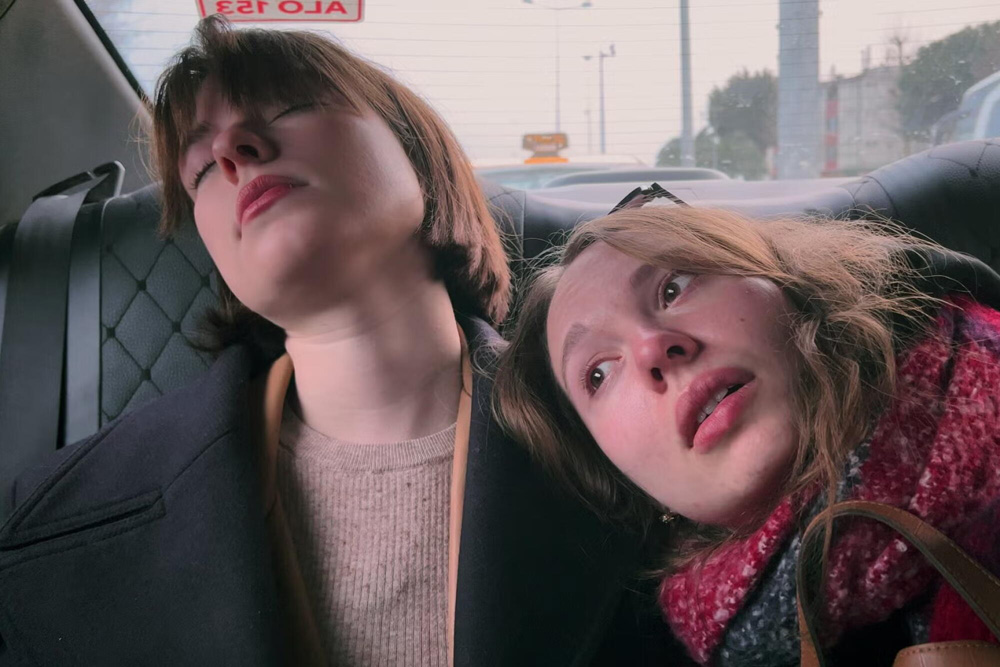
We meet Lena at the very beginning of part two and she says this beautiful thing — she’s roommates with Ksenia and Lena and she was 22 when I started filming her. She’s the youngest anchor at TV Rain, and incredibly smart, incredibly professional, but one of those people that looks entirely different when you see her on air with her stage makeup. And the minute she’s off air, she’s incredibly open and just shows all of her emotions — that strange mix of an old soul depth with this glamour that feels like a silent movie star. You can see everything on her face. She is someone who cannot hide an emotion, so you’re feeling everything on her face and when we meet her in Istanbul, she and Ksenia and another girl are roommates and they’re living in a like a $10 a night hostel and then somebody else lends them a free hostel and they’re trying to talk their way to this other hostel room, which was supposed to be booked for one person, but they need three people to stay there. They don’t have jobs, they don’t have anything and Lena says it really beautifully, “Yesterday, I had job, I was an anchor at TV Rain, I had a boyfriend, I had an apartment, I had a home, and now I’m this loser in Istanbul.” She laughs because she’s aware of the absurdity of this situation also, but it’s also a complete crashing down of everything for them. All the while, they’re very aware that this is happening as their country has invaded another country and they need to get back to work so they can report the truth to Russians about this war.
Even in your narrative work, the conversations have been able to come across like action set-pieces in a blockbuster. Were there certain ones that became foundational pieces for everything else?
I discover everything in the editing. Obviously sometimes as you’re filming, you hear something [and think], “Oh yeah, that’s good.” But then I do due diligence on everything and really try to approach the footage like, “I don’t know” and see what I can learn from it. Sometimes you think the center of a scene is here, but it’s actually over there. But also sometimes more events happen, do lines that happened a few months ago suddenly take on completely new meaning or the scene is transformed.
I wish I could write as well as these people speak. I will never write this well, and I’m trying to learn from them because they’re constantly going from drama to humor to some incredibly deep political observation, said in a very offhand way to cracking a joke. That’s the life of the conversation. It really is incredible dialogue. Michael Taylor, my co-editor, and I would be looking at this and going, “This is just like great written dialogue. It’s just we didn’t write it.” Unfortunately we can’t take the credit for that.
But there was a scene, for example, where two of the protagonists, Ira and Alesya, were getting threats. And I flew over to Prague because they just received these really creepy threats and they were going to the police station. They were getting descriptions not only of their passport number, but when they were about to go on a trip, they got their airline reservation information, like “here’s your flight number, here’s your seat number and hotel address. Also, by the way, here’s your home address and a description of your snorting dog,” something you would only know about the dog if you were watching it in close proximity. [And Ira and Alesya] were saying, “Well, we have this friend, she’s a human rights activist, she also got threats. And they said, ‘Let’s film with this woman.” So as I was filming it, she was a friend of Ira’s, someone that Ira had trusted and I was filming it in one way. And then during the edits. Ira had published an investigation where it turned out this person was not who she presented herself as. Much of what she had told them was not at all true and was actually very much a lie, including the threats and this was a seemingly quite unsafe person to have around. Of course, that changes how I would edit the scene. I didn’t realize it the first time I filmed it.
That revelation hits like a stack of bricks when you have the text on screen revealing she had once worked in the Russian police. As you’re behind the camera yourself, did you think you got a better feel for what you wanted to capture?
I tried not to think of what I wanted. That’s almost the wrong question to ask yourself as you’re filming is what do you want? You try to show up for the circumstances that seem like they capture a particular time or character and you try to be there and then it’s a matter of really paying the most intense attention and listening because we sometimes forget that. When you’re filming, you have to listen to what’s happening outside the frame because that determines where you’re pointing the camera next.
Just looking at it through the camera and responding with the camera, I think of it as a dance where you know they’re leading, I’m following and there’s a dance partner involved. There’s no second take. This is a film that often feels like fiction. It’s not an informational documentary or where you have set up shots. This is people living their lives and all of a sudden you have an unexpected emotion, like when Lena is just overcome by emotion and then breaks down crying and you’re in that moment trying to be present as a human but also respond with the camera in that moment because it’s not going to happen again. You only have that one chance to get it in the best possible shot, and that maybe a dumb thing to say, but it’s the shot that your body and your eyes are responding with in that moment to the emotion of the moment.
Ksenia, Lera and Anna have been with you on some stops of the rollout for this film. What’s it been like to travel together?
It’s been wonderful to just spend time with them. Some of them haven’t seen each other in a while, and we’ve had different configurations at different festivals. Everyone lives in different countries now, so for example, during New York Film Festival and the Film Forum run, quite a few of them were staying at my house and we were hanging out and having dinner. There’s something really lovely about bringing people together because as I said, this is so much a film about community and friendship and love, so to be able to share that time together is great. Of course, I love listening to how they answer questions at Q & As. It’s so lovely to hang out with these women and I think there’s so much about life and politics in the world that I learned from them and I just want to share that experience with people and share their story.
This has also been such a big part of your life for the last several years. What’s it like to get to this place of letting go of it, at least for now?
Scary. I don’t know how I will live when I’m not editing them every day. I’m not really sure what I will do. I’ll probably do another fiction. But we do hope to eventually do a part three, but that requires for the political situation in Russia to change. So we won’t be back with that film next year, unfortunately. At the moment, things are only getting worse as I’m reading about normalizing Russia at a time of this criminal war. But should things ever change and these people can go home. We’re doing it. We’re making another one.
“My Undesirable Friends Part II: Exile” is now open in New York at Film Forum and at the Laemmle Royal in Los Angeles, presented in two parts with Chapters 1-3 as one screening and Chapters 4 and 5 as another daily. It will open in San Francisco at New People Cinema on November 1st and Austin at the AFS Cinema on November 29th.