



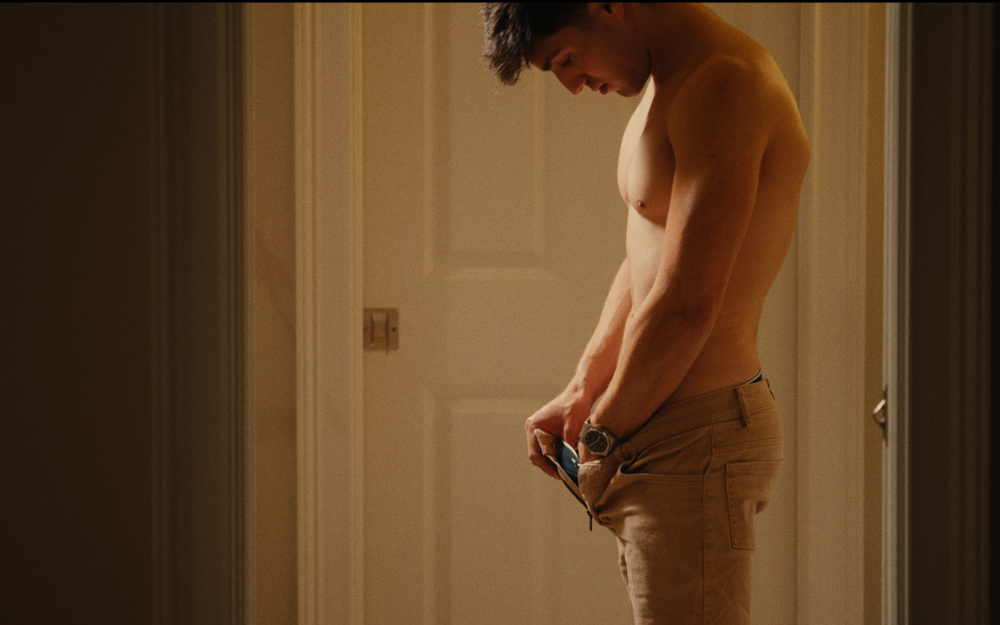

“Not really too much men can do to change about themselves,” Ruben says in “Manhood,” shown to be lifting weights in a gym to not much avail, describing himself as “tending to not feel as big as I am” when he does have cut the figure of a gentle giant with considerable presence but rather soft-spoken. On those terms, it’s no wonder that he seeks out the services of Dr. Bill Moore, a physician who pioneered a nonsurgical penis enlargement procedure known as PhalloFILL out of Dallas where injections of hyaluronic acid are expected to add girth but can likely yield more confidence when few others are going to see the end result except the patient.
Yet there are questions abound in Daniel Lombroso’s playful and provocative look at a present-day masculinity crisis through the recently surging male enhancement industry, positioning men like Ruben squarely within the audience of manosphere podcasts like Tom Segura and Joe Rogan where advertisements and general chatter can routinely make men feel as if they’re somehow lacking and while pills and more extreme measures such as Dr. Moore’s practice can offer a quick fix, the whole business raises deeper issues. Lombroso, who fearlessly thrust himself into the underground of the alt-right movement as it was making its way above during the first Trump Administration in his feature debut “White Noise,” again brings to the surface some incredibly unsettling undercurrents in American society as he sets up shop in Dr. Moore’s strip mall office in Dallas, yet it is inevitably as amusing as it can be shocking watching men from all walks of life undergo the cosmetic procedure as well as learn more about the flamboyant physician behind it, having done a complete 180° from a closeted youth in the South to living out loud in the present with flashy cars and a penchant for threesomes.
If Dr. Moore can sell himself as a model for confidence, the price can still appear steep for others when Ruben is willing to upend the modest life he leads with a family of five by spending thousands of dollars per injection that surely could go elsewhere and Lombroso also comes to meet David, a young man from Miami whose boyish good looks led him into the adult industry, but after feeling inadequate compared to other men he worked with, he endured a botched procedure that he goes to Dr. Moore to fix, though any efforts to improve looks like it’ll come at a cost. As absurd as this pumped-up world that all occupy can appear, Lombroso brilliantly depicts the reality that there are few spaces for men to actually air out the anxieties they have with plenty of self-interested actors willing to fill the void and while being a tremendously entertaining dive into potentially lurid subject matter, “Manhood” leads by example when suggesting it should be taken more seriously.
After first turning heads at its SXSW premiere earlier this year, the film is now starting its theatrical run in New York and Los Angeles and Lombroso graciously took the time to talk about how the film expands on his previous body of work, conscientiously filming in such sensitive situations and how he was willing to take the production down to its last dime to get the film to be in the best shape possible.
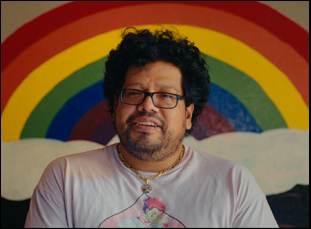 How did this all come about?
I’m interested in the fringe and the wild and the weird and the political extreme and disaffected men and I had done that in more serious journalistic avenues like white nationalism or southern baptism, all types of extremism. But I started reading about the the male loneliness epidemic about three-and-a-half years ago. It felt almost like a cliche, there were so many New York Times headlines. The alt-right was a little bit easier to conceptualize, like they’re marching in Charlottesville with the dumb tiki torches, but [I thought] how do you show male loneliness? It’s tricky and around that time, I read about penile enhancement and how it was getting so popular. So I had this crazy premise — and I didn’t think it would work, I’ll be honest, [but I thought] what if these men, while they’re getting enlarged, will talk about their feelings?
I called all these practitioners and they [said], “You can interview me, but [it was] very limited access. And then I met Bill and he [said], “Come on down. Anything you want to ask me?” And when you meet a doc subject like that, it’s always like a question mark in an interesting way. You [think], “This is going to be a fun adventure.” And then at his clinic, I immediately started introducing myself to patients. I was very careful not to be too pushy. I would just leave the camera in the side room and I met like a mega church pastor getting his penis enlarged and a border patrol agent and Ruben, a father of five [who ultimately became one of the film’s main subjects]. Once I started meeting those guys, I [thought], this is just an incredible story that I haven’t seen before.
One of my favorite scenes in the film is when Ruben has to explain in the club he’s in why there’s cameras following him around and he says to someone, “It’s a documentary about penile enlargement, but it’s really about mental health.” Was that actually the pitch you were making to people?
Yes, I am so grateful when that happens [in the film] because people have this assumption. You always wonder if people get that it’s a piece of journalism or that you’re not the friend [of the subject] and you have to remind them. I’d be like, “Bill, I just want to remind you, I’m not your friend,” and they did get it. And like when Ruben had that moment, I was like, “Oh, he really does get what I’m trying to do here. I really admire that about about him. And now because of Lance [Oppenheim] and Nathan [Fielder] and that incredible film [“You Can See Everything”], everyone is talking about the craft of being a documentarian, and many use elements of deception. I don’t. I have always believed In taking the front door, I will always remember the first call with Bill [where I said], “You speak so openly about yourself at the end of the film, you hear [how] someone called him “a little dick motherfucker” [when he was a kid] and he started doing all sorts of enhancements, and I’d never heard someone speak this openly. What would it mean if a film [in general] speaks that openly? I want to help start that conversation. That’s exactly what the movie was designed to do. It’s not easy to talk that openly.
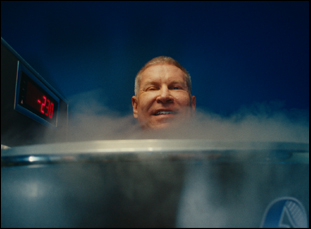 Did making “White Noise” before this actually help you facilitate those conversations? I’d imagine there was a lot of carryover in terms of how your subjects felt about being so open.
I feel like I’ve become a better filmmaker since. At that time, I was in the world of journalism and Jeff Goldberg at The Atlantic said, “Kid, you have crazy access,” and I’d take a camera in a tiny backpack and I would just follow them around. And now I’m starting to learn the tools, so the themes are the same, but I started to think about like what does it look and feel like and how should it be shot and scored?
At an interpersonal level, I knew how to talk to those guys because It’s coming from a place of… I wouldn’t say understanding, but open-mindedness. The main ding on “White Noise, which I still stand by, was trying to understand the psychology of these people, not to condone it. And I love that filmmaking like when you watch a great Errol Morris movie, he is not telling you how to feel at all. It’s up to you. And I think we live in a more heavy-handed cultural space now. On social media, it’s like “These are five things you need to know about why Trump is an evil person.” We’re used to that kind of messaging and it’s really confusing when like a movie comes around that doesn’t tell you exactly how to feel. With “White Noise,” I did that. And I tried to do that [with “Manhood” where] I made a very intentional choice not to be pro- or anti-penis enlargement and the way I was able to get that access was because I brought that openness to the way I spoke to people. Of course, they’re not beyond criticism. There’s many indictments in the movie. Like Ruben loses his home and Bill is making millions of dollars and sleeps with a patient. That’s just what happened in front of my camera.
What was it like figuring out a camera style that would be equally nonjudgmental, but take into account a certain amount of discretion given the subject matter and also the inherent absurdity?
I never thought that I’d tell my dad I’m going to go film 35 penis enlargements in Texas. It’s something I had to be in the space to understand. It’s a very small room. I wish we could have l the high-budget Netflix version that’s kind of a reality show [where we] would have built a set and gaffed it with lights. We had to use the real environment. They were doing the enlargement [procedure] and i’d be like, “Sorry, can I move my tripod? and Bill would pull his syringe back and move the tripod some times. There’s a bell lake one investor we spoke to [who said], “Oh my daughter goes to ballet adjacent to [this office]. We didn’t even know, but you could hear kids doing ballet behind the flimsy walls. All of that took was like the New Hollywood guys in the ’60s when they got off the sets and were just like, “Fuck it, let’s shoot on the Lower East Side.” There’s something to the texture of the space that I wish we had control and could have lit and gaffed, but [what was there] was so weird and has this futurism vibe [with] all the red light machines, so it was really about embracing the absurdity of where we were and then juxtaposing that with the real loneliness and emotions of these men at their most empty moments.
As you mentioned, Bill was the start of this, but you go to conventions, you meet a whole lot of doctors. Did you know what the focus would be from the start?
Yeah, I think I always knew Bill is a vehicle for understanding this political and social moment, which is the surging popularity of cosmetics. He’s a fascinating character, both visually and intellectually, but the part that I knew would be the hardest to do, but also would make it special, was getting real patient arcs. And when I started, you always are going to be a little bit nervous going into a verite film, [thinking] there’s no way these patients will let me film them. At first, it was like just nose down or anonymized and you get those guys as like a Greek chorus in the movie. I love those interviews. But the more days I spent, I would meet more people who were like, “You want to come home and meet my family?” And I’d say yes, and Ruben, I pulled him into a side room and [said], “I know this sounds crazy. You’re a comedian, you seem very open. Could I come meet your wife?” And I’m the opposite of a reality TV producer. Although I have my editorial distance, I also want to remember my newsroom training and make sure everyone understand what that means. So I’m like, “You’ll be in a film, your wife will be your kids will be in a film. Are you sure?” And he’s like, “It’s totally fine.” That’s why he has that moment at the bar [you mentioned earlier]. There is something to admire in his open-mindedness and he really believed that he could help create space for other men by talking the way he did in the film.
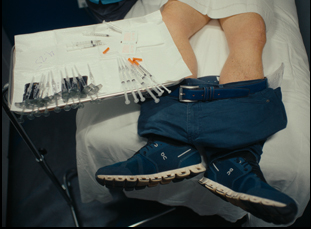 From what I understand, David originally was going to remain anonymous after production of the film wrapped, but he changed his mind. What was it like reconfiguring the film around a decision like that?
The level of stress, anxiety and insomnia I got when you’re spending years on a topic and something like this mounts over time. I’d say eight months in, I start to realize that David is really the heartbeat of the film. Here is this queer OnlyFans star, so sweet and good looking and a nice guy who made a decision that literally ruined his life. His penis was unrecognizable, as people say in the film [after his procedure]. So at that stage, of course he’s going to be like, “I don’t want my face in this movie.” So I had to agree. I didn’t want to push him. But we always held out hope maybe he’d come around. And it was a very slow evolution. We never really figured out what the solution would be [if he wished to remain anonymous], but we thought maybe it’s blurred and if the movie’s about shame, people will accept it. But my producer Kerry [Mack], and Randy [Barbaro] and Fenton [Bailey], the [executive producers] at World of Wonder, was like, “Let’s keep trying.” Fenton was the one who [said], “The movie’s locked for South By, let’s just show David.” I’d never done that, and we had literally $420 left for the movie and the the cost of the flight was like $280 — we took him to one dinner and we didn’t say, “It can’t be more than $100…” but we showed him the movie and he loved it. He cried and called his family and decided to be in the film. He’s in a much better place now. He’s done with all that and he’s working in a hospital. He’s really proud of the movie. We did a night at IFC with him. It’s been awesome.
That’s so great to hear. Was there any dimension to the story that grew as you worked on it or perhaps as a whole take a direction you didn’t expect?
I expected the deep feeling of hopelessness, like these guys who are choosing this are choosing it for a reason. I expected all the humanity and also all the humor and there’s a lot of obvious unexpected things, like every age man is doing this. There’s young men, there’s old men, mostly straight men, and some queer men — about two-thirds of the patients in my anecdotal experience are straight. But the most unexpected thing, I hate to put it this way, is how preoccupied people are with their penis. I know that’s so strange after having spent years on this. It’s just not something I think about and I’m sure if I had a partner who said something, I would. There’s many reasons that I’m privileged —I’ve had a good job and a good career. But whatever issues I have in my life, I could not imagine a reality where I would wake up and believe that the root problem is my penis. But for a lot of men it goes beyond obsession. They come to believe Bill, and Bill believes that a bigger dick fixed his problems along with all his other work and he wants to help like a televangelist. He wants to help other people feel that way. So it surprised me how much people could be seduced by that. I get it. Life is hard and life is complicated and if only the answer was joining a white nationalist movement or getting a bigger dick, it would be so much easier. But life is confusing and hard and that’s what I try to lean into.
“Manhood” opens on October 28th in Los Angeles at the Laemmle NoHo 7 and October 30th in New York at the Village East. A full list of screenings and dates is here.