


Sky Hopkina has steadily built a reputation for taking audiences where they’ve never been before – or at least seeing them in a way they never have — with his shimmering debut feature “malni: towards the ocean, towards the shore” in which he found the afterlife right here on earth amidst the wilderness of the Pacific Northwest and served as another revival of sorts when he’s so deftly employed visual language to carry on another beautiful vernacular, the tongue of Chinook Wawa, which could’ve easily faded away as the region was colonized and at one point this century, said to only have one fluent speaker, yet “malni” and shorts “Wawa,” “Anti-Objects, or Space without Path or Boundary” and “Fainting Spells” have all kept it going. If he’s created a transcendent space in all his work, it’s no wonder that he has long had the itch to bring a powwow to the screen.
“When I very first started making films, it was one of the things that I actually wrote a very early treatment on, so it’s long been in my mind because I’ve always felt like these are really cinematic spaces,” says Hopkina of his second feature, “Powwow People,” which returns the director to Washington state where he first came of age to bear witness to an event that had ignited so much within him.
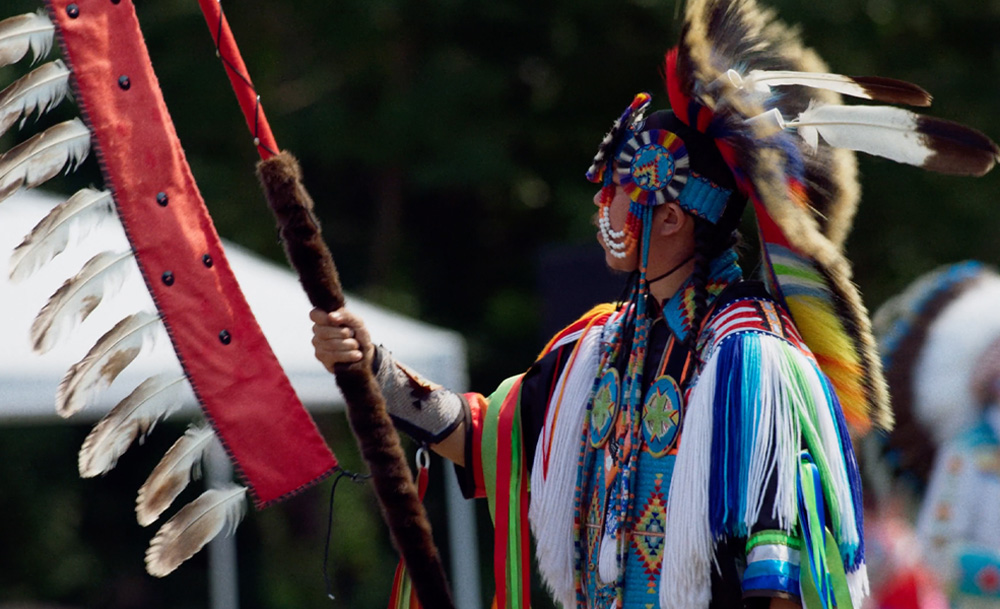
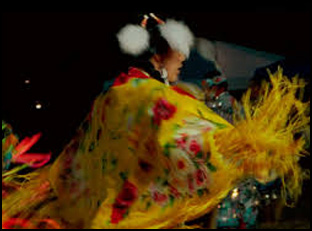
Although the director didn’t stumble onto a naturally occurring powwow, instead plotting one out in advance with Gina Bluebird, with whom he had previously coordinated the cultural ceremony a few other times before, peeking in on the event in Daybreak Star in Seattle has the kind of magic about it that can’t be planned for as it brings together generations of Native Americans in celebration. The movement at the center of the esplanade of the Daybreak Star Cultural Center can be enthralling as a swirl of dancers and drummers joyously make their way to the middle to add their individual flair to traditional standards as a glimpse of what the world might’ve looked like centuries earlier can be enjoyed as vendors are arranged on the outside perimeter, not only forming a place to pick up snacks and other commemorative items but also a sense of community as it is less a place of commerce than communion. But equally enchanting as the action — all amusingly described by Ruben Little Head, a dryly funny emcee — is the shift you can see the eyes of the young who may be too young to participate but recognize their place in a legacy besides being eager to bang on a drum.
In Gina, Jamie John, a two-spirited twentysomething who brings plenty of energy to performing at the powwow, and Freddie Kozad, whose family has been a staple at powwows for decades and whose health prevents him from participating yet truly is at the ceremony in spirit (a feeling that Hopkina respects by having his voice laced throughout the film), the film may not leave the premises of the powwow over the course of a day, but it presents an entire breadth of experience as it spans generations and reaches ecstatic heights. Moviegoers in Los Angeles have the opportunity this week to be treated to all of Hopkina’s work on the big screen as the director comes to town not only with a special screening of “Powwow People” at Vidiots on October 12th as part of a national tour, but presentations at the Los Feliz 3 of his shorts on October 11th and “malni” on October 13th, all with the filmmaker in person and before the multidisciplinary artist makes his way to town, he graciously took the time to talk about how he could bring the infectious energy of a powwow to the screen, working with a cinematographer besides himself for the first time in another noted filmmaker Shandiin Tome (“Long Line of Ladies”) and what it felt like to reach the end of long days of filming.
 I know you have roots in Washington State where this was filmed. Did you know the community there that was coming to this?
There’s definitely new community members because I haven’t lived in the Northwest since my twenties, so there were some people that I knew and some that I had never met before. But the Daybreak Star Indian Cultural Center has a summer powwow every year, and I grew up going to that powwow and dancing there, so it was a place that I was familiar with and there were dancers that knew me when I was a baby, and they know my mom and dad. So it was a nice mix of people of people that I’ve known and new friends that I’ve made that are really integral parts of the community.
What was it like to get this off the ground?
I definitely skewed more towards let’s just run a powwow because I feel it was the most authentic way to film the event because we didn’t want to stage scenes. We didn’t want to try to make people into actors, so it just became the clear choice to run the powwow like a powwow and to film it with a small crew.
This is my first time working with another camera person, let alone a [director of photography]. Shandiin Tome was the first person that I thought of [since] I’d known her for about 10 years now and I’m a big fan of her work. She’s just a really wonderful human being and she’s also someone that knows powwows too. So it was just trusting her to shoot what she wanted to shoot and I would do the same. We’d definitely be in conversation and sometimes we’d split between handheld [camera] and being on sticks or try different things out for each different session. But ultimately it was just try to have fun with it.
As the organizer of the event, I imagine Gina was a pretty obvious person to follow throughout this, but how’d Jamie and Freddie become central to this?
Jamie was the first person that I talked to actually because Adam Piron, one of the producers of the film, and I were brainstorming just some dancers, drummers, and powwow people we could talk to. I was looking for a young dancer, just living the ways and making their way in the world and Adam mentioned that he knew Jamie because they had participated in one of the Sundance Indigenous labs. We had a phone call and I was just really taken with the way that Jamie talks about their life, their journey as well as their thoughts around powwows and powwow culture so forward-looking and thinking about the questions of how does this thing continue to live and also the questions that are important about tradition – the things you hold on to, but also the things that you let go, which is I think really important for the survival of any culture and community.
Then I was planning on shooting Freddie, Jamie and Gina and Freddie was all set to come to the powwow, but he became ill a week or two before and his presence was definitely missed. But it just became really important to include his voice even though he wasn’t able to come just because of the structure of what all four of those people represent in terms of the film – the past, the present, the future, as well as just grounding in the powwow itself.
You also end up having a cameo from an Oscar-nominated filmmaker as well in Julian Brave Noisecat, who co-directed “Sugarcane.” How’d he end up in the mix?
The month before our powwow, in July of 2023, Adam Piron and John Cardellino, the producers, and I went to Daybreak Stars Powwow for Seafair Indian Days, just to check on the powwow grounds and chat with the people there. So we’re walking around and Julian comes up and introduces himself and we’re like, “Oh sweet, nice to meet you,” and we told him we were going to do the shoot and invited him, if he wanted to come dance. And he showed up. So it’s funny because I hadn’t met him before and it was later that fall when “Sugarcane” came out, so to meet Julian [before and think] he’s a great person and then just to see his success – his film and also his new book that came out recently – it’s just one of those really beautiful things about how small Indian country can be. It’s also great when you have amazing people and dancers showing up.
 Either because it was intense filming yourself or because Shandiin caught something you didn’t, was there anything you found after the fact that you were really excited to capture?
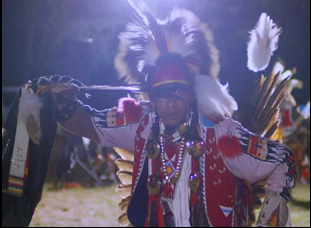
There’s so many things because Shandiin and I were splitting camera duties and there were quite a few things that I was just really happy to encounter. One of which was the grand entry shots. That and the dance competition, regardless of category, are two of the fundamental parts of a powwow that I really wanted to focus on for this film and the grand entry was the hardest to film because it’s just like, how do you film it? [The whole thing] was filmed over three days and there’s four sessions, so we had four different shots at filming the grand entry. It was the second day in the afternoon when Shandiin had filmed that grand entry [that’s in the film], which is a long take with pans and moves and sweeps and a lot of rack focusing. For me, that really captured what it feels like to be at a grand entry and you can actually see me in the background. I have a camera during that shoot too and was trying to move through the dancers, but that didn’t really turn out the way that I wanted it to. So it was just [Shandiin and I] talking to each other, trying different approaches to filming these different dances.
Then also some of the drum moments as well, [where I was] just hoping that the camera works with some of the intertribal stuff. It really was all those cutaways too. Shandiin had shot the one portrait of those two little boys on the bleachers drumming and when I came across that I [thought],”Oh my god, this is so perfect because it just really encapsulates being a kid at a powwow [because there’s] a lot of play in the bleachers, but also practicing powwow.
You film the final dance, which is a nearly half-hour-long unbroken take that must’ve required as much energy if not more than who you’re filming to capture. What was it like when you got it in the can?
That was fun and it was challenging. I just remember it was the last song and I think I was behind Ruben and then I moved into the dance floor and I just realized they’re spread out way too far. How do I film them? How do I get them in a two-shot or a one-shot? I need to move and catch up there. So all the things that I thought that I knew going into how to film this this dance were put into question because there’s so many things that are on the fly There’s a few different ways to run a dance special and I wasn’t quite sure how they were going to do it, but that was also part of the fun of it as well. It was definitely exhilarating and a little exhausting when I was done, but it was cool.
It’s such a rich film sonically as well. What was it like to get the audio mix right for this?
Dungeon Beach and Tim Korn really had an amazing hand in developing the sound design for this piece. Part of it too is there was a bunch of Foley that they had to do, because even the cutaways of kids or people getting ready, you could still hear like Ruben [the booming emcee] in the background or maybe some drums or music playing. So a lot of [care went into] trying to piece things together while still filling out the space and knowing when to use the onboard mics from the camera or from the PA system where we had a Zoom plugged into.
Also, [there was a question of] how do you create distance where Ruben’s voice might be totally clear in one section, but then also make them sound at a distance when you’re moving through the space yourself, like with the vendor sequence. That was really fun, sitting in on the sound design process because that was where the space really came alive and became its own world.
What’s it been like getting this out into the world and seeing people engage with it so far?
It’s been good. You never really know how people are going to respond to a film when you make it, especially one about a subject as ubiquitous for Native communities as powwows, but I feel like the biggest compliment I get when I show the film is that powwow people say it feels like being at a powwow. That’s what I was going for and my hope too, especially for non-Native people or people that don’t powwow or maybe have never been to one before, is they have a small experience of what it’s like to be there and encourages them to seek out powwows in their local community and to learn more. The film is by no means designed to teach you about the history or [capture] every little thing going on in it, but rather to give you a sense of the depth of this event and these different parts that make up all these different dances and all these different parts of the structure of it.
“Powwow People” will have a free special screening in Los Angeles at Vidiots on October 12th at 7:30 pm and a collection of Sky Hopkina shorts will play at the Los Feliz 3 on October 11th at 4 pm and “Malni – Towards the Ocean, Towards the Shore” will play at the Los Feliz 3 on October 13th at 7 pm.