



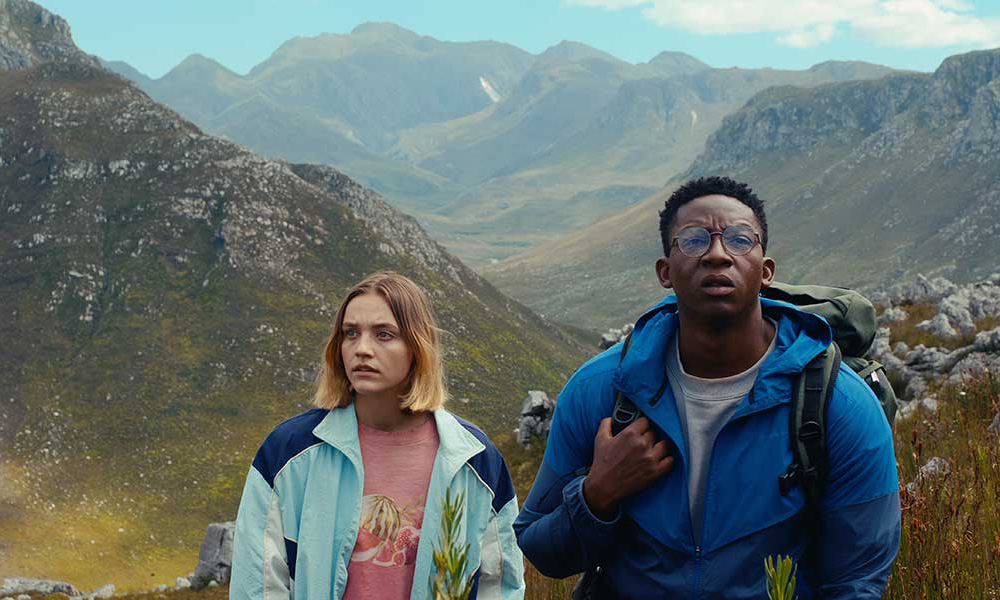

It can feel as if it isn’t just the characters in “Future Tense” that have outsmarted a larger system when writer/director Jenna Cato Bass pulls off the most inspired time-travel film since “Safety Not Guaranteed,” likely using as spartan a budget. Assuming audiences will accept an undeveloped piece of wilderness as 1647 if the story insists it is, the film imagines a world where modern luxury resorts have been set up across time as if it was a new form of real estate, offering guests wealthy enough to afford transtemporal transit a chance to enjoy a random day from another era as if it were a visit to Rome or Tokyo. Although Lwando (Lawrence Maleka) and Tara (Kristen Raath) don’t appear to have the kind of credit line for that, the pair from South Africa head back to the 17th century after winning a contest with the former having more than relaxation on his mind.
While the sci-fi conceit is convincing, the couple at its center isn’t exactly, though that’s partially a demand of the plot as Lwando and Tara only recently met speed dating and after a passionate night together have decided to go on this adventure together. While Tara seems like someone who does things on a whim, Lwando is far more quiet and calculating, making their match in the first place a bit unbelievable when their personalities don’t mesh at all, but he invites Tara to go with him when as a Black man, a white companion would ease him through the various security checks required by Platonia, the company that administers the time travel, and the tension between them is bound to rise when she’s expecting a vacation and he has to come clean about plans to rewrite history, finding at the particular juncture they’ve been sent to is the opportunity to turn away a ship of Dutch colonialists that would set the stage for racial subjugation.
Bass, who last impressed with playing on anxieties that have persisted since the end of apartheid in the horror film “Good Madam,” again comes up with a fiendishly clever premise for a genre picture that plays a lot bigger than the resources likely afforded to it and much like one of Mark Duplass’ high-concept forays with a mumble core, the chemistry between the two actors at its center drives the action. Makela and Raath have a healthy rapport that more than carries the day, though the two never come across as romantically inclined towards one another with increasingly unfortunate callbacks to a night of passion insisting that there was some amorous spark between them. Still, along with the strong performances, only a few ancient elephants and period-era ships are thrown in as part of the scenery to sell the idea Lwando and Tara are navigating a world several centuries before they were born and face daunting odds to survive it, let alone change it for the better. When the fantastical set-up so elegantly handled requires so little explanation, it leaves the room for the more provocative questions that Bass wants to raise as the pair actively engage in the hard conversations and demonstrate the cooperation to create the future they want to see regardless of whether the Butterfly Effect idea Lwando has works or not, with “Future Tense” unusually thrilling as much for its optimism as its action.
“Future Tense” will screen again at the Toronto Film Festival on September 16th at the TIFF Lightbox at 7 pm and September 19th at the Scotiabank at 8:50 pm.