



A pair of elephant tusks stands tall in the living room of the Erasmus family home in “The Smell of Apples,” a keepsake collected by its long-dead patriarch from an infamous revolt when black farmers were chased off their land by a group of White Afrikaaners. Johan (Hilton Pelser) and Leonor (Maude Sandham), who own the house now in Cape Town circa 1974, would like to think they’re raising their son Marnus (Dawian van der Westhuizen) in more enlightened times, though relics of a racist past remain all over the place when they feel compelled to acknowledge their heritage in some way when they have no other history and while they consider their maid Doreen (Celeste Matthews Wannenburgh) practically a member of the family, as well as her teenage son Neville (Courtlin Baron), she still works as a servant due to the color of her skin.
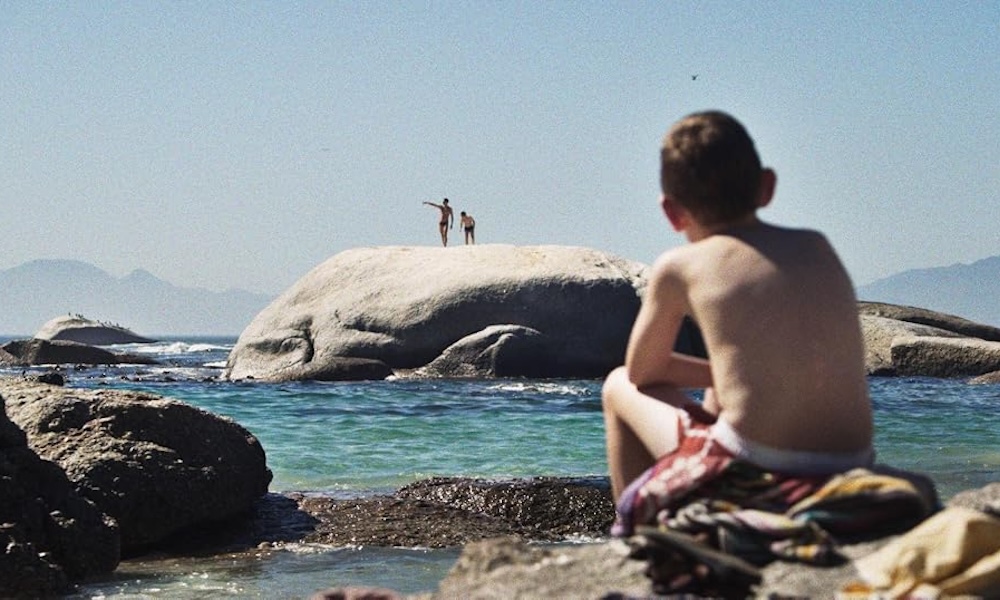
These are things that the prepubescent Marnus only starts to question in John Trengrove’s searing adaptation of Mark Behr’s award-winning novel, tracking the boy’s growing consciousness of the fraught world he was born into over the course of a summer that only grows more sweltering by the day. Trengrove, who fearlessly has never shied away from confrontational subject matter in films such as “The Wound” and the Jesse Eisenberg drama “Manodrome,” provocatively takes the view of a child whose beliefs are only just now forming as he spends carefree days by the sea with his best friend Frikkie (Wian Carstens) and comes back home where concerns start mounting as Johan invites over the mysterious Mr. Smith, his superior in the military, more and more after getting a promotion and grows suspicious of Neville, whose vaguely erratic behavior wouldn’t draw more attention than any other teen if he weren’t Black.
A camera that moves fluidly throughout the home yet often keeps a distance as situations mount that Marnus is only able to make sense of with the limited information he has as the youngest member of the family starts to reflect a fuller picture than what can be seen on screen as the legacy of apartheid clearly shapes the family in ways they’ve become unconscious of and it may be up to Marnus to break the cycle. Maturity may also lead him to see his father in a different light, a hero in his eyes at the beginning who may be potentially irredeemable by the end when he may be too corrupted by the system to overcome it. Trengrove delivers a staggering drama as Marnus loses his innocence and his perspective is changed forever, with the film likely yielding the same effect and as “The Smell of Apples” makes its premiere this week at the Toronto Film Festival, the director graciously took the time to talk about making a film that could stay with audiences as Behr’s 1993 novel remained with him, as well as sensitively articulating a shifting perspective through the camera and forging a family dynamic with the strong ensemble.
How’d you get interested in this?
This book has been a fixture in my life since I read it when I was 15 years old, and it was one of the first things that I encountered that articulated something that was so close to what I had felt growing up. I am an Afrikaner, a white South African, and my early childhood coincided with the last 10 years of apartheid, so [the book connected with this feeling] that before you’re really fully aware of the kind of system that you’re born into, you’re growing up in this world and bits of information reach you. The world is looks beautiful and well-maintained and good and right and yet there’s this underlying sense of dread and fear and paranoia. So when the opportunity came along to to adapt this novel, it felt like a very meaningful space to delve into and in a way it relates to my own conflicted feelings about my culture, my heritage and my mother tongue.
This is your first adaptation. Was it any different?
Yeah, you think it’d be easy because it’s already written and it’s already brilliant, so you just have to funnel it into a screenplay, but when you’re adapting something that you really care about, it’s actually quite a brutal process. You really have to tear it into pieces and then reassemble it and make some very difficult choices about what it is that you’re trying to do with the work. The novel has a lot going on in it and it’s driven by a first-person inner monologue, so that’s really something that you have to find a new language for and a new emotional engine. It was a laborious process, and I found myself rearranging a lot of elements, trying to make things work in an a different way in order to become more cinematic. But ultimately it was about it was about steering it towards this mood that permeated the novel that I wanted to get right. A lot of plot was changed in the service of honoring something bigger for me, which was an idea and a feeling.
It was interesting to see how this connected to ideas in your previous work, particularly about masculinity and a growing consciousness and after films about men at different ages, it was particularly interesting to see a boy at this age forming his perspective. Did it feel like an extension in any way?
This felt for me to me like a bit of a departure, a chance to dive into something else but there is this very potent father-son narrative and of course I think patriarchal systems and structures can’t be separated from an oppressive regime like apartheid. So there was this strand that felt very rich and familiar to me that I could follow into the story. But it’s interesting what you’re saying about these different ages. That certainly wasn’t a conscious choice, but “The Smell of Apples” for me is so much about what children are taught and asked to internalize in order to sustain a regime like apartheid or any kind of situation where one society or group of people dominate or exert power over another. You need a very sophisticated set of rules and a system for mind control and there’s something about the way in which these ideas are brought into the family home and instilled at such a young age that I really wanted to engage with. We kept saying “This is a children’s movie, but it’s not for children, and it was very important that we that myself and my producer Cait Pansegrouw made this rule that we really wanted to open this this process to our young actors for it and for this to be a meaningful process for them in spite of the very challenging subject matter.
What was it like to find the right cast for this?
I have such deep love and admiration for this cast and in terms of that process, it started with s very prolonged and broad search for Marnus, the lead actor, but also his friend Frikkie, his older sister Ilse, and young Neville, who’s Doreen’s grandson. We were looking for all of these kids simultaneously. And Cait, who was also the casting director on the film also cast my first film, “The Wound,” so we’d been through this epic search process. And it really is a numbers game. For every hundred kids that you put on tape, there’s going to be that one that has a certain spark, just an ability to let you in and to be able to see what they’re thinking and feeling, that was Dawian. The first video he sent in was him solving a Rubik’s Cube on camera in a minute and he was very young and very inexperienced at that time, so we continued looking, but I just knew it had to be him. He had something that was so intrinsic and felt so true to the character that I fell in love with him immediately. We also found Wian Carstens to play Frikkie, which was also a difficult role to cast and and one that required a lot of sensitivity and preparation before we shot.
From there, it was then a question of finding a father, and Hilton came along. He’s such a phenomenal actor and I have so much respect for the bravery of and the commitment of his performance. He just had this natural chemistry with Dawian, so that cemented that and from Hilton was actually a little bit younger than I imagined the character, but I started thinking, “well, what if what if these are young parents?” which would be fitting for the time and it would add a layer of pressure and and vulnerability to the cast, so then Maude Sandham was a great fit for Leonor [the mother] and someone who deserves a very special mention is Celeste Matthews Wannenburgh, who plays Doreen. She walked into her audition and said to me, “This role is mine” — and she had a good reason because her mother was a domestic worker for a white family in the 1970s in Cape Town, so she knew this role intimately. It felt like we were blessed with this cast. They just came together and once they were there, all of them in the room together, it was It was undeniable.
Once you get the actors there and you start seeing the dynamics with one another, did anything change about this in your mind?
Yeah, in lots of lots of big ways and small ways. For example, it’s Karoline Watson, who plays Ilse, she was not an actor at all and had no interest in acting. I actually we found her because we started looking at teenagers who play piano competitively or have some serious skill and it was by speaking to teachers and following that route that we came upon across her. And she just had something [where] it doesn’t matter that she’s not an actor, but there’s something about her intensity, her seriousness and her intelligence that just felt right. The character wasn’t written like that, but I thought this girl is so interesting that I just want to shape and adjust to be able to bring her in. Then the ages of the parents is another thing where it was the actors who really bring something in and then you go with it. With the kids, the friendship between between Dawian and Wian, you just had to look at the their real dynamic and draw from that [for their characters]. It makes no sense to tell kids to play a character that’s not themselves. You just want to make it okay for them to follow their instincts and be spontaneous. That’s when the magic happens, you know.
The camera has a real personality to it, like a curiosity in terms of how it moves. What was it like figuring out perspective on this?
Lennert Hillege, a fantastic cinematographer, and I had long conversations about exactly that, the placement of the camera and the perspective. We wanted to create tension by maintaining a slight observational gaze and to not be too immersed in situations, [where] there would be this slightly ominous, sinister observational camera. We half-jokingly developed this idea of Opah’s ghost, the deceased grandfather who’s referenced in the story [being] a ghost in the house, [with the camera] creeping around and catching fragments of things going on and missing other things, spying through windows and doors. There’s a lot of those kinds of shots in the film. Ultimately, what we didn’t want the audience was to get seduced in a children’s movie with a subject matter that’s quite loaded and and provocative, [we wanted] to keep a critical distance and not to get sucked in by the emotion and the childlike story of [this], but to keep watching and keep thinking about what’s happening on screen.
There’s an almost an element of thriller in the film, even though the story doesn’t lend itself to that genre, but the way in which we approached it and thought about it was always about like how do we how do we hold that tension? Even when there’s something banal happening — a boy showing his father a report card — the camera is just telling us, keep watching and keep thinking. Don’t get too comfortable.
Was this all shot in an actual house for the family?
It is, and it was quite complicated to secure it. We could either do a kind of Frankenstein and shoot in lots of different locations and build some sets and or we could just go all in and invest in one location and [deal with] its limitations. It was actually quite a small space. It doesn’t always look like it, but there wasn’t a tremendous amount of room to move around, but I think it has a real presence because it’s one room to the next. There’s a a personality and a feeling that is maintained just from shooting on location. Our production designer was also just a dream to work with. She is Afrikaans and was in Cape Town in the 1970s, so she knew the world intimately, and think all of that really comes through. It’s a very typical Afrikaner home that you see in that film.
What’s it like to get to this point with the film?
It’s so exciting and it’s such a long road that you walk, so it just feels great to be heading to Canada with our cast and crew to celebrate this this movie that we made. It’s going to be a real treat and you can’t you can’t control how an audience is going to receive a film, but we’re going with a lot of pride, excitement and joy in what we did. It’ll be special.
“The Smell of Apples” will screen again at the Toronto Film Festival at the Scotiabank on September 12th at 6 pm and September 18th at 11:45 am.