



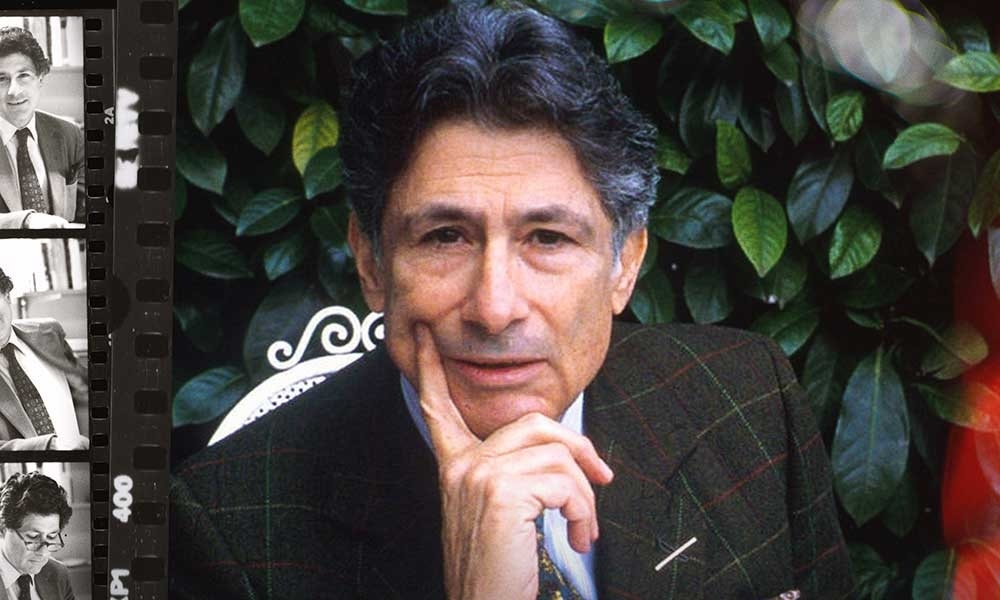

“I realized I had to make myself over again for what the system required,” Edward Said says in “Edward Said: Between Worlds” when in his teens he was sent off to the Mount Hermon School for Boys in Massachusetts after much of his family had already resettled in Beirut following the Nabka in 1948 that led Palestinians to flee Jerusalem as the State of Israel was born. He recalls in America, a country he never imagined that he’d find himself but would spend much of his life, he could identify a national history that wasn’t being taught as classes would cover the time of slavery and Native Americans in brief, leaving him to wonder what legacy Palestinians would have when an erasure in the Middle East was likely to take place as much in text books as on the ground. Teased mercilessly in school for his unusual last name, he would become accustomed to defending himself, an ability that ultimately he extended to the entire ethnicity he represented as an erudite academic whose initial focus on English literature made him a great elocutionist of conflicts in the Middle East for the Western world.
Because of that, it is no surprise that director Maiken Baird draws the narration for the all-archival documentary directly from interviews Said gave before his passing in 2003 when no one could articulate the barriers to peace in the region better, and sadly that his words continue to have as much currency as they did when he first began speaking out about Palestine during the 1960s. When Said’s life covered a time of prosperity in Palestine from 1930s through the start of the 21st century when Palestinians and Israelis were at least engaged in talks over the fate of the West Bank even if a détente seemed unlikely, the film offers the kind of historical context to the ongoing war that gave the scholar such insight into a situation that was happening a world away, but also brisk and energetic with a buoyant score supplied by Kareem Roustom, it takes on his engaging personality as he makes sense of a conflict that persists beyond reason.
It’s emblematic of what’s to come when Baird opens the film with footage from Said’s childhood that tells a far larger story when his father had both a passion and the wealth to own a film camera to make home movies, capturing not only Said as a young boy, who describes the footage as “boring” when he was always running towards the camera, but crucially in the background what Palestine looked like before entire communities were displaced. It is hard to fathom that 50 years later, Palestinians would be grouped together and dismissed as terrorists internationally when seeing such a vibrant, refined society at the start of Said’s life and the film arguably is more a biography of 20th century Palestine as it is Said, whose personal milestones are only really touched on in relation to his political awakening. Radicalized in a sense by the Six-Day War in 1967 after he imagined that he’d strictly be teaching comparative lit at Columbia for the rest of his days before it was no longer tenable not to speak out, he became a regular presence on political talk shows where he could be depended upon to be a voice for Palestinians with the credibility afforded to him by his university position, but simultaneously well aware he was playing into the mainstream media’s need for a dissenting opinion to help bolster a predominant narrative.
When Said was constantly spoken over on panel discussions, there is something powerful about giving him the entirety of the floor with an editing team of Jay Arthur Sterrenberg, Plummy Tucker and R.A. Fedde weaving together interviews that allow one to trace the line of thought that led to his landmark book “Orientalism,” in which he spoke to the idea of a culture being defined those outside of it, and to ultimately oppose longtime ally Yasser Arafat as the PLO leader entered the Oslo Accords in 1993 to secure a peace deal, rooted both in pragmatism and personal experience. While these views were often controversial and the approach Baird takes could be seen as limiting when it prevents any other perspective from making it on screen, audiences are spared the usual interviews celebrating a subject’s genius as well and as Said says at one point, an intellectual’s responsibility is to provoke, it’s remarkable to find that he can still get a rise out of people when his ideas remain so strong and relevant. Despite having just one central voice, “Between Worlds” fosters a real conversation between both the past and present and between Said and those who either want to debate him or learn from him, becoming the start of a dialogue rather than the end of one.
“Edward Said: Between Worlds” will screen again at the Toronto Film Festival at the Scotiabank Theatre on September 13th at 8:50 pm and September 20th at 1:15 pm.