



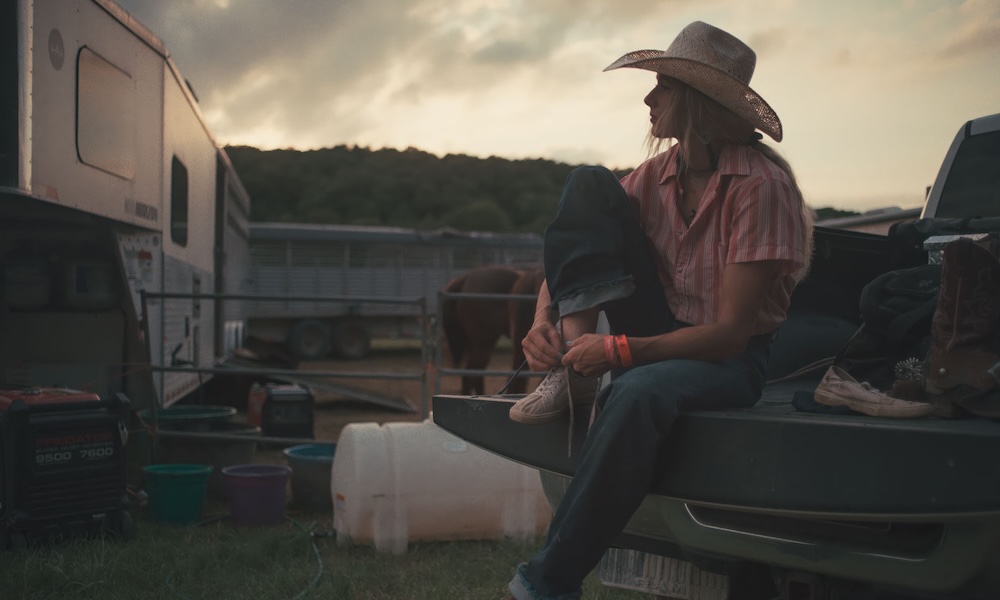

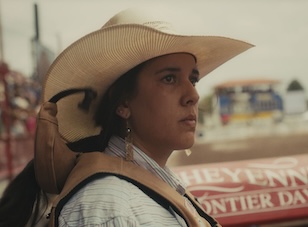
Cheyenne Frontier Days is routinely called “the daddy of them all,” a 125-year-old rodeo that regularly attracts 20,000 people to Wyoming for an event that is over in a matter of seconds, but as Taimi Arvidson depicts in her riveting documentary that takes its title from the sport’s world championship, it takes decades to compete at a high level. Yet for much of that history, women had been excluded from saddling up despite having great interest in the sport, with an early acceptance of the fairer sex as competitors phased out when someone tragically died, though that never stopped the men from carrying on with bucking broncs. A new effort to allow women into the field called the Women’s Ranch Bronc Championships, spearheaded by Daryl and Michele McElroy aimed to change that in 2016, legitimizing what had been practiced regionally as an amateur sport and as Arvidson chronicles over the course of a year in her second feature, there may be reason to think Cheyenne soon could be called “the mother of them all” to go by the talent on hand.
From the Utopia Rodeo in Texas to the Black Hills Roundup, “Cheyenne” charts the ups and downs of four fierce competitors both on wild horses and off of them as they all seem drawn to the sport for an ability to take control over a situation with their skill that seems to generally elude them in their daily lives. Arvidson captures thrilling rodeo footage, but affords a sense of awe to how the quartet handles themselves in a variety of tough circumstances, whether it’s Lake ‘iolani Stevens-Ram, a Hawaiian who enjoys the distraction of competing as she mourns her late mother, or Bee, a single mother from Wyoming who strives to be a portrait of strength for her young son to emulate, though in doing so she worries she is one bad fall away from leaving him without a guardian. The two are joined by two relative newcomers to the women’s circuit in Brooke Offi, a bright-eyed young Texan who learns quickly that the potential for injury is no joke, and Allysa “Ally” Spierings, a skilled who’s primarily only competed against men and hopes the prize money could help her pay to fix for a broken horse trailer. They all have eyes on Cheyenne to prove themselves, but also women’s place in the sport in general when some are skeptical and others simply fear for the worse in terms of safety, though as Lake says convincingly after one successful ride, “We’re rockstars. We don’t feel pain” to a young girl who clearly takes the inspiration to heart.
Not only do the women in “Cheyenne” revive opportunities for their gender, but renew interest in the staple of the Old West as a whole and Arvidson, who has directed for the episodic series “Home” and “The Invisible Shield,” captures the adrenaline rush that must be felt by riders that enter the chute and hang on for dear life. With the film making its premiere this week at the Toronto Film Festival, the filmmaker along with Spierings and ‘iolani Stevens-Ram generously took some time out to talk about the documentary, being part of a grand tradition and the responsibility to carry it forward and the power of persistence.
 How’d you get interested in all this?
Taimi Arvidson: I grew up in Oregon, and rodeo was something that was very common and I was familiar with. But I actually came across an article that said women were not only riding bucking horses, and I had gone to rodeos and only seen women do timed events, I’d never seen them on broncs or bulls. That was really special to me and interesting. But then as part of that, I also learned that women had actually ridden bucking horses from the beginning of rodeo history in the late 1800s/early 1900s, so it felt like “This is a really special moment in sports history, not only rodeo history. This is one of the last sports women don’t do. So that’s what drew me in. I [thought], “This incredible moment in history is happening and I want to capture it.”
What I read was that there was a basically a professional sports league, the Women’s Ranch Bronc Championship where all of these women were gathering and competing in a women’s only circuit. So I approached the circuit first and I said, “I’d really, really love to film this” and they granted me access. The first person I spoke to was actually Lake and I gradually just met all of the women through that.
Did you actually spend some time on the circuit before jumping in or did you just hit the road with a camera?
Taimi Arvidson: I probably did what no filmmaker should do. I just filmed it all myself and paid for it all myself, so that was crazy. When I started, I [thought], “Okay, maybe I’ll get some tape. Maybe we won’t film this year, but we’ll film the next year. And I’ll see if anybody will commission it.” But then when I started it, I [realized], “It’s this incredible moment in sports history. This first world championship is happening now. But also all of these [women] were so incredible. They may not have been there the next year.” So I [thought], this is the season we have to film. I did truly like max out every credit card to just keep filming and gradually [thinking], “Can we even get to to the next place?” And then having my credit cards bounce. It was just really living on dreams and loving the story so much that, there really wasn’t any plan other than “This story is incredible, it’s magic, and we need to film it and somehow just get there.
Ally Spierings: We filmed so much. We filmed so many different aspects of all of the girls’ lives. And a lot of us didn’t truly know the direction that this film was going to take, just because there were so many different goals or focuses that could have been had. But I think that timing did a really, really amazing job of [having] the film speak for itself in a way.
Lake, when you know you have camera on you, was there anything that was important to you to get across about the sport or yourself?
Lake ‘iolani Stevens-Ram: I think a lot of it was just capturing us in our natural state. We were all there for Cheyenne and we’ve all had Cheyenne at heart and in our heads and that’s what has been leading us through the tunnel, so we’re like, “If you want to follow that’s great, but we’ll be getting ready to get on a horse.” And they’d be trying to mic us and a lot of us were like, “No, we need to get on this bronc.” So at times, it was challenging to help Taimi get her vision and other times We were so grateful all those cameras were there because we’re studying the footage, we’re studying the ride, and we’d have an extra camera on us to watch us conquer this one horse that we’ve been wanting to ride for a while. So it was challenging, but I think in the end we’re all really happy that we found a way to make it work.
Taimi, what was it like filming at a rodeo where you’ve got to literally cover so much ground?
Taimi Anderson: I learned a lot about that as I went along. Everything happens at once simultaneously. It’s really hard, [especially] if you’re an independent filmmaker. It’s not like I could roll in with multiple camera units. And it was so stressful because even with three or four camera units, I would [think], “There’s people coming out of the arena and they’re having this emotional reaction, but there’s someone getting on a horse right now, and we just don’t have enough cameras for this.” It is eight seconds and Cheyenne itself as an event is probably six or seven minutes total, which is so hard. Anyone that came out to shoot did it for free. They were really good friends of mine that just cared a lot about it, and we just made it work. But definitely like early on [I realized] we need so many cameras all the time to do this.” And now, I did a women’s race car series last year and they were like, “It’s really fast [as an event]. It’s going to be very stressful” and I [asked], “Well, how long is this race? and they [said] “45 minutes.” And I said, “As long as it’s not eight seconds. I’m good. That’s a lifetime.”
Lake and Ally, when two of you see the film and see your lives in context like this, does it help you figure anything out?
Ally Spierings: I think there’s a lot of maybe secondhand embarrassment. There’s been a lot of growth that’s happened. I think everybody’s had that takeaway, like, “Oh my goodness, I don’t think I’d want to be friends with her if I was still her, like if I met who I was four or five years ago. I don’t think I’d want to be friends with that woman.
Lake ‘iolani Stevens-Ram: It was really nice to get to see what everybody else was going through because at the time, we were consumed in our own battles at the moment, and a lot of us didn’t realize that the other one was struggling as bad as they were because we were all really just trying our best to be there. So it’s really a relief that we all came out at the other end with the light at the tunnel and to still have the sisterhood and then to rewatch all those highs and lows together as who we are now, as Ally was saying, a little more developed, a little more mature.
But that’s the beauty of seeing it unfold on film too is we have had to have a lot of grace for what we went through back then because of our struggles that were leading us at the time. It is a big emotional roller coaster, but there are so many different angles that you could take away from it and I think it applies to a very broad spectrum of the audience that anyone can really relate to, whether it’s Ally’s story, my story, Brooke or even Bee’s story of being a parent and really just wanting to succeed for your child, no matter what that looks like in life whether it’s rodeo, your job or making a comfortable home. So I think Taimi and the team did a really good job making it applicable to almost anybody. They don’t even have to know horses or know that there is a challenge. Everyone’s going through a challenge and [this shows] to have grace with your challenges.
One of the moving things about where this movie leaves things off is seeing that there’s a generational cycle with this and Ally, you’re shown in particular, encouraging the next generation to come up. How actively do you think about that?
Ally Spierings: I am still teaching schools and I actually have teamed up with the Australian [WRBC] director, so I fly internationally to help girls get on their first bucking horses. If this is what lights their soul on fire and they want to do it, I want to provide a safe space for them to learn because when I first got into riding broncs, I was flying by the seat pants. I didn’t know my head from the hole in the ground and I look back at all of that and I think “What was I doing? I should not be able to walk right now.” And if I can help this one girl not have a baptism by fire into the sport [like that] and if I can prevent those preventable injuries from happening, I’ve succeeded.
I feel like there’s a lot of weight that gets put on the veteran girls in the sport as far as trying to help because we see ourselves in the younger generation and understand how hard it was. And now we have an ability to look back on it with the developed prefrontal cortex – or maybe on its way at least – we’d do a lot of things a lot different. That responsibility for the veteran girls is very heavy because you feel responsible for somebody else’s life. Every time you crawl in, you’re nodding your head to a life or death situation and knowing that somebody might be looking up to you, trying to mimic what you’re doing without the knowledge on how to stay safe while doing it, it can sit pretty heavy on you. That’s why the WRBC has been so diligent in making sure that there’s an opportunity for women to come to a three-day school and at least have access to gear and to safety equipment and [provide] knowledge. We give them the options and the information to [decide], “Hey, this is just an option. Pick your poison.”
Lake, you make a decision to step away from the sport. Was it a clean break or are you staying active?
Lake ‘iolani Stevens-Ram: It was. I may not have gotten the saddle or the buckle [of winning the rodeo], but just to be on that stage and really applying yourself the best you could [was meaningful]. At the end of the day, it’s luck of the draw of what horse you get that day and we were just fortunate to get the horses that we did and get to dance the dance. It brought a lot of peace to what I was going through in life and opened my eyes that I wanted to focus my heart and passion more into the roping side of the rodeo world, so that’s what I’ve been doing lately. I get to teach roping to a lot of other people in the community and I’m really glad that out of everyone, Ally’s the one teaching the next generation because the rest of the women and I that year talked about this a lot – Ally had the best grace and style of riding and a lot of us were just muscling our way through it, so for her to go on and be the coach, we couldn’t have picked a better person to represent what we did and what we all went through to really hold the hand for the next generation. So there’s a lot of peace in my departure with that. I’m still friends with all the girls and I’m really grateful for the experience.
Taimi, what’s it been like to get the film to this point?
Taimi Arvidson: It’s really a dream come true. I walked in just to do the tech check yesterday at the empty theater and I started crying. I have never been at a festival like this and with a film of your own, it is really, really such an honor, so we’re so grateful to TIFF and Thom Powers and Lauren Clark, who’s a cowgirl herself. It really does feel like a once in a lifetime opportunity.
And since so many people who are at this festival or who might read your publication are filmmakers, just what it means to be here, I just want to encourage people to never give up. If you’re out there and you’re making an independent film, there were so many times that I wasn’t even sure we’d have enough money to get to Cheyenne to film and so many times these last couple of years, I [thought], can we even finish this? So to be here I hope is a testament to [the idea that] if you have a story you really love, don’t give up. It will find its way. Films have their own spiritual journey and they want to get made, and so this found its way. Don’t give up.
“Cheyenne” will screen again at the Toronto Film Festival on September 20th at the Scotiabank at 1:05 pm.