



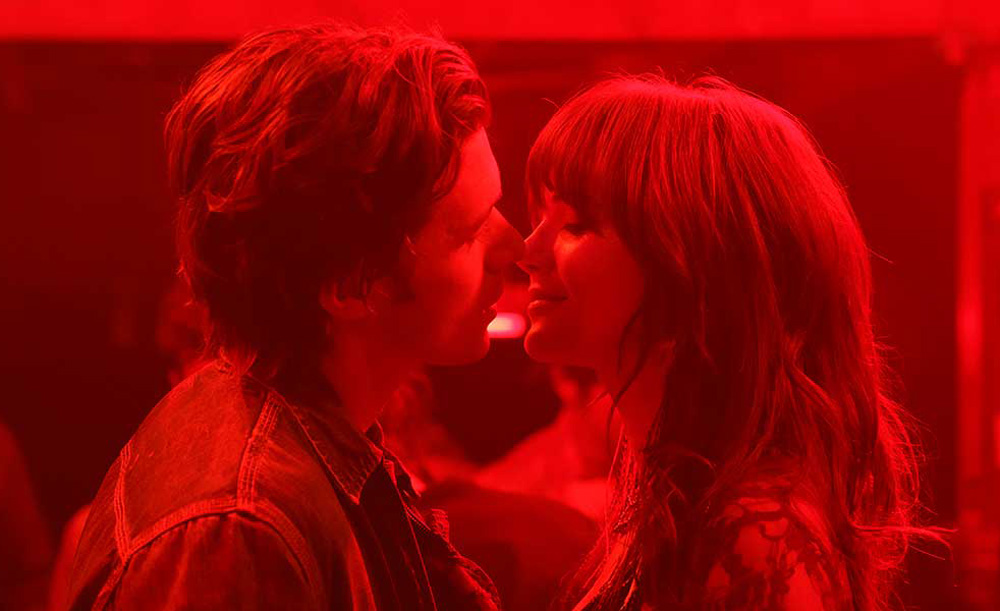

It’s evident early in “Charlie Harper” that a bit of deception can be romantic in Tom Dean and Mac Eldridge’s bewitching feature debut as Charlie (Nick Robinson) walks up to Harper (Emilia Jones) as if to ask her out for the first time, though she quickly turns the turns the tables on him by recalling that they knew each other from high school and that he must not remember. You don’t forget people this charming, so there’s reason to be suspicious of the two are role playing, but while the revelation that they’ve actually spent the last five years together may not come as a surprise, the depth with which Dean and Eldridge consider the idea that the two have pretended to be someone that they’re not for the sake of their longterm relationship does after they’ve perfectly set up how partners don’t always align with the person you have in your head.
That isn’t the only dawning realization that is bound to bring a smile in the film’s opening minutes when the seemingly benign title cleverly comes to reflect a sentence rather than a name as its two title characters are not yet married, but inextricably tied to one another as their first true love. They also deserve equal billing when they each get their say, presented separately confiding to someone off-camera that obviously isn’t their significant other about who they thought they were hitching their wagon to as both were leaving high school. Besides the dual recollections that aren’t necessarily in sync, Dean and Eldridge create a jumbled timeline to compare what idealized version Charlie and Harper had of one another to the reality of who they age into, jumping back and forth across their five years together to find how at times — willfully, given how in love they were — they could look past what grows to become a major issue in their relationship when Harper eagerly chases after her dream of working as a chef in New Orleans and Charlie, who supports her every step of the way, still disappoints her when he doesn’t show the same ambition towards his own goal of being a writer.
When Charlie brings Harper home for the first time and is coaxed to read Frank O’Hara poetry from a voluminous bookcase that seems unusual for both someone of his age and station in small-town Florida, it’s understandable how she could be enamored with him for the same reason that might doom a lifelong union when it’s only later she recognizes that he required a nudge to actually pull a book off the shelf in the first place. Dean and Eldridge refreshingly eschew any typically major obstacles to overcome like distance or infidelity when Charlie’s struggles to reach his full potential, or at least as she believes it to be, lead Harper to be concerned by his tendency to drink and other forgivable flaws start to irk, creating an unbridgeable gap between them. This could be the road to misery for all involved including the audience in the wrong hands, but the filmmakers give everyone reason to stay engaged when the chemistry between Jones and Robinson is undeniable and the central idea is equally irresistible when it illuminates how neither Harper or Charlie can be entirely faulted for things not working out as hoped and accepting personal responsibility becomes a key part of accepting each other.
With the film’s timeline starting out in 2008, not only does “Charlie Harper” boast a great laugh line as one of Charlie’s friends declares in the wake of Obama’s election that “anything is possible” upon entering the party the night of where the title characters first hook up, but it’s hard to remember a depiction of the push-and-pull of a romance this satisfying since that president’s first term in office when “(500) Days of Summer” and “Like Crazy” were rolling into theaters, full of passion, but also perspective when the issue of commitment extended beyond the thought of a couple to the individuals involved needing to make decisions about the kind of people they’d like to be for the rest of their lives. As Charlie is thought by Harper to have a lack of imagination, Dean, who exclusively is credited as the screenwriter, shows plenty of it in creating collisions of expectation versus reality with a sharp, nuanced script and with Eldridge, employs some savvy visual chicanery to sort out the mixed chronology, with the past presented in a wide aspect ratio while the present seen in a square frame and “Whiplash” cinematographer Sharone Meir showing how even in the same room, the couple quite literally see things in a different light. The characters may fool around in all kinds of ways in “Charlie Harper,” but the film itself feels as true as they come.
“Charlie Harper” will screen again at the Toronto Film Festival on September 6th at 2:45 pm at the Scotiabank.