



Time will tell if it’s the happiest day of their lives for either the bride and groom of a wedding that Holly (Benedetta Porcoroli) crashes in “The Kidnapping of Arabella,” but the uninvited guest is compelled to declare at the reception that it’s definitely that for her already, surrounded by other delighted attendees who raise a glass to her even without knowing who she is when she decides to give a toast. The ruse is nearly undone by her prepubescent companion Arabella (Lucrezia Guglielmino), who assumes that a golden egg heirloom that the newly married’s family has brought to the ceremony can be thrown into the gift bag for guests, leading Holly to sternly admonish her when it could mean being cast out of this paradise, pleading with the young girl, “Do you realize how difficult it is to be accepted like this?”
Of course, Arabella isn’t conscious of such things, nor should she should be at her precocious age, which ironically is why Holly picked her up in the first place. In Carolina Cavalli’s gleefully devious second feature, the seven-year-old is offered up as a flower girl when the couple seems to be without one and Holly is looking for a good time, but she would seem to fill in a missing piece of Holly’s life as well when the twentysomething pushing 30 is under the impression that she may be looking at her inner child – a possibility that Arabella doesn’t dissuade her from by introducing herself as Holly from a name tag she picked up. Both have something that the other wants because of the age they are – Arabella could use Holly’s car to escape her father (Chris Pine), a serious novelist who doesn’t have the patience to put up with his daughter’s demands for Taco King, and Holly, who works a dead-end job at an ice skating rink, believes that if she really is seeing the young version of herself, she can recapture some of her lost innocence and look at the world a little less cynically than she does now.
The possibilities lead Holly to decide against asking some obvious questions, like why is this young girl walking around in a fast food restaurant parking lot late at night without supervision when she invites her into her car, something less overlooked by authorities who begin to suss out the trail of the two as they amble their way down the Italian countryside, though Cavalli is intriguingly less interested in that pursuit than what Holly is chasing in trying to reconnect with her younger self. The writer/director saw the comic possibilities in such an idea in her exquisite debut “Amanda,” her first collaboration with Porcoroli, where an introverted young woman resorted to attempting serious conversations about dating with girls one-third her age when she didn’t feel there was anyone else she could share her anxieties with, but in their follow-up, the film poignantly blends the playful spirit of their previous adventure with real signs of growth both in front of and behind the camera as Holly’s delusions start to reveal a lack of introspection as they become more fanciful and further removed from what’s really going on.
As down as Holly may feel at times, it’s evident from just a pair of films so far that no one can lift spirits quite like Cavalli, one of the most exciting filmmakers working today and following its premiere at the Venice Film Festival last fall, “The Kidnapping of Arabella” is set to steal hearts as it crosses the Atlantic and finds its way into U.S. theaters. Cavalli graciously took the time to talk about working with an actress she’s come to know well and a much younger one she didn’t at all and locating the magic in what they had in common.
 One of my favorite scenes in “Amanda” was the scene between Amanda and her much younger cousin, talking about boyfriends. It felt like that particular age dynamic could’ve been something you wanted to explore more in this. Was that the case at all?
I really loved shooting with children in “Amanda.” That was a very fun experience for me and there’s always something about childhood, especially for girls that really interests me, starting from the books that many of us read, like Pippi Longstalking. They have these personalities [where] they try to fit their world in their imagination. It’s very fascinating for me and I really liked the relationship between more adult women and younger women that are not family or a maternal [relationship], because in this film but maybe as you said also in “Amanda,” these two characters share a feeling of being alone and not being heard and this is something they bond over. Of course, I’m talking emotionally — Arabella is very young, so she shouts, but it’s the feeling of not being acknowledged and that’s how I started to think about their relationship and their trip.
What sold you on Lucrezia to play Arabella?
Yeah, it was the first time that I had such an important role to give to a child and I wanted to make sure that she really wanted to do it, first of all, because sometimes with children maybe their parents wants them to do it. You could tell from miles away that she really wanted to do it. And then it was important that she understood that it was acting a character, which I wasn’t really familiar if kids at their age understand they’re playing someone else. And then it’s a very different process [of casting] because you don’t go through agencies, but you go to schools and summer camps and I felt she really seemed someone ready for an adventure. Immediately when I saw her, I was ready to trust her. And I’m a bit anxious because I love to control things as much as I can, but of course with the child, you can’t and that’s their beauty. So I really learned a lot from her. And she knew that she was acting but being herself and very natural at the same time. For me, it was a great experience working with an actress at this age.
You write a character on the page and then a real child shows up and of course, the surprises are daily. For every scene, what surprised me the most was how quickly Benedetta and Lucrezia created a bond. It made me feel even more that the set has a big power of creating connection when it works.
What was it like reuniting with Benedetta?
Honestly, the hardest part for us was the forgetting the previous character, Amanda, because it was a such a big part of our relationship. two years of our life were spent around the film, around seeing [Amanda] dress in a certain way, moving in a certain way, and acting in a certain way, so we did not to feel stuck on that character emotionally because you end up loving a character, so we were trying not to be nostalgic and build a new one. What I knew from before was the capability of Benny to give an inner life and tenderness to women who are not immediately likable or do wrong things. She has this capability of really showing all the nuances in a tone that are sometimes a little complex [especially] because it’s a bit of absurd world.
 In both a literal and figurative sense, but it’s a little bit darker film than “Amanda,” with much of it shot at night, but there’s a real casual beauty to it. What was it like to figure out the aesthetic?
Visually, when you create a world, it’s very fun and freeing because you start from a map that has to be coherent inside the world but you don’t feel responsibility of being geographically or historically accurate. I also felt that this film had a bit more aspects that were more intimate for me. Even though the tone of the absurd was in the writing and the dialogue, but it was also a visual tone for me [where it wasn’t] a way to escape reality but to go a little bit deeper into their feelings, so it would represent visually what they were going through, in particular, the older character.
There’s one single frame that really stuck out for me – it’s after the wedding and Holly is in a towel room where it’s got this amazing black-and-white tile wall and a goat ends up making its way into a door frame – you get to see Holly reach rock bottom, even though it’s not an especially terrible moment. It’s very natural and surreal at the same time. What was it like to set up that scene?
Yeah, it’s very weird because that was not supposed to be our room. As it always happens, you imagine things and then they have to change because of [the circumstances]. But as soon as I I saw that room, I really felt it could work because that space was a bit claustrophobic but also infinite at the same time [because of the tile design], which is a contradiction that these ambient settings always have. It was Lucretia who started to play with the [black-and-white] wall at a certain point because I think she saw a piano there.
As for the real music in the film, what was it like to work on the score? It has a real verve to it.
Yeah, on my first [film] something that worked very well for me was having the score while I was writing the script because after the images can mix with the music and then you rewrite and rearrange the music, but [it sets a] tone and everything together creates the world in advance. Of course, the characters don’t hear the music from the outside, you have this piece that can help you and I worked with Noah Deshe and Thomas Moked Blum — one is a film director and the other is a composer — and they immediately understood this idea I had that it’s a kidnapping in the sense of being kidnapped by a hope or by an idea and trying to make the reality fit your hope or your idea. I also thought that the starting point was always a woman who doesn’t feel she’s enough according the expectation of the world outside, but of course, this world can also be cold and absurd.
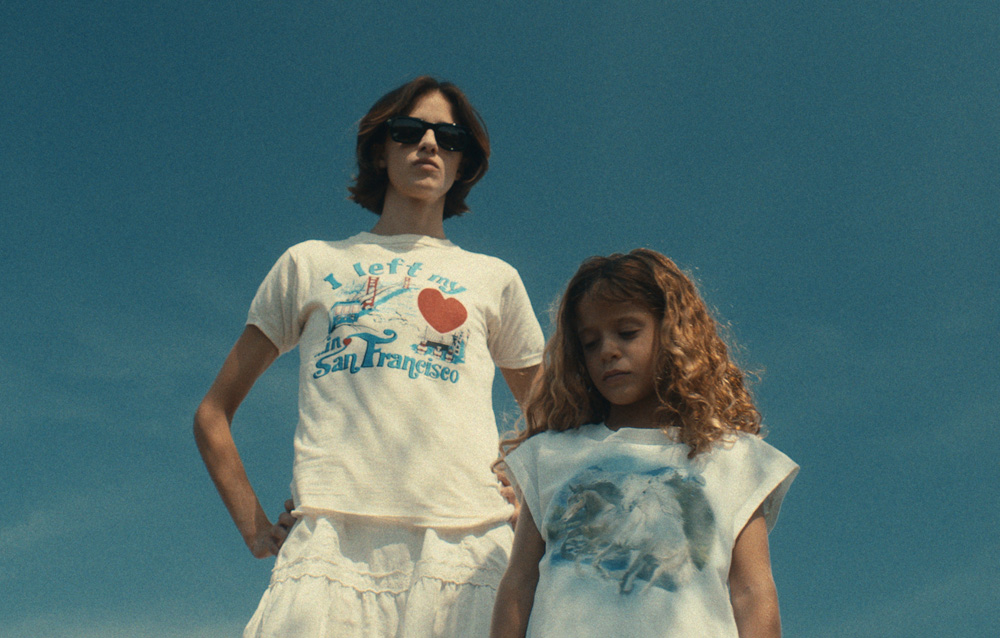
What’s it been like to see the film get out into the world? I imagine it played well at the san Francisco Film Fest when Benedetta wears a “I Left My Heart in San Francisco” shirt for a good deal of the film.
It’s always weird because you write it in a small room in your apartment and then you see it bigger. It’s always a strange experience but when you travel with the small films or like first feature, second feature, you kind of have to travel with the film and I do it with pleasure because the moment in which I can see the audience, everything becomes so real. It’s like the experience I grew up with of going to the theater and watching something that maybe was shot on the other side of the world or so long ago that maybe people who worked on the film even died fifty years ago, but still the hope is always to communicate something. In San Francisco, it was very fun for the t-shirt, which was like a piece that we found in a pre-loved stock and I love the fact that she’s wearing a T-shirt with a different city than where she lives because it gives me the impression that life could be somewhere else at the same time. It’s like getting a bit lost even more.
“The Kidnapping of Arabella” opens on July 17th in New York at the IFC Center and July 24th in Los Angeles at the Laemmle Monica Film Center and the Laemmle NoHo 7, July 30th in Chicago at the Gene Siskel Film Center and July 31st at the Detroit Institute of Art, Lake Worth Playhouse in Lake Worth Beach, Florida and the Oriental Theater in Milwaukee.