



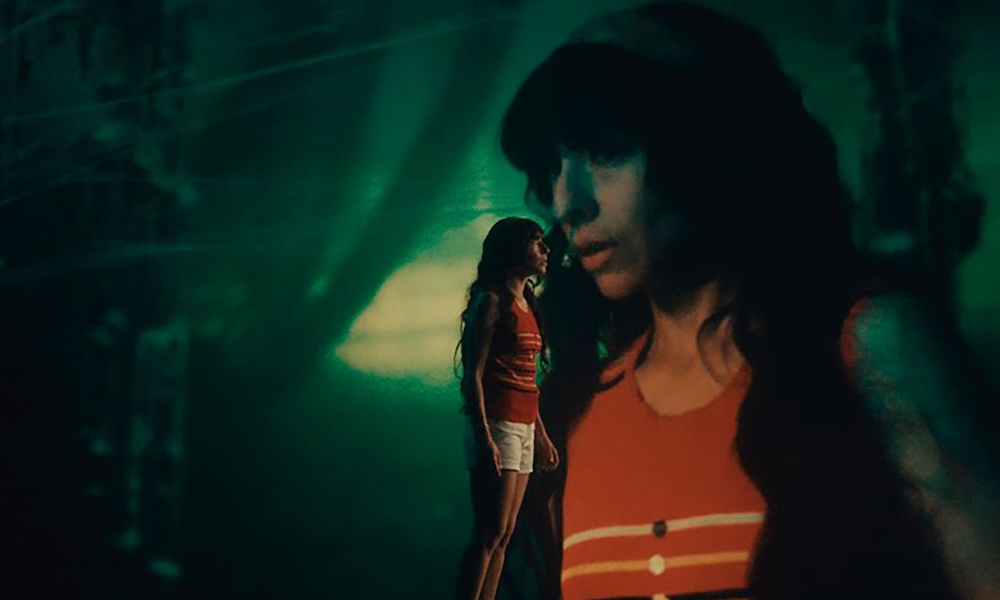

The late, great Marjane Satrapi came to mind a lot watching “Donkey Princess,” at first because of the pastel pinks and purples directors Cristóbal León and Joaquín Cociña bring into their gradual metamorphosis into live-action after starting out in animation, reminiscent of her first live-action feature with Vincent Parronaud “Chicken with Plums” where the use of color bridged the uncanny gap for both the filmmakers and audiences, and and then when she attributed her recent passing to “a broken heart,” after her husband died a year earlier. León and Cociña’s film is unusual in the way you might expect if you saw their stop-motion debut “The Wolf House” or their first stab at a hybrid in the “The Hyperboreans” that make them seem poised to take their place alongside the likes of Satrapi, Michel Gondry and Terry Gilliam as specialists in bittersweet tactile fantasies, but their latest also has a perspective on love that doesn’t typically show up on the big screen, considering the cost of caring so deeply about someone else as a young woman named Diana (Antonia Giesen) is thrust into different dimensions after committing to a partner.
Both ambitious and well-executed enough that you wish León and Cociña had the resources and wherewithal to make a slightly larger-scale version of it, “Donkey Princess” nonetheless boasts the big imagination and handmade charms of their previous work as they enter the kingdom of King Arthur (Francisco Melo, in one of many incarnations), presiding over the land of their native Chile in medieval times. Although the King answers to no one, he is left bereft by the death of his queen, making their lone child Diana especially precious in his eyes and while he’ll do anything to raise her without want for anything, he is keen on preventing her from ever falling in love herself, knowing the heartbreak it’s caused him and the added benefit of prevent himself from ever being fully alone. However, the King can’t entirely secure the perimeter, allowing in a young man named Lalo (Andrew Bargsted), who has found his way into a royal party after coming to visit his grandfather, and Diana can’t help but be disarmed by him – songbirds actually underscore their first encounter and hand-drawn animated rain drops pour from the sky.
It is a sly part of the design of “Donkey Princess” that the film starts out as a fairy tale in the Disney mold, complete with animated touches, and gradually moves towards a modern reality as Lalo gives Diana a bracelet that will grant any wish she has should she press the jewel that adorns it, though the catch is that someone she loves “will pay the price” in another kingdom – another time and place – that she isn’t necessarily obliged to be concerned with. That wish is to be with Lalo when the King learns of their budding romance, but a chain reaction is set off when she decides consequences be damned to ensure that she and Lalo will meet in another dimension and be together, still finding herself unfulfilled when to care for her father who takes ill in this kingdom drains her of energy to put either towards Lalo or herself. Both her devotion to others and what she’s asked for doesn’t change, but the demands of her only seem to become worse as she’s caught in a vicious cycle after her wish is granted, thrust into one kingdom after another where she can’t ever dictate the situation she’s in.
In general, it is a bit of a double-edged sword that the central trio are largely defined by their circumstances rather than having strong personal characteristics of their own, making a potentially convoluted narrative easy to follow as the Diana, Lalo and the King travel through time, though what the characters feel they owe to one another seems less a product of who they are individually than a function of the story. Yet the idea that love can feel like a debt, both inescapable and unconsciously weaponized is consistently intriguing, as is how Diana’s warped relationship to the world is expressed – an early barrage of images upfront conveying the multiverse that León and Cociña concoct may be a bit jarring, but while the film settles into a more relaxed pace, it keeps lively as both the characters and the audience adjust to the new world they’re in and illuminates the dangers of accepting reality as it is rather than questioning it when Diana’s fate is manipulated. Love may not conquer all in “Donkey Princess,” but it expresses what a powerful force it is in a unique way and finding another route itself to sneak into the heart.
“Donkey Princess” will screen again at the Locarno Film Festival on August 8th at L’Altra Sala at 11:15 am and August 9th at PalaCinema 1 at 9:30 pm.