



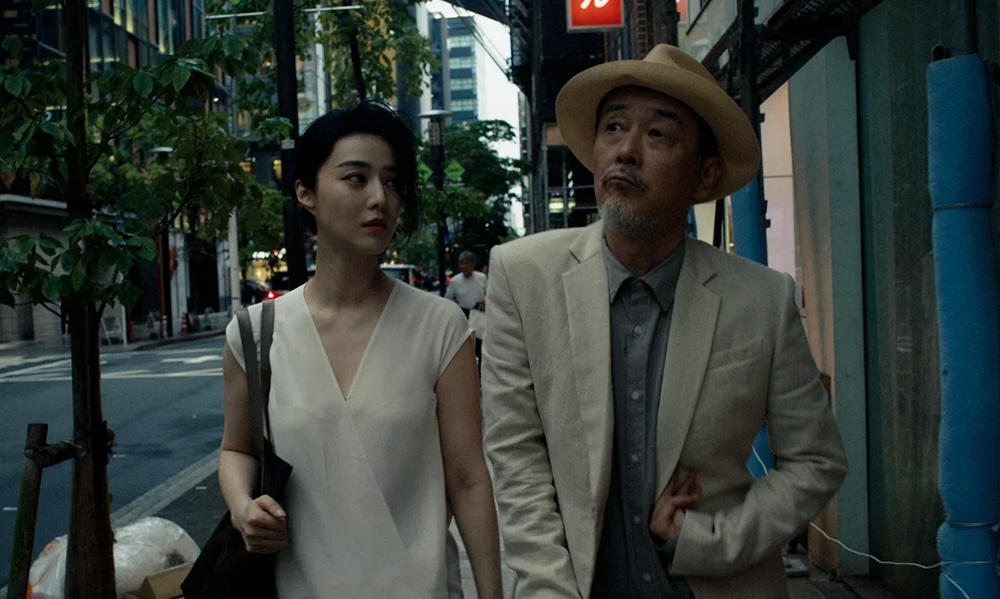

“It’s better to be killed by a beautiful woman,” Utsugi (Lily Franky) tells his daughter-in-law Susu (Fan Bingbing) in “Diary of a Mad Old Man,” relating a story he heard on the news about a man that was recently poisoned by his wife. With death on the mind a lot these days as he has little idea of what to do in virtual retirement, the thought of leaving the earthly plain in the arms of the fairer sex is mighty appealing when the feeling of impotence he carries around after suffering a stroke, left in a largely empty house with little to do, might as well be considered an early grave. When Wayne Wang’s darkly delightful adaptation of Jun’ichirō Tanizaki’s 1965 novel, published just four years before the author’s own passing, opens with showing how Utsugi attempts to pass the time, furiously masturbating without much success in his golden years, the gauntlet is thrown down that the old man isn’t going to go quietly into the light, an invigorating thought that animates the finest and friskiest film that the “Chan is Missing” director has made since “Smoke.”
There are reminders throughout “Diary” that while Wang was capable of making the gentile “Maid in Manhattan” and “Because of Winn-Dixie,” he also jumped at the chance to make 2001’s “The Center of the World” with Utsugi’s occasional sexual fantasies rivaling the infamous lollipop scene that caused the Molly Parker-Peter Sarsgaard drama to avoid the ratings board completely, and it was special to see him return to the Toronto Film Festival with a vengeance where his last film “Coming Home Again” bowed seven years ago and accompanied by the thought it might be his last. With Wang in his seventies, age certainly was a consideration, but also the resources that might be afforded to him when the beautiful two-hander about a mother and son set inside a San Francisco apartment was like watching a master chef prepare a meal limited to the ingredients randomly in the kitchen. “Diary of a Mad Old Man” comes across as a sumptuous feast by comparison, though the scale of the story isn’t much bigger, largely unfolding in a resplendent minka home built from Utsugi’s professional practice as a kimono maker and boasting true star power in Kore-eda regular Franky and Fan (“I Am Not Madame Bovary”).
The two make a beguiling pair brought together by circumstance when Utsugi might think no one cares for him as he’s aging, but Susu feels similarly neglected in her marriage to his son Jokichi (Takumi Saitō), for whom Utsugi doesn’t have a lot of love for now either. His sister-in-law Hana (Yûki Kudô) also wants to put more distance between herself and her late sister’s husband, but she may come to regret suggesting that Susu should when Utsugi and his new caregiver share perverse sensibilities, liable to sneak off like schoolchildren having a bit too much fun with each other. Utsugi is definitely the more juvenile of the two, appearing nearly 50 years younger than he is when Susu dares to show a little leg and increasingly looks amenable to indulging his foot fetish, but true intimacy is never a matter of shedding clothes but inhibitions stemming from how lonely they are deprived of touch, making each other feel wanted in one another’s company. She may joke about how she feels his blood pressure rise around her, but the exchanges really do quicken the pulse of everyone involved with Wang drawing out the considerable charisma of both actors, particularly Franky as a comic performer willing to go for broke.
The fact that Utsugi and Susu get on like a house on fire presages the possibility that in fact Utsugi’s humble kingdom may ultimately be set ablaze, either from the anger that grows around their relationship or frustration between them that both know it can only go so far, and Wang doesn’t shy away from a ferocious finale packed with panache that feels as if the master filmmaker is driven by the sense he still has something left to prove. Of course, he doesn’t, but the punk irreverence that led him to make such films as “Life is Cheap…But Toilet Paper is Expensive” and “The Princess of Nebraska” can be felt amidst the polish he developed over decades – evident in the exquisite blocking of the actors that’s as dynamic as the playful tete-a-tetes penned by Kelvin Wyles – making him ideally suited to tell the story of a man with truly better things to do than just sitting around his house and resting on past laurels.
“Diary of a Mad Old Man” does not yet have U.S. distribution.