



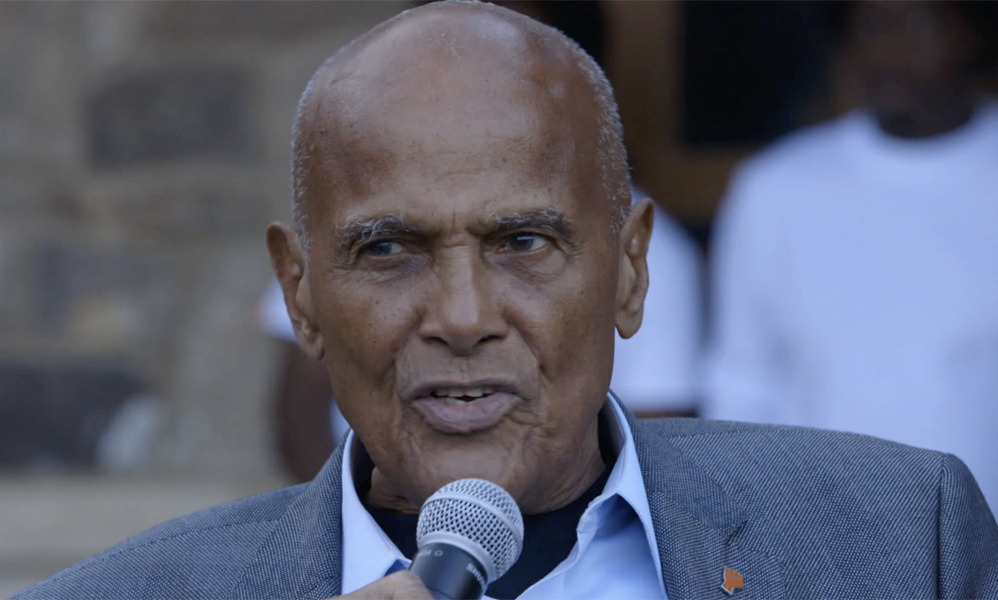

“I think artists are the greatest change agents the universe has invented,” Harry Belafonte can be heard saying in “Following Harry,” considering how his own influence on social issues can be parlayed through a new generation of artists as he enters his golden years. Filmed over the last 13 years of his life, the iconic singer, actor and activist isn’t about to consider himself retired, opening up an office in New York where a variety of different social justice advocates have a place to work and he remains engaged as ever, traveling to Florida in the wake of Trayvon Martin’s murder to join the sit-in at the state capitol to protest the Stand Your Ground law that let his killer walk free or making the calls necessary to get the world to watch the Women’s March on Washington in the wake of the first election of Donald Trump. (When Lady Gaga is too busy to answer when she was preparing for the Super Bowl, he just needs to scroll down on his phone to pivot quickly to Alicia Keys.)
After Susanne Rostock had filmed with Belafonte for the 2011 documentary “Sing Your Song,” highlighting his first eight decades of activism, she ended up having a front row seat to watch him pass the torch as one of those invited to work at his building, observing him construct something casting an even larger shadow than the New York skyscraper. “Following Harry” presents Belafonte as someone restless in his old age, unsatisfied with an unparalleled legacy when he could say he stood shoulder to shoulder with Martin Luther King Jr. during the civil rights movement and uses the quiet from any room he enters where the reverence is palpable to continue to speak up for the most pressing issues of the day. As Jesse Williams describes to Rostock, it was Belafonte’s fiery speech to the BET Awards a decade prior that led to his own controversial address to the same crowd in 2016 when he railed against police brutality, and the filmmaker sits in on meetings between Belafonte and the likes of Aloe Blacc and Aja Monet who are used to moving people with their voices and find the confidence in conversations with Belafonte to deploy them towards progress for the greater good.
Keeping up with a busy Belafonte right up until his passing at the age of 96 in 2023, Rostock is able to track not only the many causes that he took up from gun violence to famine, seeing them all as connected, but to show how many people he brought together from different spheres to work with one another for change. His inspiration not only lives on in all of the different lives he touched, but in what Rostock was been able to preserve for posterity and with the film finally now available to audiences all over, she and Carmen Perez, the CEO of Belafonte’s social justice organization, the Gathering for Justice, took the time to talk about Belafonte’s tireless commitment to making the world a better place, quantifying a lifetime of activism and giving audiences the galvanizing feeling of being right there alongside of him.
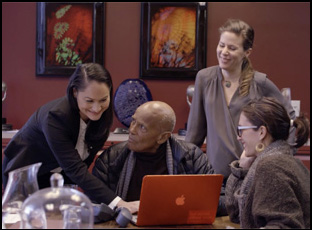 Susanne, you had a preexisting relationship with Harry from “Sing Your Song,” but how did this come about?
Susanne Rostock: After the first film, Harry was moving into a new office and he said, “Would you like to come and join me?” And I picked up all my editing equipment and moved in, so that that was the the beginning. And if you’ve seen “Sing Your Song,” it ends with the question, “What do you do now?” This was in 2009 and Harry was so concerned about the future. He was already worried that something was brewing that needed attention. So I wanted to answer that question and when he invited me into the office, I thought, “Well, there’s the opportunity But now how do I do that? It’s such a big question.” I was very curious to know what Harry would do moving forward because, as he says in the end of “Sing Your Song,” “I’m not going to rest on my laurels. There’s too much work to be done.” So I was thinking, “What is that work?”
At the same point, Carmen Perez, who was head of Harry’s organization, the Gathering for Justice, and lived in California, she did what I did — she just packed up on a dime and moved in [to Harry’s office at his invitation]. So here we had this amazing space and an incredible, endless group of people coming in trying to find answers from Harry, the sage, wise man who really understood life so well and and worked from his heart. He was so open and giving, he became a mentor to so many and I thought, “Maybe I’ll just document some of this.” Then Trayvon Martin was murdered and Harry hit the ground running and it opened from the office to the streets. That was the beginning of the film and I just kept on following him.
Originally. it was meant to come out for the 2016 election because we were in a bad place — worse now, but we were in a bad place then — and there was this big concern that people, especially young people, would not come out to vote. So I thought I will make the definitive film that will get everybody up and out there voting because you have no choice. You watch this film, you hear from Harry. You know from history that people died to get the right to vote and and you’re just going to toss it out and not vote because you think that’s a good idea. So that’s what the film is going to be. But then I saw the trouble we were in and I thought I’m going to keep on capturing as long as Harry’s here because I’d have to preserve Harry for the future because there is no other Harry Belafonte.
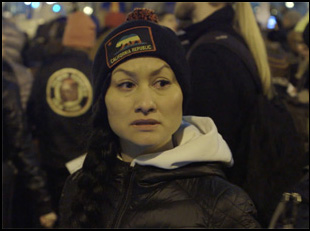 Carmen, did you feel like this captured what it was like to be pulled into Harry’s orbit?
Carmen Perez: It did. A lot of times Susanne was there filming us as we were planning, plotting, strategizing in the streets and there’s a lot that didn’t make it to the film. There’s additional behind the scenes of behind the scenes where there were disputes, there was uncertainty, and a lot of fear. It does come up in the film, but we have to give it to Susanne trying to package all these years of footage into 90 minutes for the world to receive the gifts that Mr. Belafonte imparted on all of us. Like Susanne said, this film was supposed to be done a long time ago, but the lessons in “Following Harry” are still important today because of the political moment that we’re in. The things that are happening have happened in the 1960s, right? But now there’s a blueprint that we could take in the lessons and the conversations and the vision that Mr. Belafonte had for the world and I just hope that people understand the magnitude of a man that he was and the life that he lived and the service in which he lived his life, always in community with people, guiding and strategizing and giving. Susanne [was] able to put this fine piece of art together in order to inspire generations to come.
Susanne, what was it like to put together when there was so much ground to cover?
Susanne Rostock: Well, I went into a trance for a couple of years and I have no idea how I did it. [laughs] There’s so much more – it was worthy of a much longer film. Now I know you can make a four hour film and they’ll sell it and I would have made it like “Musk. But it was very painful. There was a lot of blood on my cutting room floor and I did it chronologically. I decided to make it a journal feeling, so it was chronological. That helped a little bit and within each of those stories, there’s a four-hour film, so it was very challenging. But I used Harry as the guide, just knowing I had to be sure he was in every segment to to move the story forward. But I’m sorry that there isn’t more and there’s so many important, amazing people that should be in there that that aren’t. I feel I’ve let people down by not having them in their not having them represented in in their struggles and their beautiful achievements. But I’m so happy I could get who I got in and I feel great about the film. A 12-year-old boy came up to me afterwards and thanked me and said, “I now understand who I am and I know what I have to do” and he was 12, so I thought the film speaks across many aisles — age, race, gender. That’s what I wanted it to do, so I have to accept that it does what it’s supposed to do.
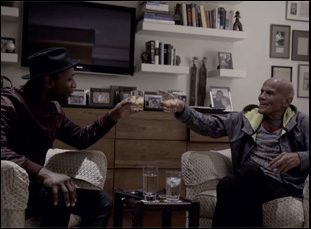 Carmen, one of the things that was so powerful to me about the film was how it shows that this is a struggle and it’s going to keep being a struggle, but at the same time you’ve got to celebrate the wins such as the coalition that was built at the women’s rally. What’s it like to look back on that in the film and keep going?
Carmen Perez: When I watched the film, I took a deep gasp and I cried a lot because Mr. Belafonte is so present in the film and it also highlights the work that we were able to accomplish from the protests and rallies and marches that we were organizing at the time. However, I will say that the opposition is very quick to take you down from your pedestal, so the victory was never something that we were truly able to celebrate because of what came after. However, seeing it on a film, it’s going to be there forever. It’s going to be part of the history and of the blueprint that is handed over to the next generation. And very similar to Mr. Belafonte talking about the lessons that he’s imparted, I hope that people will watch this film knowing that there is a role for them to get involved in whatever capacity they have. Like Susanne said, there is no age limit on getting active or becoming an activist. You don’t need to have a big platform to begin with. You just start with your community. So I hope that inspires people to want to get active seeing the young people from Parkland meeting with Mr. Belafonte and learning from him, getting his wisdom, there’s a role for our elders to share the knowledge that they have with our young people. This film is intergenerational, it’s intercultural and it’s interconnected — it’s everything. And I’m just grateful to have been one of the people that is in the film that you could see he femme-tored and mentored, but also there are so many people that are going to continue his legacy. All of us have a role to play in that.
“Following Harry” is now available on all the major VOD platforms.