


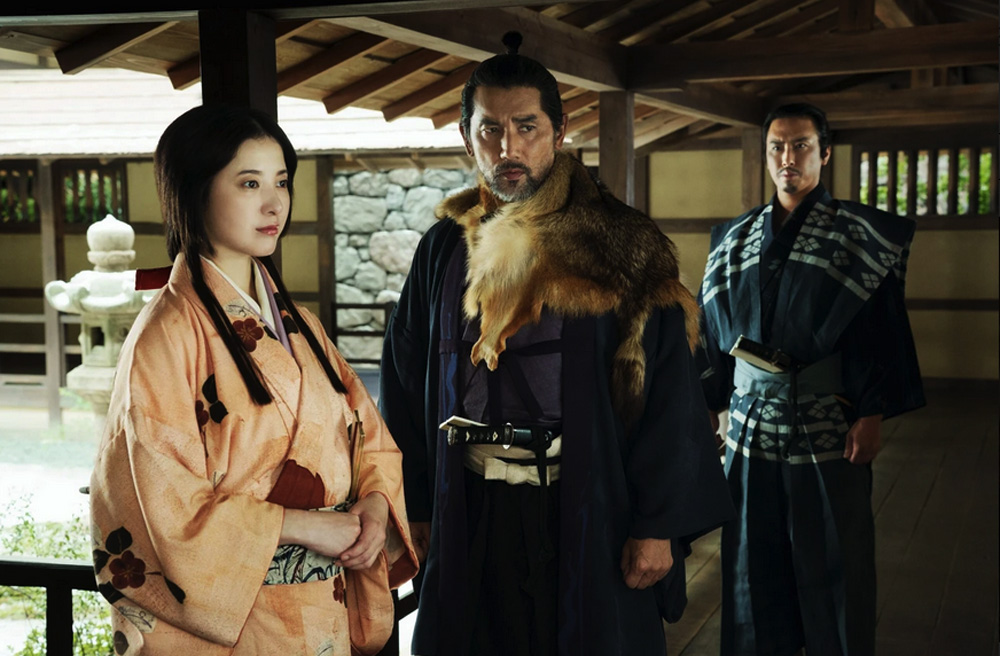

“In this world, attachment always leads to pain,” Chihoyo (Yuriko Yoshitaka) advises Lord Murashige (Masahiro Motoki) in “The Samurai and the Prisoner” as he decides to start parting with some particularly prized possessions in his collection of tea kettles. He seems to have been prepared for this moment, noting this collection wasn’t the product of a frivolous hobby or intended to be decoration of his palace, but the fact he knows baubles can be used to appease those less principled than himself and he imagines a coveted kettle or two could play a part in assuaging Nobunaga Oda, a fast-approaching enemy with plans to expand his own kingdom by upsetting the tenuous peace that exists across Japan to invade others.
Not being too precious is a quality that Kiyoshi Kurosawa would seem to share with the lead of his latest film, at least when it comes to being practical or sentimental, perhaps dreaming for some time of making a jidaigeki, the type of feudal-era fight over power that’s his country’s most celebrated cinematic export – well, besides the genre he helped launch with the J-horror phenomenon at the turn of the 21st century with such chillers as “Cure” and “Pulse” – but biding his time until he could do it right. Following up the triumphant and ultra-modern cyber thriller “Cloud,” Kurosawa heads back nearly seven centuries prior to find Lord Murashige attempting to deploy tea over more usual weapons as a means of warfare, not only planning to gift Oda a kettle to keep him at bay, but often serving Oolong to accompany interrogations of the men under his command who wonder if they should pull rank when resistance appears futile.
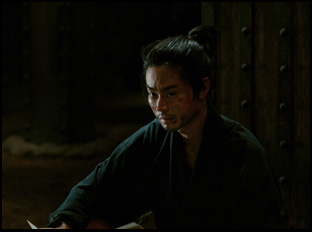
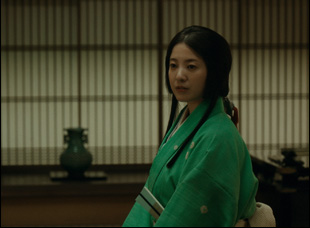
For those expecting sword fights, Kurosawa obliges, but the battle of wits that ensues can be just as thrilling when in the face of Lord Oda’s invasion, Murashige shows mercy to Jinen, the young son of a traitor, who offers to kill himself and he still ends up dead after he’s spared, leading Murashige to a meticulous investigation to get to the root of who inside the Akioka Castle is responsible amongst a variety of different factions from riflemen and samurais who already feud over credit for killing the enemy — when beheading them, a disfigured general’s head becomes an issue over who was responsible) — and are at odds over the best way forward. A moral man who shows no appetite for taking lives, but will do what needs to be done to survive knowing that a replacement is likely leave the castle worse off, Murashige ultimately finds himself without anyone to confide in but Chihoyo, his wife who is haunted by memories throughout but seemingly sage beyond her years, and Kanbei (Masaki Suda), who locked away in the castle’s dungeon has an unbiased view of what’s happening above and demonstrated from the start his tactical and strategic wisdom, even if he can’t be trusted.
There are many reasons to instantly identify Kurosawa’s adaptation of Honobu Yonezawa’s prize-winning novel “Kokurojo” as a classic, yet the film feels as modern as any of the director’s more cutting edge contemporary dramas as he glides throughout Akioka Castle finding intrigue in every corner, curious not only if Murashige can survive but his predilection towards pacifism when it would be so much easier to eliminate threats with all the brute force at his disposal. The film boasts marvelous performances from Motoki as the conflicted head of the house and Suda, reuniting with his director from “Cloud,” as the enigmatic prisoner in the basement who offers counsel, and demonstrates that even after leaving nothing to prove as one of the true masters working today, Kurosawa still tackles every new film with the verve of someone just starting out and seeing fresh possibilities in the form. After premiering at Cannes earlier this year, “The Samurai and the Prisoner” is now starting its theatrical run in the States and while in New York, Kurosawa graciously took the time via a translator to talk about finally having the resources to make a historical drama on his terms, the film’s striking cinematography and compositions that enhance the tension and why he doesn’t think a director should have all the answers.
 You’ve said that you wanted to make a film like this for some time. What made it the right time?
It was just a very lucky opportunity. This novel was brought to me by a producer and the novel itself is a best seller, which allowed us to get the kind of budget required for making this type of period films, so this was just the right timing. As for the figure of Araki Murashige, he’s someone that I was interested in before I even read the novel. He’s a warlord who fled his castle, leaving behind his retainer and even his family, so historically he’s considered a weakling, a coward, and a traitor. I was very excited when I read the novel that it is a very detailed, albeit fictionalized, account of what happens leading up to his fleeing of the castle and I was excited to adapt it into a film.
From what I understand despite the large scale of it, it was a very early decision to keep this limited as far as a setting both in time and place. There’s no flashbacks and it doesn’t stray from this kingdom. Was it an exciting creative challenge to put those constraints on yourself?
Yes, the decision to not use flashbacks was one that I had early on because this isn’t just a film that’s about a detective solving mysteries, but this is very much about Murashige having to solve these mysteries because he must convince his retainers [of his authority] and maintain order in the castle. That is the greatest drama that exists in the film and solving the mysteries is all in service of that, so I knew that rather than leaning on flashbacks, it was important to show these very careful scenes of Murashige explaining things to the people around him and then also to film the reactions of those people listening.
As far as locations, although this is a drama that takes place primarily within the confines of a single castle, we actually filmed across many different locations. We filmed in five different castles, and there were also additional locations like a temple in Kyoto, and all of those needed to be pieced together in order to convincingly portray an experience of everything taking place in a single castle. Because this was my first time working almost in such a vast way, even though filming in multiple locations is very commonplace in films, I was definitely worried that whether they convincingly appear as though it was one place, but thanks to the magic of editing, I think that it comes across as one place.
You fooled me. The way you move about the castle with the camera is fascinating. How much was dictated by the spaces you were in?
The camera position and the framing were dependent on location but because this is a jidaigeki in the world of feudal Japan, hierarchies were very clear and that was very apparent through people’s body positions, so those in power may often be standing up and looking down upon the kneeling, those who do not have the power. Of course, in scenes in this film, sometimes that power balance is disrupted and then figures stand and kneel depending on that. Something that I wanted to be very clear in depicting was how a power balance is constructed, how it’s maintained, and then how it is disrupted, so in blocking the characters, I needed to consider what camera positions would allow for those to stand and to kneel and for all of that to be captured within one frame. As you can imagine, the height difference when you have a character who is standing and one who is kneeling is quite hard to capture in a single frame, so all of that needed to be part of the calculations. Of course, much of this is thanks to the work of the [director of photography] that worked on this film. But It was just really important to position the camera so that the shifting power imbalances and contrasts were framed in a way where there weren’t any contradictions across the scenes.
 In any film, you build a world from the ground up in any film, but with a period piece like this, do you feel like you could get away with more in terms of telling the story through elements beyond the dialogue when unlike a contemporary film, it’s a reality people don’t have as much of a familiarity with?
It was a very exciting experience that had both freedoms and constraints. As you said, because of the costuming, the makeup, the art direction, we had to construct this world from completely a place of zero. But what was so interesting to observe was that when the actors put on their costumes, wearing their makeup, and put in these sets that are designed to look period specific, they organically start to transform into figures of that time. Of course, it’s all written in the script and their dialogue is written in this old style of Japanese. But it was so interesting that the environment could influence the actors in a way where hierarchies organically emerged. And as for the sets, if we moved the camera just slightly in any way, we would suddenly be confronted with present day Japan or we might see the rest of the studio set, so there were also a lot of constraints in terms of how we could frame the world so that it was believable.
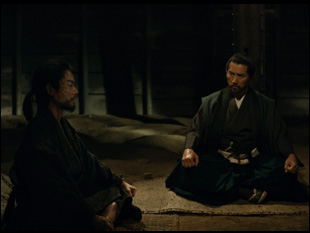 Matoko Masahiro has such an incredible performance in this, and it’s a quiet evolution. Was there anything you could do in terms of setting this up to facilitate the performance?
Typically, I don’t hold rehearsals for my actors in films. Part of my fear around holding rehearsals is that if you concretize a performance in rehearsals, then that thwarts a lot of the freedoms that can happen on set. But because the context of this film being a jidaigeki was so specific, we did do her rehearsals for this one and what I noticed was that with Motoki Masahiro playing Murashige, there was a clarity that he was able to grasp about how he might approach acting as this historically specific figure. But I also a sense that he had a hesitation about whether that clarity was indeed the correct approach to the character. So for him, regardless of the rehearsals, I think on set he was trying to forget whatever he learned and to really face the cameras in a fresh way.
And the greatest theme and mystery of this film is why Murashige fled the castle and what his motivations were behind that. In a sense, it stays a mysterious element of the film and I think that Motoki Masahiro was very conflicted and confused about what his motivation was meant to be and why he left the castle. But I told him that it’s fine if you’re confused and if you don’t know and I think until the very end he didn’t really understand 100% the character of Murashige, but I encouraged him to give himself over to the role and be okay with the fact that he himself doesn’t know. Perhaps Murashige also doesn’t know because certainly there in our experiences as just as human beings, there are times when we do things and we don’t understand why we do them. So I had to trust in the fact that the cinematic expression of that character would stimulate the imagination of the viewer to have multiple interpretations of why Murashige might have left. Even as the director and the screenwriter, I can’t say that I know for sure why he fled the castle.
“Kokurojo (The Samurai and the Prisoner” opens on July 31st in New York at the IFC Center and Los Angeles at the NuArt Theater before expanding on August 7th in Los Angeles to the Laemmle Glendale, the Encino Town Center 5 and the Monica Film Center and additional cities across the country. A full list of theaters and dates is here.