


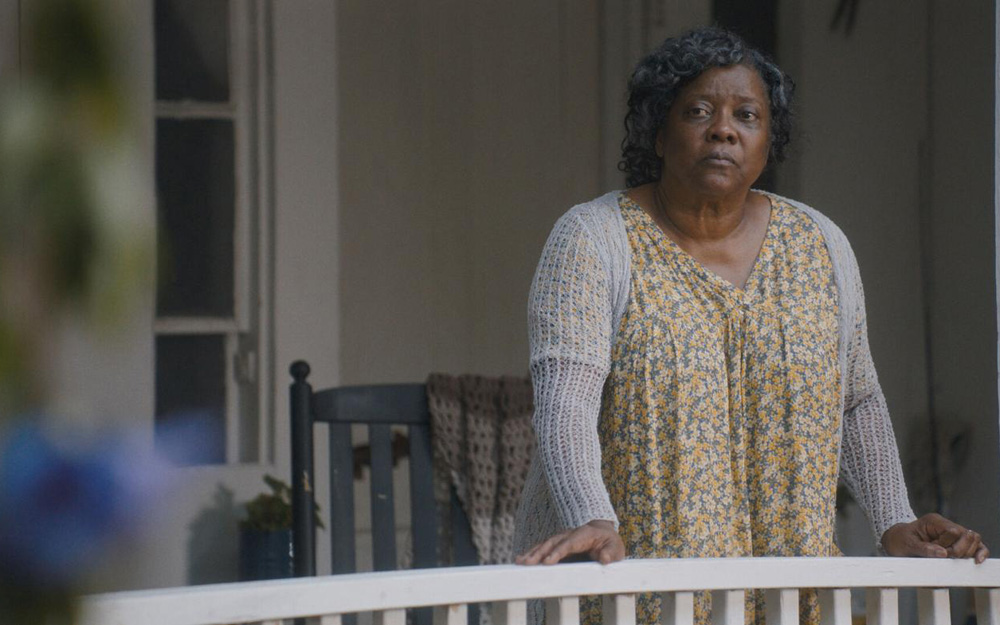

There’s a “Yes, We Can” flyer up in the office of LouEster Gibbs (Malynda Gibbs) in the months leading up to the 2008 election in the small town of Puckney, South Carolina in “Bull Street,” where you probably won’t hear much about the election when conversation is kept polite, but a visit to the local diner where the a group of women still meet to play cards as descendants of the daughters of the confederacy reveals that the legacy of a segregated past remains even if it’s rarely acknowledged now. LouEster would appear at first to have too much already on her mind to give much of a thought to national politics in Lynn Dow’s drama, having to care for her gregarious grandmother Big Gal (Loretta Devine), who’s known around town for her big heart, but just had to have her pacemaker replaced, but if all politics are local, she finds herself thrust into the heart of the matter when the death of her biological father Harrison, from who she was long estranged, precipitates a legal battle over Big Gal’s property when it’s discovered there’s no deed to the land, a common practice in the Black community for generations in these parts when their rights in general weren’t recognized.
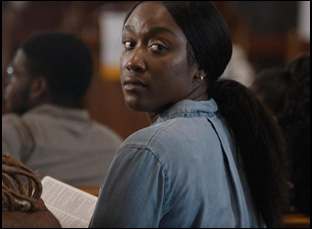
In her feature debut, Dow makes a juicy old fashioned drama with fresh perspective when the lack of title wouldn’t have come to light without the arrival of LouEster’s stepsister Kendra (Arielle Prepetit), who begrudgingly makes the trip south from D.C. to attend Harrison’s funeral per his final wishes and can’t help but be intrigued to learn that beyond leaving behind his first wife Sadie and their daughter LouEster to live in the nation’s capital, he also had land in the family that ended up with Big Gal that could have tremendous value for its lumber. Of course, should a case get to court, particularly in front of Judge Mary-Ann (Amy Madigan) who has a regular seat at the local card game, it could leave everyone connected to Harrison without any land at all when there are those that see an opportunity to claim its resources if a determination that the ownership over it is illegitimate. Although LouEster isn’t a lawyer yet – she has an offer to pursue her studies in California that she has to weigh against continuing to care for her beloved grandmother – she is pressed into duty when she has such a personal connection to this particular case and the discovery process isn’t only for the benefit of the court but allows her to learn more about her own complicated family history.
The central narrative of “Bull Street” may be fiction, but Dow’s experience of making it mirrored what occurred on screen to some degree when the passing of her own grandmother led her back to the south to learn a bit more about her own past after growing up in Harlem and the production was a bittersweet occasion when it was her grandmother who gave her the confidence to take a chance on filmmaking after planning to go into the much more secure field of finance by saying she could always come home again. In fact, Dow appears to be exactly where she’s supposed to be behind the camera as “Bull Street” unfolds at a relaxed clip, keeping pace with life in the small town, yet never short of intrigue. With the film now available far and wide on VOD, Dow, who is generously taking questions from audiences who want to connect via the film’s social media channels, sat down for a few from us about how the personal story behind her first feature, her destiny as a storyteller and finding a community coming together around the film.
 How did this come about?
I actually wrote “Bull Street” after losing my grandmother. She was the heart of our family like every grandmother, so my writing became my way of working through that loss. The story just kept growing into something bigger, but family is at the heart of it. So many people take a loss like that and we don’t know where to turn. I had to work it out and find my way.
From what I understand, it was actually your grandmother that gave you the nudge to get into the filmmaking in the first place…
Yes, and I’ll tell you this is the funniest story that I tell, but when I was probably about four or five years old, my uncle had a nervous breakdown after his wife left him for another man. So he was just completely swamped and they wanted to medicate him and things like that. My grandma, who was before her time, said, “You can’t give somebody with a broken heart medication.” So he had come to live with my mom, they’re very close in age, and my mom had given him my room, so he locks himself in this room for what seems like a lifetime. My family said it was probably about three months and I could never catch him. I would always just like bang on this door, [like] “What’s this guy doing here?” And when he finally opened the door, I go into my room and I see this stack of papers and on the top of it, it says, “In the beginning God created heaven and earth…” And two weeks before that for my Easter play at church, that was the scripture they handed me. [I was told] “Just get up there and say that.” And that’s what I had to memorize. I look up at him and I said, “You wrote the Bible. I found who wrote the Bible.”
So I went around telling everybody at the church, everybody in kindergarten, all over the place, “I know who wrote the Bible.” I didn’t understand the word “copy” at that point. [laughs] But I knew my uncle wrote the Bible, so to stop me, “My grandmother says to me one night, “But Lynn, you are a better writer.” And I [said] “Really?” I’m thinking to myself, “I’m better than the guy who wrote the Bible?” And she would just say, “Lynn, you just write, write, write.” That’s really when it tapped into that little creative space of mine. Fast forward to after I lost her and I was going to counseling, trying to get rid of this grief and I could actually hear my grandmother and feel her presence all over me. I could still hear her say, “Write, Lynn, write.” And I just started writing and I could not stop. And then when I get to my first draft, which I look back on now, it’s just me crying all over the place and I was like, “Nobody wants to hear my tears and all about my grief when we’re all going through it.” So I decided [on something less direct].
My maternal family is from a place called Summerton, South Carolina, the same town that gave us Briggs Vs. Elliott, which is the first of five cases that led to Brown Vs. Board. It’s a small town in the middle of the state near Santee. And my grandma would take me down [from New York] to visit her sister. Her sister was the only one who stayed and I wanted to follow my grandma everywhere she went, so while my cousins and siblings were saying, “We’re not going to the South, it’s just too country for us. There’s not anything to do”… well, I fell in love with a Piggly Wiggly down there. In New York City, we don’t have a Piggly Wiggly, so I started going down there and [after her death], I felt lost and I thought I’ll take her back home and I’ll trace her steps. As I did that, I find out that it’s her grandmother, which would be my great, great grandmother, who died on Bull Street. Now Bull Street is an infamous name in Columbia, South Carolina [because it] was the address for the what they called originally the lunatic insane asylum. But I find out that it was my great-great-grandmother who was fighting off the sheriff who wanted to take her land and when they were fighting back, if the jails were overcrowded, they would take you to the state hospital, so they carted her off there, committed her there and stole the land, so there’s no generational wealth. There’s no legacy or anything like that in South Carolina for my family. It was then that I knew I had my story.
This really captures the rhythm of life in Summerton – the card games, the night fishing. When you’ve got such a strong narrative to begin with, was tucking in those moments that really said something about the town something you had to protect?
Yeah, because it was so personal and I was on this healing journey, so every moment in there is so much about my life, from dealing with the father and how do I take everything that I was going through and just make it one story that the audience could follow along with. I was very protective of the town. The town had gone through so much that when I originally approached them, they thought it was about the Briggs Vs. Elliot [because they said] that’s all everybody wants to hear with the small town. That’s where they did Sidney Poitier’s “Separate But Equal.” It’s also where “Marshall” [about Thurgood Marshall’s] first case working with the NAACP [was set]. And one of the things that I have tremendous amount of respect about this small town is that have plaques and they never forget what happened to Briggs and they never forget that this is the same county that gave us 14-year-old George Stinney, the youngest in America to be executed, but when I approached the town [with the idea of filming there], [it was dismissed as] “Oh, it’s about Briggs Vs. Elliott.”
So when I brought “Bull Street” to them, they read this script and I like to say they were my extra crew members because they opened up the town, they embraced it and now they’re known for “Bull Street.” The diner is still there the same way my great, great grandmother left it. The pharmacy’s still there [how it was] back in the ‘60s and ‘70s, so I was really protective of the images I wanted to show and of the town and its history. Then everyone in the town came along for the ride and opened their homes. The locations are these are real locations. We didn’t have to build anything.
 LouEster drives an incredible old Chevrolet that’s kept in pristine condition, but I’m not sure it drove so well. Was that a find on your part?
That was that was a mistake there. [laughs] So I was going for a Volkswagen Beetle and the Volkswagen just broke down. The owner says, “Hey look, I’m sorry, but we can’t get it from here to there.” [And I thought] How are we going to get this car? Then I’m driving down this dirt road in South Carolina at night, going back from my hotel and there it is in somebody’s yard. I was just like, “Oh my God, [that car] has so much. There’s a story there. And I could put it around LouEster’s mother, like that’s her car.” So I pull over, I’m honking my horn because I [thought], “Okay, is there going to be a dog that comes out of here?” But the guy [who owns the car] comes out and [I asked] “Do you mind if I use this for a movie? And he already heard about the movie and says, “Oh sure, I would love that.” It was just really exciting for him because he could tell people all over that his car was in a movie with Amy Madigan. [laughs]
Incredible. And the film does have this wonderful cast. When it’s a personal story like this, how much do you want to share with them about your own life versus having them create their performance from the script itself?
The funny thing is I didn’t really have to share much. The only question I had [was from] Malynda Hale, who does a magnificent job as [LouEster], the granddaughter. We had conversations about my relationship with my grandmother and she would talk to people who knew [her]. She wanted to hear it from different perspectives. And my great grandmother was a force in the town. Everyone knew her and she did so much great stuff for the town, so that history has been passed on. When they heard that name, they had so many stories that I didn’t know and I didn’t get any chance to meet my great grandmother, so we would just literally sit there and just listen. The cast was just so open to hearing all these wonderful stories and they thought it was just quite interesting that I was going back going back to this town. You don’t get to do that [often] — to go back to where you were and where your family comes from and still hear the history, so it was just really inspiring for everybody who was there. It’s just so surreal for me to even think about it.
What’s it been like to be able to preserve your own history in a way and share it with others?
It’s tough. I don’t want to tell any filmmakers that it was just so easy. I have Bob Dylan’s music in here and that was just really great, but I [don’t want people to think I] was just fed this through a silver spoon. It was tough. But the personal part of it is what propelled me and every time every scene was freeing me [from] the depression of losing my grandmother. Every scene I was just growing and letting go. So that was exciting. Then the business part of it and getting it out there takes you in a completely different direction. We started off going the film festival route and we were in Sarasota, which was just an extraordinary festival and we were at the Regal Theater, and Regal called the next day and said, “Hey look, how would you like to put this film in South Carolina? It’s a wonderful movie.” And we’re like, “Wait, what? We’ve [submitted to] all the film festivals at that point,” but then I thought that would be a great way to give back to South Carolina, so we opened up [there] and they put up in all the theaters there and then other theaters thought, “Hey, we want in,” so they called and got us around. We played London.
It’s work, but if you believe in what you’re doing and you believe in the project and you believe in the script — and you’ve got to believe in production and in post-production, and then you’ve got to believe in the whole marketing/distribution part of it. Each of those parts is different. But I’m excited to see it [out there]. Of course sometimes, especially when I’m in South Carolina, I’ll drop a tear when I’m thinking about my great aunt and my grandma not here to see it, but I’m really excited about this movie. People are really seeing it and seeing family means everything and hopefully, it can bring so many families back together.
“Bull Street” is now available to rent or own on Prime Video and Fandango at Home.