




When Dr. Edith Widder went deep sea diving in 1984, testing out a suit called the Wasp that would allow her to reach subterranean levels few had ever experienced, she tuned off the lights that would allow her to see where she was and was surprised to find the sea creatures around her had her covered. She would recount the episode to colleagues as if it were like watching Fourth of July fireworks, a description that would earn some scorn when it wasn’t scientific sounding, but it did properly convey what she saw in the bioluminescence that surrounded her with a whole range of different colors as well as the excitement she felt when the creatures’ chemical ability to create their own light was practically exploding inside of her.
From that point on, Dr. Widder would devote her life chasing that high, reaching some even greater ones ironically as she got closer and closer to the sea floor over the next four decades studying bioluminescence, an area of research that would also require her to become an expert in cameras that she could take down in order to capture what she saw that would be sensitive enough not to disrupt the natural habitat. In “A Life Illuminated,” director Tasha Van Zandt takes the plunge along with Dr. Widder, who prefers to be called Edie when in general she’s not someone who puts on airs, as she chases her own white whale, which is not any specific creature at all, but a potential form of communication called “flashback phenomenon” which seems as if it could be a language based on light in the furthest reaches of the ocean. Her quest might seem implausible if she hadn’t already managed to do the impossible a few years before in 2019 when she developed the technology that would lean on a red light imperceptible to sea creatures to capture a heretofore unseen giant squid in its element, and as she pushes the cameras to capture things they never have before, she expands the scope of what humans can know about other forms of life on earth.
It’s breaking new ground even for Van Zandt, a filmmaker who has proudly stepped foot on all seven continents, and “A Life Illuminated” exudes the exhilaration of discovery as Dr. Widder comes up with inventive ways to any obstacles that come her way in capturing sea life, some of which include being a woman in a male-dominated field. Putting up with the fact that deep sea equipment such as the Wasp suit wasn’t designed with her gender in mind, Dr. Widder can be seen as a pioneer in all kinds of ways as she rises to the top of her field with such inventions as creating an electronic jellyfish that could be an optical lure for typically camera-shy sea critters and the film itself admirably highlights how much unnecessary adversity she’s had to overcome while taking on already impossible pursuits, almost all of which she amazingly captured for posterity. After premiering last fall at the Toronto Film Festival, the film is now ready to make a splash at theaters across the country and Van Zandt spoke about how her appreciation for what Dr. Widder has accomplished only grew with trying to document her deep sea adventures herself, as well as figuring out the logistics of filming in submersibles and taking inspiration in her persistence.
 What got you interested in this?
Yeah, my previous film “After Antarctica” was about Will Steger, a polar explorer who had seen so much of our polar world that so few people have ever experienced and that was really a turning point for me in terms of thinking of stories of people who are building bridges to these unseen worlds. So I started thinking initially about the story of the giant squid. I grew up fascinated by the “Myth of the Kraken” and “20,000 Leagues Under the Sea” and in 2012, I was so captivated when I saw this incredible footage of a live squid in its natural habitat. But it wasn’t until years later I started to really wonder what was the story behind that video, so I ended up reaching out to Edie. My first conversation with her was about her giant squid expedition and that’s when I realized there was this whole other world that hadn’t been told of her story, of her countless expeditions and discoveries and really this lifelong quest to unveil this undersea world to the public and build these bridges to it. That was really the pivot point where I realized I was drawn to bring to life her own journey and then over the years we got this wonderful opportunity to join her on her expedition and that ended up becoming such a large part of the film.
When it turns out she’s such an innovator with cameras to capture the sea creatures, what was it like talking with her as one filmmaker to another about the expedition?
One of the many things that Edie and I bonded on so quickly was our shared love of cameras. Edie is such a documentarian herself and has such passion for documenting this world to be able to share it with others, so I had so many questions for her about how she did this very early on. That’s when I learned that she pioneered the technology that she used to document so many discoveries because when Edie started her career, there really weren’t any cameras that were light sensitive enough to document bioluminescence. On her first dive when she went down and saw this incredible light show in world of bioluminescence, she wanted so badly to be able to share it with the world above, but there were no ways to do it, so she started [working on] these incredible inventions to be able to document what she was seeing down there.
We’ve had so many great conversations just about documentation itself and that’s been really special. I’ve learned so much from her and and then in preparing to document this [expedition], Sebastian Zach, the producer and also cinematographer on this, and I had so many late night conversations with Edie, brainstorming and trying to figure out how can we document this flashback phenomenon that she’s been trying to share with the world but never was really fully able to capture it until now. No matter how much we tried to prepare, we couldn’t fully know until we had the experience to go down ourselves and just see it firsthand and and problem solve in the field.
From what I understand, you took two submarines down simultaneously, but you and Edie were separated. What was it like collecting the footage and perhaps only knowing what you had after the fact?
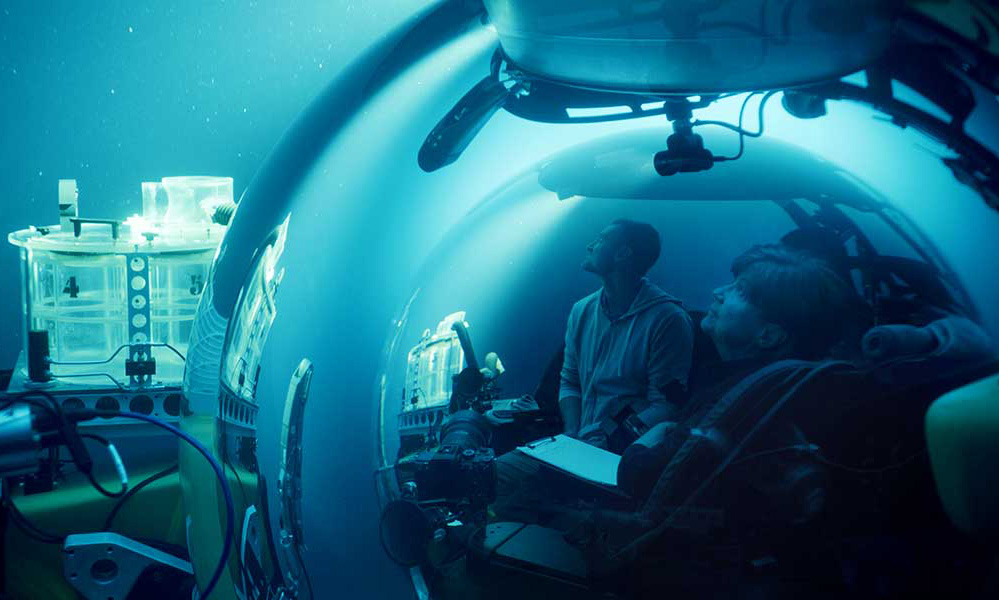
Yeah, one of the very first questions I ever asked Edie was what does it feel like to go down in a submersible, turn out your lights and see this magical world of bioluminescence? She described it so beautifully then, but over the years, but nothing could fully prepare us for what it feels like to really go down first hand and there’s been very little documentation of this part of our planet because it is so extraordinarily difficult and often nearly impossible to document. When we had this opportunity to go on the mission with Edie, we went down in two submersibles. One was the science sub, which was Edie, Mason Robinson, and the submersible pilot. And the second sub was the media sub where we had myself, Sebastian, our incredible submersible operator Mario, and a submersible pilot and it was so remarkable when we went down – to dive down in a submersible felt like going into a spaceship and traveling to another world, yet it’s our world.
It was really transformative and changed my whole perspective of how I see life on the planet. When I was a kid, I was so fascinated by the ocean, but also by space. I have loved hearing interviews with astronauts who come back and speak about the overview effect and what it feels like to see how small and interconnected our planet is from space. And to dive down in a submersible, we landed down on the seafloor at 3,300 feet and it really gave me the feeling of this interview effect, really seeing the scale of our ocean planet and how small we are in this vast space. that we, as Edie says in the film, have only visited .005 percent of. We know so little of what is down there and yet within that small percentage of what we know is there, Edie has documented giant squid and numerous other discoveries, so it really transformed the way that I think about how much wonder and magic exists on our planet that we just haven’t even known how to look for yet.
The other deep dive you take is nearly as impressive when Edie obviously has all this footage from past expeditions. What was it like to find what was important to tell this story?
Yes, there is so much material to draw from. Edie’s been documenting her dives and discoveries and what she’s witnessed in the deep sea since the very beginning, so we had this treasure trove of remarkable archives from her entire life. And this easily could have been a completely archival film. of the incredible adventures that she’s had. But from the moment that I started talking with her and hearing her descriptions of what it feels like to dive into the deep and to go into the Twilight Zone and how remarkable and life-changing and eye-opening that is, I realized we really needed to find a way to document that in the film in a way that feels really immersive so that people can finally be able to experience that. It’s really a rare world to see, so that become became a mission really early on – to bring people into this undersea world right alongside of Edie. I just feel so remarkably fortunate and grateful that we were able to do that through the film. Once we did, I was really drawn to looking at the story in this liminal way – how even as she embarks on these expeditions, she’s constantly learning from and carrying lessons from her past, as we all are, and I really wanted to be able to show that lifelong quest and perseverance that she’s had to bring her to this discovery of the flashback phenomenon now.
Was there anything that took this in a direction you didn’t expect or change your ideas about what the story was?
From early on, I had this dream to be able to document Edie on a submersible dive and to experience that alongside of her, but it was not guaranteed. We faced so many obstacles and challenges to being able to find an opportunity together to do this. It’s so extraordinarily rare to be able to venture into the depths of our oceans. They say that more people have been to space than to the deepest parts of our deep sea world, and we had to practice these themes of perseverance that Edie has lived throughout her life to just keep looking for ways to tell that story. We were really fortunate that our partners at Ocean X came on to support Edie’s expedition and that we were able to go and document with them, but even while we were on the ship and preparing to dive at each step of the way, we still had no idea if we would be able to document and capture the flashback. It’s something that Edie has witnessed throughout her life, but has been such an enormous challenge to document because the conditions are so nearly impossible. Even once we were finally there in the submersibles, being launched off of the ship and going down the 3300 feet through the different zones of the ocean, there was still this question of would we be able to capture this?
On our first dive, we did not succeed. And we had three dives total. Two dives ended up being trial dives and nothing was working in terms of being able to capture this phenomenon. We weren’t seeing it, the cameras weren’t working, the low light cameras were proving to be so incredibly challenging. But on that third drive, we captured everything that is shown in the film. So that was just following an Edie’s spirit of persistence and perseverance. Even when there’s moments that feel like you hit a roadblock, just always keep looking for the next illusion and the next step to take and that led us to being able to to document this alongside with Edie.
What’s it been like to share with audiences so far?
Looking at Edie’s life, she has been this pioneer in changing the way we see our ocean world and has lived this lifelong mission to do so, so to be able to take all of those incredible chapters of her life and weave the story together with her and really amplify the wonders that she’s discovered and be able to share them with others has just been incredible, The goal for me with this film has really been to inspire hope and through that hope inspire action because I think we are at such a critical point in our planet. Our oceans are changing so rapidly. We are facing the climate crisis and so many threats to science and scientific funding and research, it’s a really challenging time, to put it mildly. But when I look at Edie and her story, I see so much wonder to keep fighting for and that there is so much more to be discovered on this pale blue dot that we all share that we can’t even begin to imagine. That gives me a lot of hope. So as we share this with audiences, it really energizes me and gives me the motivation to keep going and finding next steps for solutions and I hope that’s the same for audiences. And I also hope to inspire audiences to see the power of perseverance and curiosity and that even in the darkest times and the darkest places that there is so much light to be discovered.
“A Life Illuminated” opens on July 24th in New York at the DCTV Firehouse and will screen in Los Angeles on July 28th at the Laemmle Glendale and July 29th at the Monica Film Center and in San Francisco on August 2nd at the Roxie Theater.