



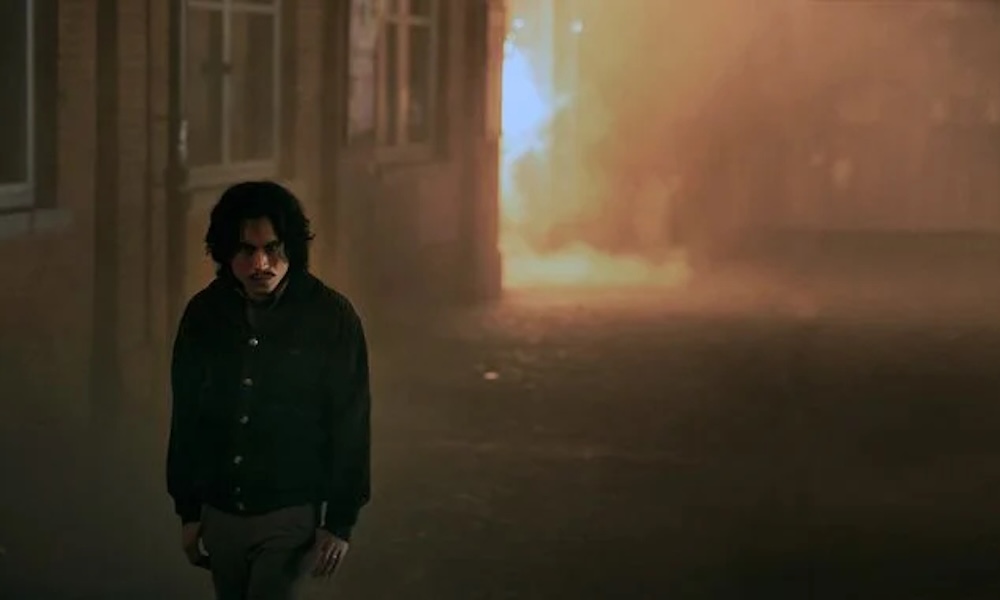

The alarm in the factory where Aldo Marín (Camilo Arancibia) finds work in Turin in “Il Cileno (The Chilean)” isn’t an unfamiliar sound, having fled his native country as the Pinochet dictatorship took hold in 1976 and sirens could regularly be heard in the streets, warning of a 6 pm curfew or police attending to some more unsavory business. While others exit the building, Marín is drawn towards the basement where he finds a bundle of dynamite that he’s able to diffuse before the timer attach goes off — the alarm presumably set off to reduce casualties — getting to feel useful in a country where he doesn’t really know the language and knows relatively few people, having the experience of working with explosives when he previously made a living in the copper mines.
Marín doesn’t have the usual concerns about finding his footing as an immigrant in Sergio Castro San Martín’s ruminative, well-mounted thriller, having no trouble at all securing work in turbulent times as he leaves political unrest in one country for another where there’s plenty going on underneath the surface. More than an arresting image, it’s fitting that Castro San Martin introduces Italy after Marín and his friend Chapa (Andrew Bargsted) simply by turning the camera upside down looking up at the same sky and the two quickly are hired and even given room and board by a factory owner whose workers are threatened to walk off the job without higher pay. Marin would surely support them if he was more familiar with the situation when his activism in Chile made him persona non grata, but he appreciates a steady job as he tries to reconnect with his wife and three-month old son who he had to leave behind and after the incident with the bomb, he comes to the attention of Azione Rivoluzionaria, a far-left group that would like him to put them together rather than disarm them.
The film is a little more reckless than Marin is with handling hazardous material for the anarchists when justifying how he accepts their invitation – Marin never seems to realize that he’s momentarily abducted by the same group that ultimately offers him a job, though it could be argued the fear they put into him pushes him closer towards them, and his initial agreement to make bombs he’ll never be involved in setting off personally seems hopelessly naive. (He also sometimes seems to know far more Italian at times than he does at others when the story calls for it.) However, nitpicking aside, it’s a means to an interesting end as the more bad news Marín receives from Chile – that is, when he’s able to even get a call through — the more he is emboldened to help the radicals Enrico (Lorenzo Richelmy) and Luciana (Sara Serraiocco) with their plans to upset the status quo, feeling helpless towards those he knows intimately at home and having some power to perhaps propel change elsewhere.
However, violence isn’t seen as an effective political tool, usually harming those that try their best to stay as far away from it as they can the most, and while that may not be the most original observation, Castro San Martín makes an unusual and compelling case against detachment in all senses as the events in one country ripple to another and Marín’s mind never leaves Chile even if increasingly it appears as if any trace of his life there is erased, left to wander around in exile in Italy where he can never register much of a presence, except for what he can offer as an explosives expert. In Turin, he marvels at the the buildings that are yellow when in Chile such a color would indicate some political neutrality, but it’s a luxury that he can’t afford and he can be seen in parallel both literally and figuratively with Luciana, his primary contact with Azione Rivoluzionaria who is more comfortably able to live a double life, helping the underground as she works as a professor until her actions with regards to a student seeking an abortion come back to haunt her. The actual bombs may not ultimately make much of a difference in “The Chilean,” but the potential blast radius of just the thought of them is wide and unforgiving.
“The Chilean” does not yet have U.S. distribution.