

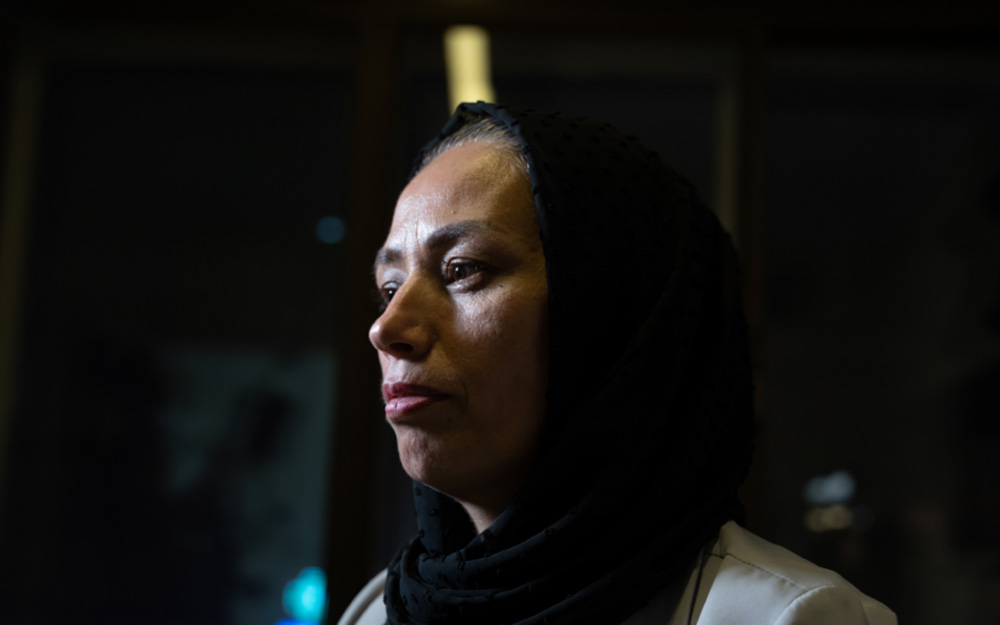

It’s bound to take one aback how easily Tahereh is able to describe the murder of her husband in “An Eye for an Eye” as she awaits a decision on whether she will face a death penalty herself in Iran, having tired not only of Hossein, who she married in her teens unaware that he’d develop a brutal addiction to drugs that would make him hopelessly abusive towards her and the three children they’d have together, but of a legal system that insists there’s no reason for a divorce. After serving 14 years in prison for the crime, Tahereh is released back into public with a great caveat, awaiting the decision of Hossein’s brother Bashir who essentially has her life in his hands when he can decide to press for an execution or not, an almost certainty should he decide she deserves further punishment.
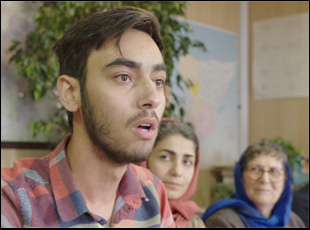
Director Tanaz Eshaghian has always managed to get her camera into places you’d never think would be possible in the Middle East, from her debut feature “Be Like Others” about transgender women in Iran to “Love Crimes of Kabul,” which relayed the horrors inside a women’s prison in Afghanistan, and her latest in partnership with co-director Farzad Jafari is no exception as she is able to catch the unfolding drama of the legal proceedings against Tahereh as she remains in limbo even after completing her jail time. While her grown children are fully supportive of her recalling the atmosphere of fear that their father created, Tahereh’s former in-laws are torn on retribution as Bashir offers some form of compromise in asking for a monetary settlement that Tahereh clearly can’t easily afford yet it is the start of a grim negotiation, mediated in part by Ms. Jabarzadegan, an anti-death penalty advocate. Any progress toward a resolution, however, is thrown into jeopardy by Bashir’s sudden passing, leading Tahereh to plead for her life to two much less sympathetic relatives of Hossein in Bashir’s son and his mother and an already surreal situation in which a dollar amount is being placed on a life is made even more so.
Although Tahereh takes full responsibility for the murder, it hardly looks like she should be alone in taking blame for the circumstances everyone involved finds themselves in as Hossein’s abusive streak was ignored for years and made permissible by patriarchal attitudes embedded into the law and following the single case, Eshaghian and Jafari are able to shed light on the obstacles women face on a regular basis in a legal system set up so much in favor of men. As Esghanian explains, it was a film that required her to stay at a remove herself, entrusting Jafari to capture the action on the ground as she directs from afar and with the film now available to audiences all over the U.S. on the streaming service Jolt in addition to a theatrical run in Los Angeles following its premiere at Tribeca last year, she spoke about how she was once again able to beat the odds herself to bring a story like this to a wide international audience.
 Since we haven’t spoken before, it’s been interesting to see you tell stories from inside Iran when you didn’t grow up there yourself, but in New York. Was it always important to eventually make films about the country?
It’s a complicated question because this is the only time I did not physically show up [to film in [Iran], this time being uneasy and also being older, I noticed during COVID that people were essentially directing remotely and I [thought that was an] interesting challenge. Let’s try it. And I tried it. I found someone who could do everything on the ground and I asked him to be the co-director and it worked.
I was looking to do a new film and I called my friend who at that time was living in Tehran and she mentioned a few stories to me, [including that] this friend of mine has access to this incredible human rights, anti-execution activist. I [thought], “Oh, that’s interesting and I spoke with her and she mentioned her cases that she’s doing and then I was like, “Oh, this is an incredible story.”
Was the focus always going to be on one individual case or did you ever think about profiling her?
I don’t overly complicate. I feel like I trust my instincts, whether it was with the film “Be Like Others” in Iran that I did myself [where] you show up and you’re like, “This is going to be great.” You feel it right away. There is some sense of who would be open to it. It’s a two-way road. In Afghanistan, I did the film in the prison and you just get a sense of who’s going to be open to it and honestly stories like this are so incredibly dramatic already that the [individual] character and the personality does matter, but frankly up to a point, because it’s already incredible. And through the activist, you’re going into all these spaces.
It was incredible to see how all parties involved are represented on screen. What was it like to figure out the logistics of this with you being abroad during filming and getting all that you needed?
Farzad, who’s on the ground, is a genius at getting access. He’s very talented with convincing people and you have a situation where I think that both sides probably thought it through and realized it would be to their benefit to be on camera. And when you’re there yourself and you could really be on the ground, it’s ideal. I probably didn’t get about 20 or 30 percent of what I could have gotten, but in terms of the intellectual experience and how I look at footage and then decide what scenes go in and communicate, which is really where you make a documentary, [the process] doesn’t really change. When you’re doing that, you’re just a little bit more a little more frustrated and a little more removed than you’d like to be, but ideally the cultural gems that you’re looking for as a director, you’re doing that when you’re reviewing the footage.
What was it like to figure out the structure for this? It moves chronologically as the case progresses, but the negotiations over the end result are in parallel to discovering the complications of the case.
This was one of the longest edits I’ve ever done with multiple editors and one of the reasons was the structure was more complicated. Unlike the previous films I made, I decided to not just do pure verite. First there’s the actual ticking clock, which is that she’s on death row and [you wonder] is the husband’s family going to give her forgiveness for a certain amount of money or are they going to execute? That was the very simple narrative we had, but it just didn’t feel like it was enough. So we decided to bring in this other element of who really did this. We went back and forth in time with the whole whodunit [question] like did she really kill her husband or was there a boyfriend? And that was all in the past. And to get that, there were a lot of sit-down interviews we [needed to] bring in and out of the structure and there are moments where you don’t want to lose the suspense element of will they raise the money [to appease the deceased’s family], so you can tangent just enough to go into the curiosity of, wait a minute, did she really do it? But then you have to go back to your ticking clock. so that was a bit hard. What you need for that is a is a really great editor and a director that just does not let it go, like, “No, that’s too TV. Nope.”
It certainly didn’t feel that way. Was there anything that changed your ideas of what this was as you were in the middle of it?
When Bashir, one of our main characters and the brother of the murdered husband goes and sits down with the human rights activist and is negotiating a “fair price for her life” to be let go, we’re filming and then I get a call that Bashir has dropped dead. And my first thought was, “Oh, whoa. What do we do now?” And slowly I started to ask [around] and they’re like, “Well, probably his son will take over. There was some discussion where I got the inkling that the son is going to be even more of a dark figure [than his father]. Like he really doesn’t care [about the wife’s fate], so I [thought], “Wow, this could actually be a really interesting twist” in that at least the father had some emotional connection to his brother and the brother’s kids, but then the son comes and he tells you “I don’t feel anything. I just want my money.” At first, I thought our film is dead [with Bashir’s passing], and then I realized we’re just going to have to incorporate this. My fear, as always, was can an audience take in so many new characters? I [thought], I have the person who has the issue, I have the person she needs to have the conflict with, [can we have] a new character, but it turned out you can do that.
It is all the more compelling because of it. What’s it been like to share the film with audiences so far?
It’s been great. You can really see when you’re with you’re at a Q & A afterwards, the audience really feels like they were able to see a slice of the world and of life that they never thought they’d see and didn’t know it existed. That’s such a like it’s an incredible moment because they’re so curious and so moved by it and you see that they’re going to be thinking about it. That’s really satisfying to to know that you have managed to enter the psyche of other people in this way.
“An Eye for an Eye” opens on August 14th in Los Angeles at the Laemmle Royal and will be available to stream on Jolt.film.