



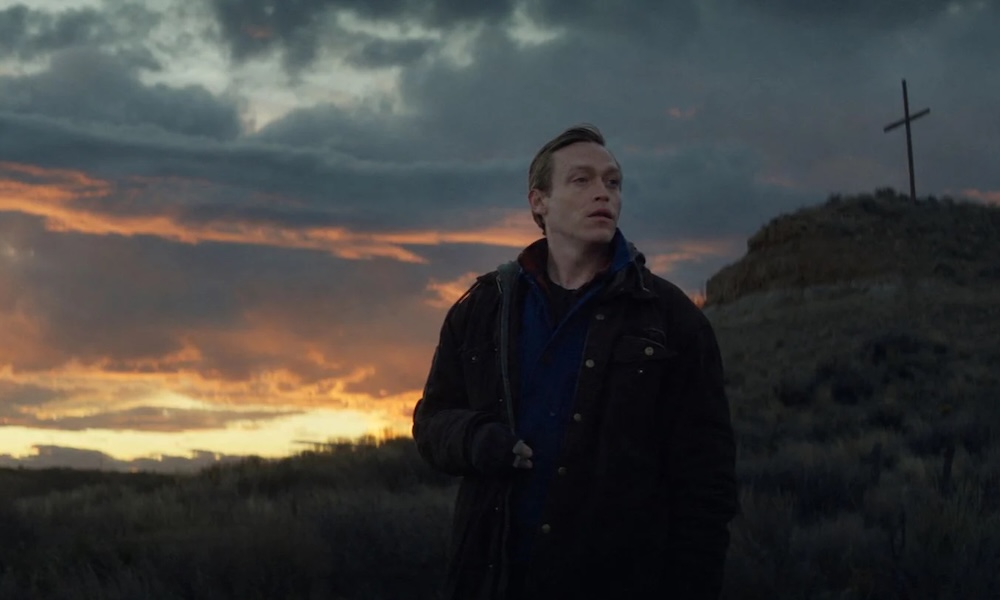

It’s a sign of things to come in “Down the Arm of God” that those most likely to observe the tenets of Christianity are the least likely to show it as Deb, a barkeep at a den of sin known as the Road House is the one who welcomes Nick (Caleb Landry Jones) into a small town outside of Amarillo, Texas with open arms, telling the young pastor, “This fucking town could use some God,” shortly before slinging some shots to those who have probably been a little overserved already. Nick isn’t one to judge, a display of his own faith, but he eventually comes to feel more at home there than at the church he’s come to run where the clergy gradually grows disenchanted with his desire to provide shelter for the homeless during a brutal winter, perhaps authentically concerned for the safety of their children whom they don’t want around strangers that have drifted into their community but simply scared of ceding any territory to them.
Jones and director Peter Brunner, who previously collaborated on the 2018 drama “To The Night” and purportedly have been plotting “Down the Arm of God” ever since, with the “Antiviral” star visiting homeless encampments over the course of years in his native Texas, deliver an unforgiving drama that has only become more resonant than when it was first conceived, though like its tortured central character, the more it displays a righteous anger, the more other issues have a way of rising to the surface. However, there is plenty of nuance in how Brunner presents the escalation of distrust that grows between Nick and his flock, a God-fearing community that is initially charmed by the pastor’s idea for a potluck when he notices a group of tents in a field on the outskirts of town. He is actually less welcome amongst the unhoused, who begrudgingly accept an invite to come to the church likely having been burned before, and from the sight of the first meal where the churchgoers are reluctant to join them at the table, it is clear some more lasting arrangement will take time, if not be impossible.
The two clearly have one thing in common, but irrational fear of one another isn’t anything that Nick can build a bridge on and he fruitlessly attempts to cite scripture and appeal to his parishioners’ better nature as reason to find a place for the homeless to stay as an arctic blizzard the likes of which haven’t been seen in the Southwest in decades. Jones, who has always projected a hint of danger even in his most straitlaced roles – and here, he literally asks a barber to give him a John Wayne cut before heading into town – is effective as the weary reverend prone to slipping up with a curse word here or some hint of a darker past there, casually joking to a child who taught himself to play the piano on YouTube that “you can learn to make a bomb on there too.” As much as the religious townspeople can be seen not actually adhering to the teachings of Christ in their rejection of the homeless, doubt can set in that Nick is an ideal messenger as he digs in, opening up the church as a home when the high school gym is out of the question, and unable to show the compromise himself he’s hoping to foster.
If Nick tries to take on too much too fast, as admirable as it is to provide shelter when it’s most needed, the film can feel a bit the same way by its third act when both guns and racism enter the mix, each well worth acknowledging as contributing to the combustible situation at hand, but so easily able to push things over the edge. A child holding a “White Lives Matter” sign outside the church as protests start to occur may be both something Brunner and Jones saw in their research and at the same time, putting a bit too much of a punctuation mark on what they’re trying to achieve. Yet the atmosphere of distrust is strikingly evoked with all of the various pressure points Nick needs to be mindful of and the education he receives on his own as his good intentions count for something in terms of gaining goodwill, but in terms of actually providing the specific support people need, he has a lot to learn. Notably, Brunner does something relatively rare in considering the homeless epidemic without leaning on pity to elicit an emotional response, but rather frustration that obvious measures can’t be taken to tackle the issue out of misplaced pride. While Nick can often overlook the flaws in others to see the good, “Down By the Arm of God” may require a little bit of the same, but the result is mighty.
“Down the Arm of God” does not yet have U.S. distribution.