


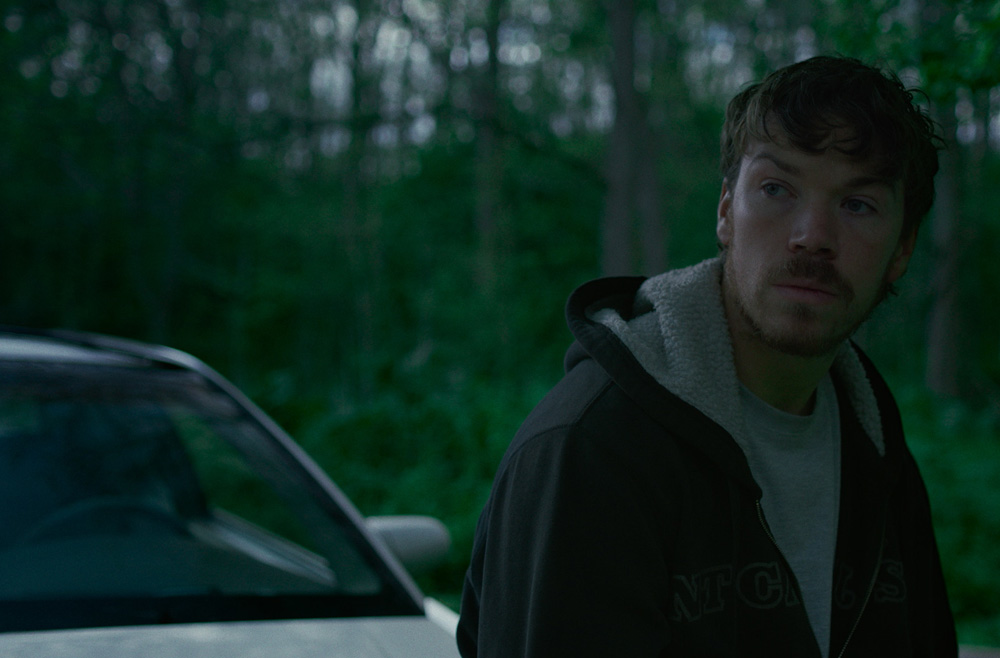

Adam Meeks wanted to shoot “Union County” in the spring when he knew flowers were in bloom in Bellfontaine, Ohio, a town of around 14,000 that often is passed by those on their way to Columbus. Like so many other areas in the Rust Belt, beautiful architecture remains from the more prosperous times when jobs around the railroad industry were plentiful, but the houses are filled with despair set in as business has been slow to return and many fall prey to addiction. Meeks wasn’t going to avoid the truth of what happened in his debut feature, but being honest meant presenting it as a place where rejuvenation was possible as well.
“So much of the movie and the way that we made it was in reaction to the fact that people aren’t used to seeing the Midwest in a way that is beautiful,” says Meeks. “Oftentimes, it’s more like a bleak, barren landscape in a post-industrial place and that was just not true to the way that we had seen the landscapes, so I wanted to look at a community that I felt was misunderstood and see if we could change that narrative a little bit and by extension also look at a landscape in a place that I felt was misunderstood and see if we can help change that too.”
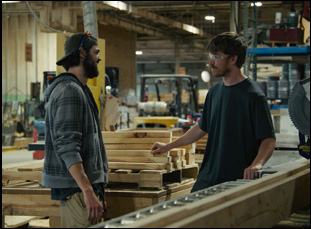
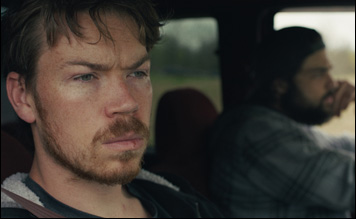
To do so, Meeks took a relatively radical approach to his invigorating drama, involving two of the most sought-after rising stars in Hollywood in Will Poulter and Noah Centineo to pair as brothers Cody and Jack Parsons, brothers who both find themselves in a drug rehabilitation program as they attempt to get their lives on track. When the two are seen in court at the start of “Union County,” they are brought before a real judge (Kevin P. Braig) and have a real counselor (Annette Deao) speak up on their characters’ behalf as part of an extraordinary program in the region that was spearheaded by Deao years ago where addiction isn’t treated as if it were a criminal matter but something that requires a more compassionate response, leading to a court where accountability is not only demanded by the judge but spread out amongst all those who arrive in need of help and become invested in one another’s sobriety.
Poulter and Centineo are frequently surrounded by real-life members of the program who can inspire as they’re actively seen reclaiming their lives as Meeks folds in a fictional narrative about the brothers trying to keep on the straight and narrow, having entirely different personalities despite a shared bloodline. While Cody is introverted and dedicated to getting clean, the far more boisterous Jack can’t help but get into trouble, pushing both himself and his brother closer to the edge of the wagon, much to the disappointment of their sister (Emily Meade). They may be young, yet it feels as if time may be running out to turn things around and while Meeks shows how much a community can create a foundation for someone trying to find their footing, it also shows both how difficult and necessary it is for the individual to find the strength within themselves to carry on.
Where the film could be dire given its subject, it becomes buoyant when Meeks captures something authentic and vital and Poulter and Centineo so seamlessly blend into their surroundings with understated performances of remarkable power. “Union County” was apt to bring audiences to their feet when it premiered at the Sundance Film Festival earlier this year and in recent weeks has had a rousing reception in its home state where Meeks made a point of visiting every county he could with the film ahead of a national release. With the film arriving in New York this week and headed west after, the director spoke about the unique hybrid undertaking that allowed him to bring out what he knew was special in the area he grew up in to a wider population, being lifted up by the community himself as a filmmaker as the characters in the film are and creating a film around an active court.
 I can remember hearing from Sundance how central a figure Annette Deao, who runs the court program and actually shows up in the film as one of the main characters, was to the making of this in the first place. How did you come to meet her?
I had been spending time in Ohio where I’m from originally and where a lot of my extended family still is. I had been connected with a previous drug court judge through my uncle and I had expressed my interest in what he was doing and I was invited by that judge to sit in on a meeting. I was pretty blown away by what I experienced in the room that day. I started to wonder how I could translate that feeling of this community experience and the hope and humanity here to the screen. Then the day that I was there, Annette was out of town that week because I did not meet her directly until I was spontaneously at a folk music concert in the area and I was telling somebody what I was up to and they were like, “Oh, so you you must be working with Annette.” And I [said], “Who’s Annette?” And they [said], “That woman over there. You’re going to be really glad you talked to her.”
So I went over and introduced myself and we became fast friends. Once I started to tell [Annette] about the version of the story I wanted to tell and what the intentions were and what the process would be, she just got so excited by it. She’s such a champion of storytelling and the arts — she studied music and theater before she ran a drug court — and she recognized the potential for some kind of impact through the story that we were telling. It started with a short that we made together in 2019, premiered in 2020. And then it’s just been an ongoing friendship and creative partnership. She’s become family to me now and after working with her on the short, not only did she open so many doors and helped me form so many relationships and be a personal backbone, but she was also really good as an actor in some of those scenes.
When I set out to write the feature, I thought I want to build a much larger role for her and she became the heart and soul of the movie in the same way that she is the heart and soul of her program. Part of that also is that she has this magical ability to not only be herself in the documentary context of the film, but also then you know sit down in a entirely fictionalized scene opposite Will Poulter and fully hold her own as well. So she became the nexus of the project and has been for the better part of the last decade.
 That touches on something I wondered about, which is that when you’re constructing a shoot alongside an active program like the court where you don’t want to interfere with what has to go on separate from the film, how did that affect the story you wanted to tell?
So much of the film and the way that it’s told did arise out of a process that we got to by thinking about all the things that we didn’t want to do and all the ways that this could go wrong. We did not want to be imposing or extractive or noncollaborative or present versions of the story that felt like they would be more reinforcing of a stigma instead of helping complicate it. So a lot of it was initially in reaction to “I don’t want to do that. That will send me down a different path, [so let’s go] this way instead.”
We built a lot of the film around the process that felt right. So much of that was I didn’t want to impose a set of dramatic expectations on a person or a group of people going through this program in real time because the last thing they need while they’re in the early stages of recovery is a camera crew following them around and looking for the kind of setback that might help the dramatic structure. It was much more about “Okay, maybe I can write a fictional character that will be performed by an actor that can weave us through this community in these spaces and the dramatic needs of the film can fall on that actor’s shoulders — or a couple of actors in our case. And then when we’re in in the room and in these spaces with the community, we would set it up in a way that did not ask anybody to perform anything scripted or take any direction from me.
It was just about us having permission and trust to be in the room with a couple of cameras and film their interactions with the judge, so the task then fell on Will and Noah to embody their characters in such a way that they could step up to the podium right after somebody who’s really in the program and it would feel hopefully as grounded in reality all the way through as possible. But it was always voluntary with all the participants. That was true week to week. Every Monday afternoon is a adult recovery court meeting and we would be in there with Will and Noah for four consecutive Mondays and without them for three previous just filming in a documentary context. At each time, we would say raise your hand if you don’t want to be filmed today and then we would just point the camera away and turn it off. And then the folks who were willing, we would film them, but it was optional and voluntary all the way through for everyone.
Aesthetically, it doesn’t appear you had to make any sacrifices either to the style you wanted for the entire film in order to get the reality on screen. What was it like to develop a visual style that could accommodate the practicalities you had to be mindful of?
My cinematographer Stefan Weinberger and I would meet in Ohio several times over the course of many years with the camera and we got to know folks in the community, but he also developed his own personal relationship to seeing the place and point of view. That also let us really think about the language of the movie over time and really chew on stuff. A lot of what we landed on was something that we started to figure out in the short — that for us, an effective way of blending the fiction and the nonfiction was to film the fiction in a way that felt more like a documentary observational approach as well. In a documentary, you can’t necessarily anticipate actions. You have to observe and follow. We tried to observe our fictional moments as well for the most part. That became a part of the editing approach as well.
Then there were some things to your point about not compromising, like when we first set up our cameras in the courtroom, we were in the corners of the room, trying to really stay out of the way and it actually felt more voyeuristic than when we ultimately decided to put the cameras right in front of the podium and in between their interaction with the judge. That took a while to find. And fortunately we had the trust and buy-in from the court and from the judge and to my surprise, nobody ever really spiked the camera or had too much trouble with the camera being right in front of them. It actually became something that felt more direct and dignifying to film it that way. A lot of those things were a result of having time to move through a process and land on the right thing, and so much of this movie was just a lesson in how there’s no substitute for a lot of time spent in the lead up to something and making decisions that don’t feel right so that you can then land on the right one.
 From what I understand, Will and Noah also had an unusual amount of time to prepare for a shoot like this. What was it like giving that kind of time to be around the community ahead of the shoot?
Yeah, Will and Noah came in about six months out for a couple days and met a bunch of people and got their feet under them in the area, then they came out for about a month before we started production and so much of that was just laying the groundwork for when we were up and running in the courtroom, the participants had gotten to know Cody and Jack a little bit and were not were not focused on the guy from “Guardians of the Galaxy” being in their courtroom. I think I watched Will and Noah in their own ways and in their own processes start day by day, week by week, settle more into their characters. They had time to really fully inhabit their [characters] — that was the voice, physicality and wardrobe. It was just really being able to be thorough and specific and take their time settling into that and watching that happen and blending between the fiction and the nonfiction in the lead up meant that when we were filming, we were really able to have very little of a dividing line between when we were spending time in the community and when we were filming in the community.
All of the credit here belongs to Will and Noah’s remarkable performances and their commitment to a process too, but what it did in real time was help us recognize that we could lean really far in the direction of a documentary process because Will and Noah were so incorporated into the fold and I realized at a certain point, we could go to this graduation at the park and we can have our actors [there] and Elise Kubler, who plays Anna, she could also come in and just be an attendee of the graduation. That was something that [the actors] allowed for and we were shifting more and more into that mode as we were doing it. This prep process is pretty unheard of with actorsof their caliber to make the time and to want to buy into a process like that, but they were so willing and eager and in many stages of the process actually initiated a lot of that stuff. I can’t imagine having done it with anybody else, both for the ways that they embody their characters, but also just for the process of making it.
 Everything that I’ve heard about the film has made it sound like the community really embraced the production. What was it like to bring the finished product home after Sundance?
I think there’s a lot of pride in in the movie and there should be, because it really was a community-made thing. When we went back for the hometown premiere, there’s this old single-screen theater that’s directly across the street from the courthouse where we filmed and there were three or four folks who are in the film who had been in the program when we filmed who were graduating at that same time, so we got to hold their graduation at the theater before playing the movie. Will [Poulter] flew in for literally six hours out of way in the middle of filming a Netflix show to come and be there for it and see everybody and a lot of us who were there for a couple more days went out to Annette’s farm for dinner. She and her husband hosted us and It continues to be a thing that I hope everyone who touched it can feel a certain amount of pride in. I hope that like everything that I make can invite that kind of community effort and sense of pride from everybody who made it because I knew this theoretically going into making my first feature, but I really saw it very quickly — the real resonance of [a movie] taking a village. This was always intended to be a movie made about a community by a community and there’s been there’s really been that feeling since since we finished the movie whenever we’re back in the area. I’m just so proud of everybody.
“Union County” is now playing across Ohio at the Gateway Film Center in Columbus, the Nightlight in Akron, the Cleveland Cinematheque and the Neon in Dayton and the Esquire Theatre in Cincinnati and opens on August 14th in New York at the IFC Center, Los Angeles at the Nuart Theater, San Diego at the Digital Gym Cinema, San Francisco at the Roxie Theater, Atlanta at the Tara Theatre, Cleveland Heights at the Cedar Lee and Omaha at Film Streams. A full list of theaters and dates is here.