

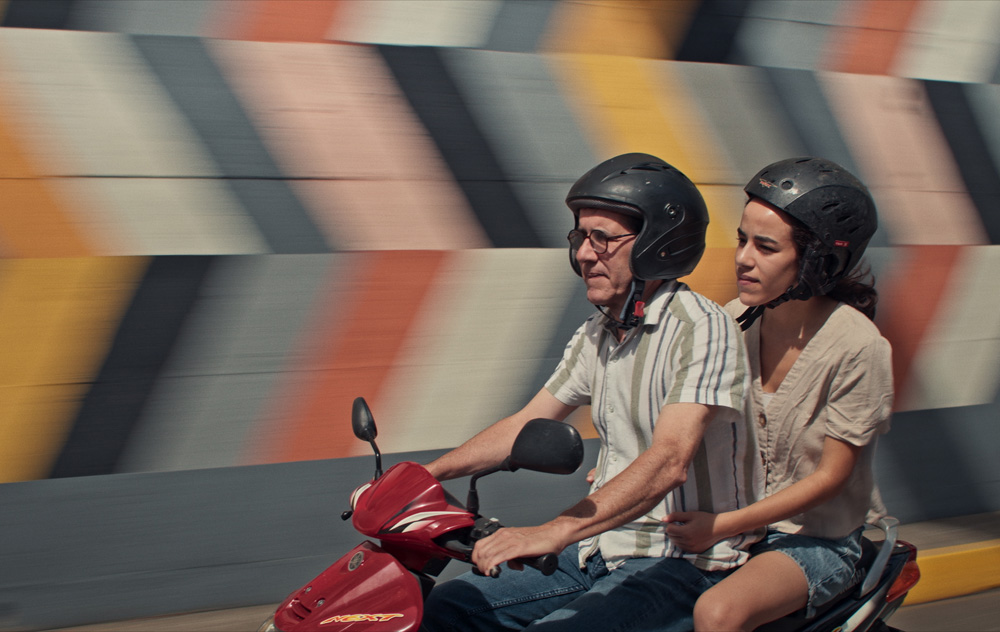

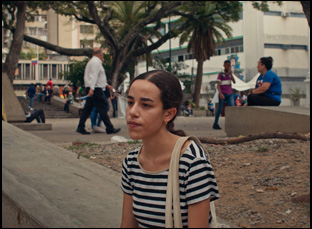
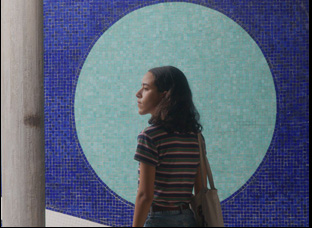
When Ena (Ena Alvarado) arrives back home in Caracas in “Lost Chapters,” she’s left a note by her father Ignacio (Ignacio Alvarado) that he’s at the bookstore, though you suspect she probably already knew that. Only days after returning home, she’s back to help sorting out the various novels and nonfiction that has accumulated in her absence as she did a few years earlier as a teen, an additional responsibility on top of looking after her grandmother (Adela Rodríguez) whose Alzheimer’s has worsened since she was last around, yet still remains the unquestioned head of the household. It wouldn’t seem much like a summer vacation for the young woman, but although the city itself hasn’t changed much, it still seems like the world around her has as she falls back into a routine that now feels a bit foreign when she comes back to it with fresh eyes.
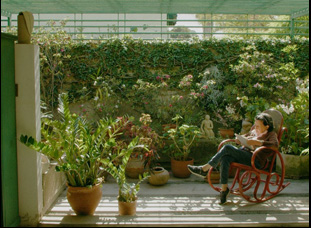
The sensation isn’t hers alone in Lorena Alvarado’s captivating debut feature, which unlike Ena feels little responsibility to separate fact from fiction. Having her real-life family members as her cast, Alvarado finds a fascinating approach to consider history’s place in the present as Ena has to care for an elder whose memory may increasingly fail her yet can seem happy enough not to be reminded if the past all the time while accompanying Ignacio on what seems to be a Quixoitic quest to track down a rare but crucial national text for his collection, ultimately hoping to open a Museum of Venezuelan Literature. The film has the airy quality of the season it’s set in with casually beautiful compositions within the family home, buffered by plantlife everywhere, and a gentle narrative where Alvarado never feels obligated to tie up loose ends, yet it feels weighty nonetheless when Ena carries so much on her shoulders, ultimately making the decision about what to take with her into the future and to leave behind as she can see the ways it can be important as well become inhibiting, reflecting a choice that her entire generation is confronted with.
After traveling the world for the past two years where it became a favorite at FIDMarseille, Göteborg and New Directors/New Films, “Lost Chapters” is now beginning its stateside theatrical run and Alvarado recently took the time to talk about how what started out as a more traditional documentary became more of a hybrid, why she was equally as interested in turning the camera towards the objects around the house as her main subjects and the careful work of crafting such a delicate and persistent drama.
 From what I understand, you were planning on shooting a more traditional documentary before deciding on inserting some fictional elements such as the search for the rare book. How did this take shape?
It started as a more classic documentary about my father’s bookstore, but that felt very boring and I had all these different ideas and fantasies and for fun, I started exploring these little fictional vignettes with my grandmother. Then I wanted to include myself in the film, but I didn’t know how to do it and I realized that I could do it through my sister. That was the final component that made me realize, “I have all these little building blocks and pieces to make a fictional film.” When I made that decision, I started writing a script without any dialogue and we started shooting and everything blurred together after that.
I tried to do some scenes that were very scripted and it did not work at all because they’re non-actors, so that’s when I realized that I had to have a hybrid approach to making the film as well. I couldn’t really try to give them lines or do a conventional film production. I realized that if I was working with real people, I had to do things in a more human way, so I had to write scenes that were what the real person would do or would really say. So even though many of the scenes are fictional, the conversation is spontaneous and it was actually a very interesting approach to try to write scenarios where the person could really be themselves. That was the challenge of the writing and of filming as well, trying to create the circumstances for everything to feel very, very real, but for me to create the story that I wanted to tell. It was very easy because our relationship is very close and we really enjoy spending time together. My dad, my grandmother, my sister all felt like we were just hanging out, having a camera on the side.
Was the idea of memory central to it from the start?
Yes. Memory loss that was always at the core of the film because on the one hand, my grandmother has Alzheimer’s, so in a very literal sense she was losing her memory and then I had my father as this person that has been safeguarding books in a country that’s falling apart, recovering books of people that are emigrating and leaving the country. So he’s a guardian of other people’s books and memories. then the third pillar was that myself and my sister left the country a long time ago when we were young and were coming back, having this fragmented sense of identity and trying to collect the puzzle pieces of this family history that is lost or disappearing, so all the characters are exploring this theme of memory in a different sense. The experience of making the film created different threads that were exploring memory — the search for the book and this lost writer also connected with this theme. So things just started popping up that resonated with this core.
 It’s interesting to know you grew up around books because the film has a very literary quality about it in terms of feeling as if you’re dipping into the lives of your characters. Do you actually feel that was an influence on you rather than other films?
I love hearing that. I actually had not thought of that, but I think it makes a lot of sense that the film feels more like a book than like cinema in a way because I love the feeling of a long summer where you read one really long book and it stays with you for a very long time and you feel like you it becomes part of your life. I think the film has that quality, like you lived in this house for a little bit or you got to know these people for a little bit. The impulse in filmmaking is always for things to be faster or to make more sense or to not leave things very ambiguous. It’s a constant effort to try to go against that flow and try to make things like a little bit slower, a little bit more abstract, a little bit more subtle and with literature, you don’t have all those pressures, or maybe you do, but making things a little bit more poetic was definitely a big effort and desire in making the film.
How did you actually gravitate towards the camera in the first place?
I’ve always been the more artistic person in the family. My father, even though he’s a bookseller, he’s a scientist at his core. He actually nowadays doesn’t really read fiction. He only reads nonfiction and and he loves science. And in the family, I was always the artistic leaning person and I discovered cinema in my adolescence and really quickly realized that that’s the path that I wanted to pursue. But I think cinema really dialogues with literature. so growing up in a bookstore was obviously very fertile ground for me and I always had a good book or at least a good recommendation of a book from my dad that could accompany me in my life and in my own journey.
Something interesting I’ve heard you say is that you placed as much emphasis on B-roll as anything else you shot because it gives such a sense of place. What was it like to put that importance on it?
Yeah, it’s beautiful how you can say a lot through a shot of B roll. All the objects in the house speak a lot. They have voices and the house has this ghostly feeling [where there’s] this presence of people but through the objects. So all the B-roll of the house is really, really important to me. It really creates the color and the texture of the place and many of the objects are really quirky and beautiful and colorful, and I speak to my grandmother’s personality and also in certain points to Venezuelan culture.
What was it like putting this together in the edit when all of it’s so intricate?
I did an initial cut that had the same structure but didn’t really communicate an emotional charge — it had all of the plot points of the film, but I think a big breakthrough was honing into that emotion and creating that poetry and that pacing. There were many moments where I was very touched and moved by what we were filming and I felt, “Wow, this is really powerful,” these beautiful moments while we were filming that felt like these miracles, but it was still very intangible. The film was very much made in the editing room and it took me a while to really find the rhythm of the film and finding the music really helped with that. Once that rhythm was figured out, the film became effective.
 The music is a great part of this. What was it like to put a score on it?
A lot of those are classical pieces that I had in a playlist for a while and at some point, I put them in the edit and it really clicked for me. It was like, “Wow, this is the mood that I want to create.” Originally, there were temp tracks because I didn’t think it was possible to acquire the rights for these pieces, but then then when I actually did the the work, it was surprisingly easy because a lot of the composers are actually in the public domain since they’re older classical pieces. I was thrilled because at that point the the music was really indispensable for the film and if I had changed any of the pieces, it would have really made it fall apart.
What was it like to see it all come together and now being able to share it with audiences?
It’s been really special. I’m constantly surprised that other people find it moving. When I finished it, I felt like, “Oh, this is just going to be something that I have on my hard drive, and like my own little memento.” But I’ve been really shocked by many people connecting to the characters and really under understanding the subtleties and they don’t find it slow, all the things that I’ve worried about. I was concerned if the film was too Venezuelan that only Venezuelans would enjoy it, and I’ve again been really pleasantly surprised to show it around the world and for people that don’t speak Spanish, that don’t know anything about Venezuela, that are from completely different corners of the world, connecting and enjoying the film. It’s just really to me been a beautiful testament to how cinema is universal and it’s been really inspiring.
“Lost Chapters” opens on July 24th in New York at the IFC Center and will expand into additional cities in the months ahead.