



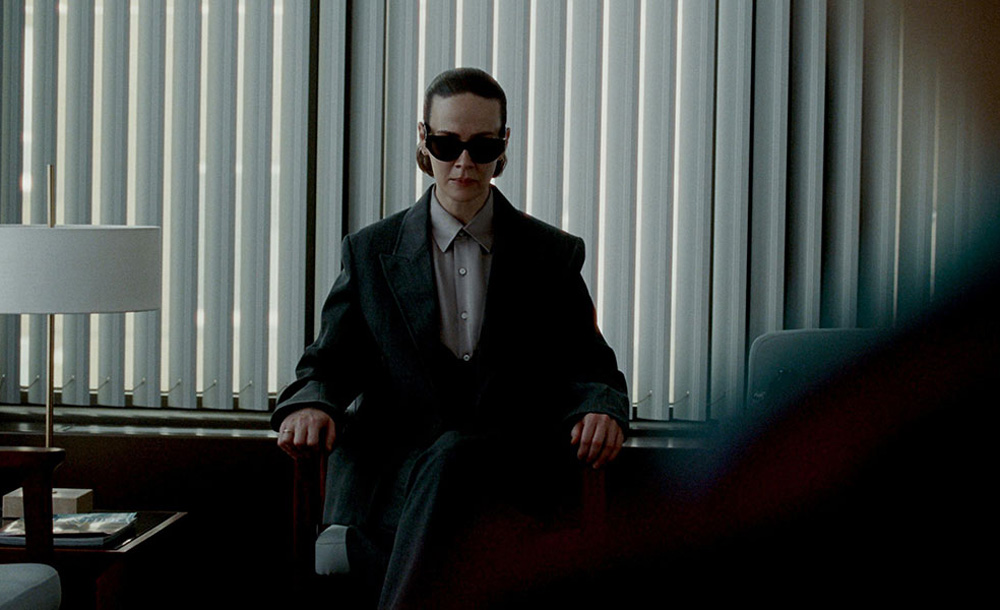

One of the very few things that’s left unspoken in “Closing Night,” where a pair of estranged sisters air out just about everything about their tortured past as one faces an Alzheimer’s diagnosis, is how Sandra (Sarah Paulson) can actually get a diagnosis in the first place. When the now-venerable actor of the stage and screen left home in her teens with no desire to look back, she set herself on a path that would involve health care and stability (which is odd to say for a career in the arts) that would elude her mother Diane (Dianne Wiest) and her sister April (Naomi Watts), who would stay behind in the suburbs working at a salon, proudly independent with no men in their lives besides April’s son Theo (Toby Wallace), but clearly not much money to go around. The particulars of why it’s been 30 years since Sandra and April last saw each other may need to be explained, but not the anger that’s built up when strangely Sandra may be dying, but cool and composed when she can be alerted to that fact while April suffers from crippling panic attacks that she wouldn’t have any wherewithal to seek a consultation about, essentially consigning one another to a death sentence when April may live longer of the two, but hardly having much of a life and is now expected to take care of her sister in her final days.
“Closing Night” opens in the middle of a rehearsal for “The Cherry Orchard,” which is a fitting introduction to Cody Fern’s impressive feature directorial debut when there’s a little bit of artifice that needs to be accepted in order to dig into what’s ultimately a juicy and sophisticated drama. It’s mostly a compliment to say that it feels as if Fern and co-writer (and fellow actor) Devon Bostick’s script might’ve been developed for the stage first with the kind of roles they’d want to sink their teeth into themselves, invested in setting up the characters before a story that can tumble like a house of cards and enlisting a pair of actors in Paulson and Watts who both are more than capable of playing to the rafters, giving performances that occasionally may register a little too intensely for the screen, yet generally elevate the film to the devastating family affair it becomes.
Ironically, the performance that may stand out the most is from Wallace, playing the quietest of the bunch when he has the least history as Theo, who lives in New York City with his girlfriend (Odessa A’Zion) and doesn’t need to trek far when Sandra initiates contact with her immediate family for the first time in decades with an invitation to her Broadway show. April is reluctant to accept, but makes the trip to see her son at the very least and learns just before the lights go down that he’s already made contact with Sandra while the sisters still haven’t spoken to one another. Although Theo could be key in bringing the two back into the same room together, his birth is revealed to have had a hand in why Sandra left in the first place as April felt abandoned.
The single mother feels cornered once more when shortly after she arrives in the city, Sandra suffers a seizure and is given an estimate of only a few months before the more dire effects of early on-set Alzheimer’s start to show themselves and appears to have no one else in her life to take care of her. The jittery April can barely look after herself – her anxiety leads her to tuck items into her purse in what is clearly the film’s most questionable element as a naked narrative device – but she can’t cut off Sandra as readily as Sandra did her, lacking a killer instinct that made one sister professionally successful but personally bereft while the other probably had an easier time living with her choices yet had a far harder road, and while Sandra can’t be medically cleared to perform Chekhov again, a reunion has more than enough of him in it to perhaps make do.
“Closing Night” goes for it as mercilessly as Sandra attacked her own professional pursuits, taking a compelling conflict and skillfully parsing out its details like breadcrumbs when simmering resentment can’t be contained any longer. The places where it can feel either a bit over the top or the plot mechanics a bit too obvious are forgivable when Fern digs deep, remaining very much in the moment of each scene while shrewdly tucking in allusions to the ripple effects that Sandra and April’s rift have had on both their mother, who is never shy about advising against having children, and Theo, who is about to become a father himself, as well as the socioeconomic gap that grew between them after parting and shaped their view of how to engage with one another. A classical score from Mathieu David Gagnon with carefully plucked strings and lightly tapped piano keys nicely accentuates just how many notes are being played at any time in the affecting drama, turning an early cacophony into a symphony that reveals Fern to be a promising and assured conductor.
“Closing Night” will screen again at the Toronto Film Festival on September 13th at Scotiabank at 2:45 pm.