



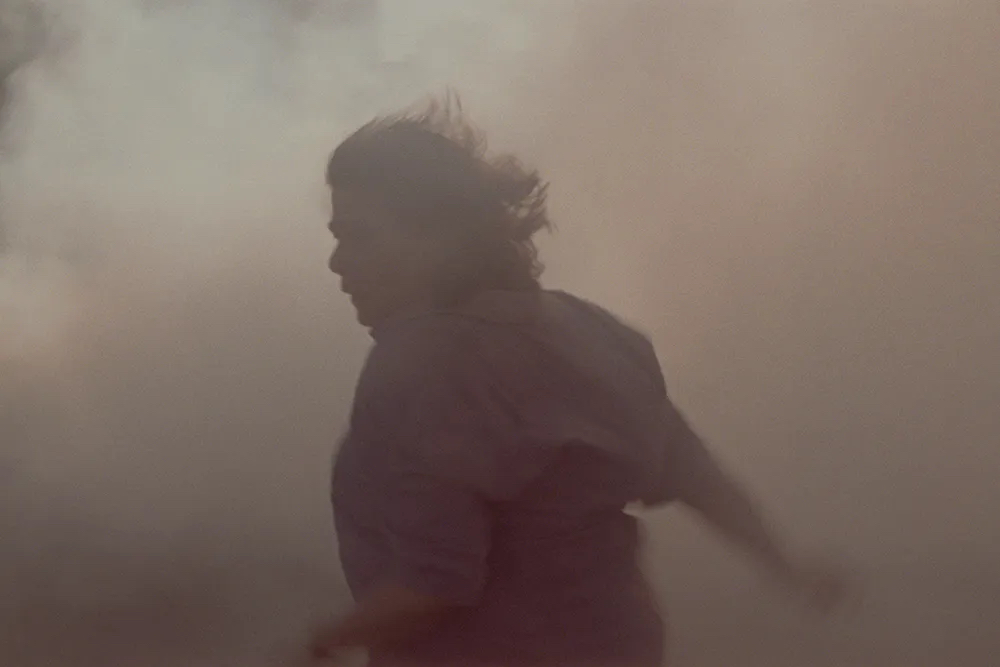

Not much is made in the moment in “Atonement” of what convinced Lou (Boyd Holbrook) to think about what he had done while serving a tour of duty in Iraq, soberly explaining to a reporter (Kenneth Branagh) why he’d like to connect with the Khachaturian family, who since had to resettle in America after suffering devastating loss during the American invasion in 2003. Lou was responsible for the Khachaturians’ pain, as were the others in his platoon, when firing indiscriminately into the streets during a skirmish, killing both sons of Maryam (Hiam Abass) as well as her husband as they were trying to find safety, but he couldn’t know that exactly when few details about the deaths that day trickled down from superiors and they discouraged soldiers from reading any press, leading Lou to only read about it later when he had discovered an injustice done to him by the military. Still apt to twitch when asked why he was dishonorably discharged, or as he likes to put it “discharged other than honorably,” due to drug use to quell the pain of his PTSD when prescription meds weren’t covered by the VA, he can’t be proud about any part of his service or even the fact that he’s come around to recognize how he may have harmed others only when he’s been hurt himself, yet it’s the kind of door opening in Reed Van Dyk’s shattering drama where the steps that feel the smallest personally have a dramatic impact.
Based on Dexter Filkins’ 2012 New Yorker article “Atonement After Iraq,” Van Dyk’s debut feature shares the same light touch with a delicate subject and lack of sensationalism that gave his 2017 Oscar-nominated short “DeKalb Elementary” about a school shooting such sneaky power as he charts a tragedy where any satisfying resolution is bound to be elusive. Remarkably, Van Dyk lands somewhere that feels just right when the film centers on the arrangement of a meeting between Lou and Maryam and her daughter Nora (Gheed), all now living in different parts of southern California nearly 12 years after, reluctantly brokered by Branagh’s reporter Michael. The timing in and of itself is uncomfortable when Lou randomly contacts Michael with a video message years after attempting to reach out directly to Maryam, who seems content to put the past behind her and a curt acceptance of his apology over e-mail isn’t enough to cut off the exchange. Of course, Maryam owes Lou nothing, which makes the various motives for an actual conversation as compelling as the potential fallout for all involved and when Michael himself is nudged towards setting it up when he can’t shake the knowledge it’d give him a good story to run, Van Dyk instills a healthy skepticism about what exactly everyone can get out of a meeting, provocatively considering whether it’s even forgiveness that Lou is seeking.
It would be hard to imagine a scene set in a quiet living room to end up as harrowing as an opening set piece unfolding in the thick of combat, but Van Dyk shrewdly designs the third act of “Atonement” to parallel the first where Maryam precariously carries on with her life in the face of potential ruin, be it in Baghdad or the Los Angeles suburbs. The understated work of production designers Erin Magill in the U.S. and Nasser Zoubi (in Jordan, as a stand-in for Iraq) helps foster a sense of what’s left to lose when residing on shaky ground in both places, at first threatened with bombs and bullets in a neighborhood that’s proximity to a police department makes it a military target and then having to fear reopening old wounds if she’s too accommodating of Lou after coming to believe the best way to get him to go away is by inviting him over for a single tea. Van Dyk is exceptionally conscious of privilege, building in small moments where one is painfully aware of the factors out of the characters’ control that have either eased or hastened their path back to a more normal life – whereas Lou can still consider law school for a future in his own country, Nora’s husband Assad (Majd Eid), a former Reuters bureau correspondent in Iraq, can only find work in transportation in the States and women are often bearing the brunt of the consequences from rash decisions made by men in their lives, who can show too much chivalry at times or not enough at others.
The notion that war follows everyone home is hardly a new one, but it is illuminated quite inventively here without much fuss, having both a nuanced script to draw from and well-tempered turns from the central trio. Van Dyk clearly demonstrates the chops to film a dynamic action sequence as he follows Lou’s unit into battle, but rather than frame the war as a spectacle, the lens tends to hone in on psychological damage it wreaks, first on civilians who live in constant uncertainty as the film spends a generous amount of time in town ahead of the attack and then tightly framing faces as the soldiers can’t seem to fathom the firepower of their weaponry, most notably observing a soldier barely able to shoulder a rocket launcher to fire into parts unknown, staggering back from its launch as if he’ll never be able to find his footing again. It’s an idea that extends all the way over to the climactic meeting where Maryam extending her hand in peace is met with a hug from Lou that unintentionally asserts his own comfort over hers, reflecting the attitude that helped bring about a conflict in the first place. In the end of “Atonement,” it’s pretty obvious there are no survivors of a war, at least in a cerebral sense, but Van Dyk finds grace in imagining a world where there could be fewer enemies.
“Atonement” will screen again in Directors Fortnight on May 15th at 5:30 at the Théâtre Croisette, May 16th at 2 pm at the Cinéma Alexandre III, 4:45 pm at the Cinéma Studio 13 and 10:30 pm at the Cinéma Les Arcades/Salle 1 and February 22nd at 4 pm at Théâtre Croisette.