



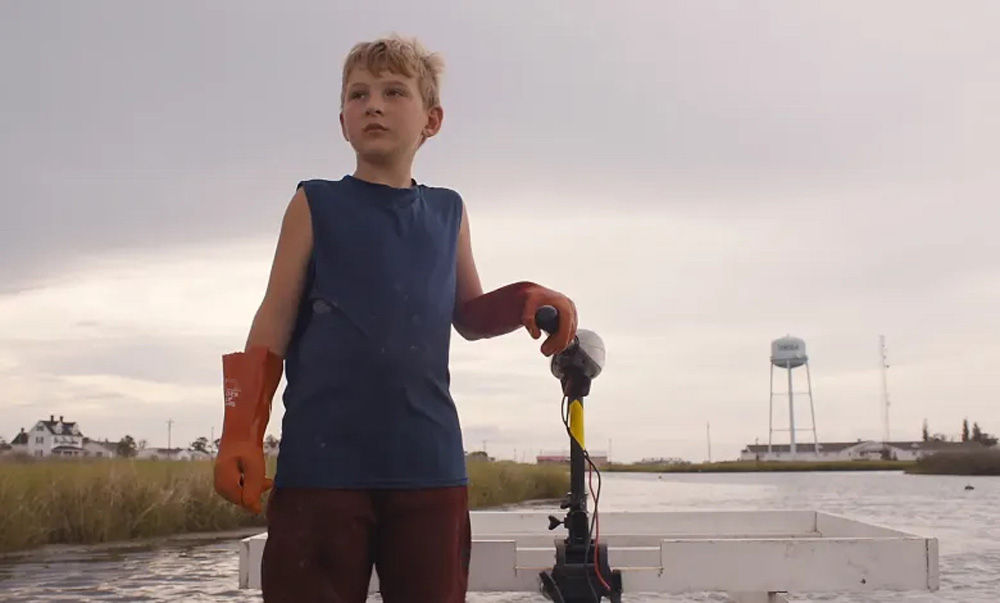

“We have a saying out here that wind is our weather,” James “Ooker” Eskridge, the mayor of Tangier Island, tells a reporter that has come out to the small community that has found a home in the middle of Chesapeake Bay in “Been Here Stay Here.” Like most of the working adults in town, Eskridge is in the crabbing business and while he can still rely on the catch to keep afloat financially, he has to wonder whether his house can actually remain on dry land when the big waves can be good for business, but can unexpectedly bring 15 inches of water into his front yard. That he’s talking to someone from the media isn’t unusual despite the fact that Tangier only has a population of 400, drawing national and even global attention when Tangier appears as if it could be one of the earliest casualties of climate change in modern civilized times when the sea level keeps rising.
Although director David Usui, who previously worked alongside the late, great Albert Maysles on his final film “In Transit” (in addition to other co-directors Ben Wu and Nelson Walker III), can’t claim exclusivity on the story, he does bring a unique lens, watching other camera trucks come and go as he settled in for years to take the temperature of a community that has come to acknowledge that the environment around them is changing, but that isn’t incompatible with the predominant belief of the residents that there is a higher power at work in a place that has one school, but two churches. Sermons are laced throughout the pure verité documentary, as are scenes of scientific researchers trying to determine how much time Tangier has left before it can expect to be submerged as one can look at nearby Watts Island where trees have started to fall into the water. Yet these aren’t seen necessarily as opposing viewpoints as they’re generally portrayed when locals think practically about solutions and reconcile their religious beliefs accordingly, though there is some mild fatalism sprinkled around when as someone says, “The Lord giveth and the Lord taketh away.”
While the island is only a little more than one square mile in diameter, Usui finds a sprawling subject, not only because he spends plenty of time on the back of golf carts that rove around the byways and the small fishing boats that curl around the shore. It turns out that in a place that seems out of moves as the weather becomes more unpredictable and inhospitable, there is a sense of constant activity to hold onto the land as much as the values that serve as the foundation for the community and while everyone is cognizant that they’re in a race against time, the town takes deliberate steps towards turning the tide back their way. It’s a thoughtfulness that’s extended to how Usui has brought “Been Here Stay Here” into world, only now starting its first big city run in New York this week after touring communities across the U.S. with a strong Evangelical presence where the considerations of the film’s cast might resonate most. With the film now ready to start conversations elsewhere, Usui generally took the time to talk to us about how he ended up taking such a strong interest in Tangier, the influence of mentors on the film and its unique release strategy.
 How’d you get interested in all this?
I studied human ecology when I was in college and my background is in environmental science, so it’s been an interest of mine for a long time and when I got into film, I was always looking for a climate story. It wasn’t until I stumbled on the story around Tangier Island that I found one that felt like it fit just right.
There was a piece that was produced by CNN back in 2017, a short portrait of Tangier Island and what made this particular piece of interest was that at the very end of their story, they were interviewing Ooker Eskridge, the mayor of Tangier. They asked him if he had any message that he wanted to deliver directly to President Trump in his first term and he acknowledged on camera that the island had almost entirely supported Trump, but he said that they needed support for a seawall, and Trump called Ooker the following week. That piece that they produced suddenly became a big splashy story, and that’s when I first heard about it. When I took my first trip down to Tangier, I think that there were three or four other reporters headed over and I initially thought that it might be interesting to do a meta story about Tangier that included all the media attention that they were getting, but as I spent more time on the island, I simplified my approach.
It sounds like you probably were aware of the religious/spiritual aspect of this, but how did that inform your thinking about how to capture this?
That actually was the most significant piece for me in deciding to put all this time and energy into the story. When I studied human ecology, there’s a woman named Katharine Hayhoe, a Canadian atmospheric scientist, but she and her husband are based in Texas [now]. The work that she’s been doing revolves around that intersection between climate and faith and outside of her teaching work, she engages church communities in conversations around climate. Hearing her describe what she does in trying to bridge that wide gap that exists on the religious front, but also on the political front has always been a big inspiration for me.
The primary interest of mine was to to make sure that it came from the community. Obviously, as a filmmaker coming from New York, I have a different perspective than they do and I wanted to make a film that was modeled in large part around the work of Katharine Hayhoe, communicating very clearly to the community itself. I felt like if I was effective at doing that, then it would also speak to the larger Christian base in the country and like Katharine’s work, I was, with the film, trying to bridge that political divide that exists in this country around climate.
The passages from the Bible that are recited as part of the observational footage you capture in church also gives the film an epic feel. What was that like to lace throughout?
It’s a two-hour service every Sunday and the second hour is a set of testimonials and the time that I spent in their churches, sitting through their services, always felt so gripping to me, just hearing the inflection in their voices that said so much about how they were processing and reflecting on their experience there and the potential loss that they might experience. It helped ground the film in familiar territory [for me]. When Catherine speaks about her work engaging in these conversations around climate in church spaces, she said that if she has an hour, she might spend 45 minutes or 50 minutes speaking about the gospel, just to establish common ground before she steps into what might be contentious territory, so my hope was to really anchor the story in that same way, so rather than pushing a charged political button out the gate, this was very subtle and intentional and I just feel like a little goes a long way.
 It’s interesting to hear you thought of a meta angle initially when the film still has a little bit of that framing as you join the German documentary crew, or other outsiders like the pastor from the Evangelical Environmental Organization. What was it like to make that engagement a part of your own observation?
It’s always interesting to see how we construct narratives, both in our own lives and then how we do that through the media, so catching a glimpse into that perspective of the German news crew was very revealing. It also was really helpful for the film. It’s an observational verite project and I didn’t conduct any interviews myself the entire time that we were filming. We’ve shot the film over two years and we traveled there from New York with the crew every month for a week for those two years. There are a lot of times that we were there and I had questions, but I was resisting the temptation. I just had to trust that the story would reveal itself. But by spending time with the crew from Germany and some other news outlets, it was really helpful because they were asking the basic questions about what was happening, who they were, what was happening, and how they were responding to it, so I didn’t need to do it. It filled that space that would normally be occupied by interviews, but since we didn’t do that, we had a chance with them to get that basic information to establish the context of the story.
You capture such a strong sense of place. Did you spend a lot of time there before turning the camera on?
Yeah, more so than any other project I’ve worked on. I took my first trip in 2018 and the first two years that I spent researching the film, I was traveling from New York down to the island, and I didn’t film anything, but was immersing myself in the community and trying to make those connections and to build trust. The island is also just so visually stunning and give as much emphasis as I could to the place that is physically disappearing and then the community that is disappearing at the same time, so I was thinking about that convergence on the visual front, making sure to include both the place and the people.
Was there anything that happened that changed your ideas of what this was as you were in the middle of it or took it in a direction you didn’t anticipate at the start?
It was constantly evolving, and that’s the magic of filmmaking. I had ideas about what I wanted to do and one iteration of this project really did give more emphasis to the media attention that they were getting. There was another version in my mind that really centered on the church – actually at one point, I wanted to produce a short film and the entire film would have been in the church itself. But as time passed, the time spent on the island really just informed all the decisions that we made and that’s the film that you saw. We followed our experience as it was evolving and what I appreciate about our experience there was that the most simple version of the story is what came through in the end and it captures the essence of that place and the feeling of what the people there are going through. It doesn’t answer any big questions. It’s not designed to fix our climate crisis. It’s designed to bring us into it in a really intimate way so that we can just feel the impacts of it and get closer to the people that are being directly impacted by it, which now includes all of us. And in order for us to get through this, we have to build community and get past what are surface differences and understand that we’re experiencing it in different ways.
The presentation of the archival footage is quite elegant. What was it like to go through and bring it into the picture as these interludes?
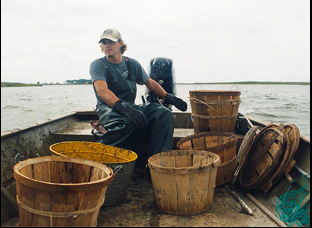
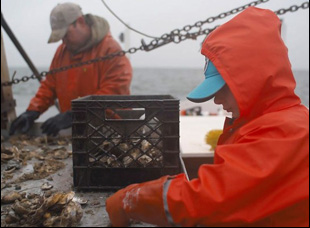
As we were exploring different options in the film, I was doing a lot of research and I stumbled on that footage, which is from the early ’70s. It’s drawn from a news piece, which is not quite 20 minutes but much longer than a typical news story and it’s shot on film and so beautiful. I haven’t been able to find out who shot that, but they obviously were very talented, and what I was struck by in that material was how similar things look [to today]. The work that you see the men doing on camera looks and feels the same as the material we were capturing in 2020, so I’m glad that it found a place in the film and helps establish a sense of expanded time there on the island. You feel the history, you feel the traditions being passed on, and it also anchors that same feeling that I was describing in a much wider time perspective, which I feel like has its own power.
What has it been like to put together a release for this so far to generate the conversations you want?
That’s actually one of the most exciting things since we finished the film. Obviously it’s really nice to screen the film at festivals and to reach those audiences and to know that it’s been well-received that way, but for me, screening it in small conservative towns in churches has been the most meaningful part of it all. That was my primary intention in making the movie and we started on the Eastern side of the Chesapeake Bay. Our first screening was actually in a little town called Anancock, a small conservative Christian community that has strong ties to Tangier Island. And we sold out the first four screenings, which was our initial booking, and they extended it for a full week, then extended it for another week. Then with those numbers, I was able to go to the other independent theaters in the area and one by one, we were replicating the same experience. It was all word of mouth and it just was a sign that we did something that was effective and it was worth sharing.
One thing that can be easy to overlook, but feels central to what makes “Been Here Stay Here” distinct, is that it’s a climate film intentionally made for a faith-based audience. That might sound simple on paper, but in practice it’s more like walking a tightrope. The film is deliberately quiet. On the surface, it can even feel overly simple. But that restraint was a choice. The story is shaped to feel relevant and personal to a Christian audience, with sermons throughout and no heavy-handed push on the climate conversation. The goal wasn’t to persuade or provoke, but to create space for recognition and empathy. If we’re serious about impact in documentary, I think audience matters just as much as message, and speaking across divides requires care. Most climate films preach to the choir. This one was designed not to.
That approach has already proven meaningful. We’re self-releasing the film and we’ve screened in small, conservative towns and sold out most of the theaters. Across 12 theaters so far, we’ve sold close to 7,000 tickets. It’s easy to gloss over numbers like that, but for an independent documentary in those communities, it’s pretty remarkable. And we’re planning to keep going.
“Been Here Stay Here” opens in New York on May 15th at the Quad Cinema and in Los Angeles with a special screening at the Monica Film Center on May 27th and a weekend run from May 30th-31st at the Monica and the Laemmle Glendale. A full list of screenings and dates is here.