




The charms of the small Mississippi town that gets its closeup in “Natchez” are difficult to resist as an organist riding on the flatbed of a truck can be seen in the middle of town so long as the weather permits and the homes that were designed as a show of Southern splendor have remained as resplendent as when they were first built. Then again, it is equally difficult to ignore that those mansions were once a part of working plantations where the slave quarters that hide in the back are often rarely referred to by the hosts that give guided tours of the properties, a reality that director Suzannah Herbert brilliantly pins down in her second feature when people in town have had to hold two truths.
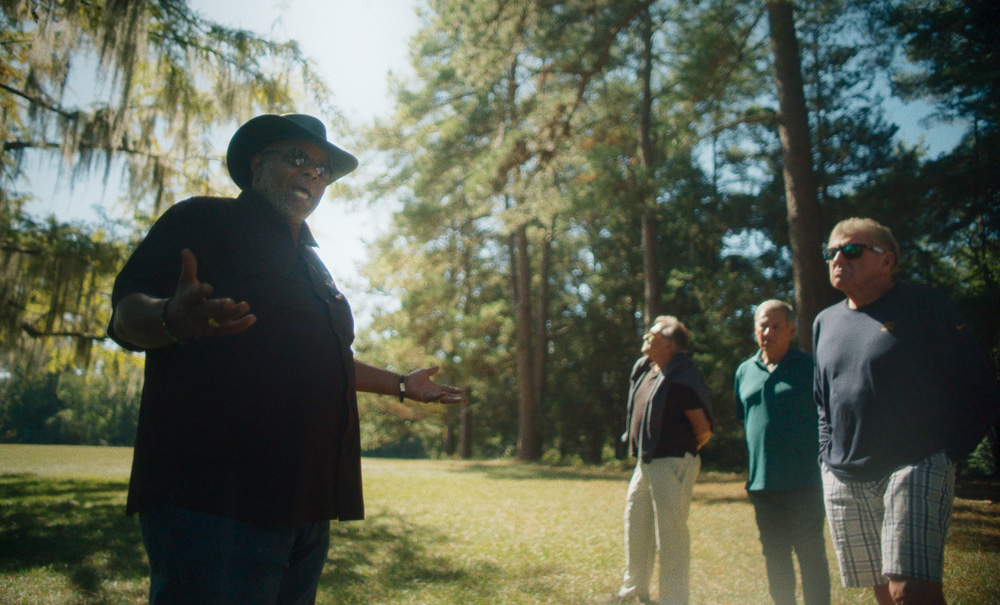
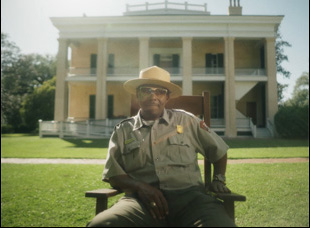
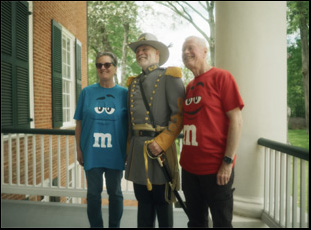
The future of Natchez is tied directly to the past when the local economy depends on the income of tourists visiting the old homes and bask in what they remember as less complicated times, yet holding onto that financial lifeline would also seem to be to deny both the full history and a potential for any future growth as a community when being frozen in time may have its appeal to outsiders but has created an internal stagnation. Filmed with spherical lenses that soften at the edges as if the town was trapped in a snow globe, the film brilliantly follows two different sets of tours – one of Choctaw Hall where David Garner, a model of Southern hospitality with a deep sense of decorum punctuated with a sharp wit who as a white man tends to shy away from the less savory aspects of the land he stands on, and a roving street tour given by Rev Collins, a gregarious Black pastor who shows people around in his spare time, making a former slave market called the Forks in the Road an essential part of his itinerary.
As a reflection of how both have processed the past or even their awareness of it in the first place, the film proves revelatory as they both have found audiences for different versions of the same story, getting at the crux of one of America’s most vexing issues where the lack of acknowledging the racism inherent in how the country took shape continues to hold it back as a whole, but Herbert, a Southerner herself who could know from all the great storytellers of the region that there has to be some sugar to get across bitter truths, puts together a film as if it were a duet of dueling banjos, throwing in an extra bit of delight with the inclusion of Tracy, who came to the Deep South as the arm candy of a wealthy husband and is eager to see another side of town as she looks to be getting a divorce with the hoop skirt she’s worn to balls no longer appearing to be worth the effort.
As we said at the time of its premiere at Tribeca last year, “Natchez” is one of the best documentaries we’ve seen in the time this site has been active and quite possibly ever and Herbert, along with producer Darcy McKinnon, hatched a release plan that was as ingenious as the film itself, rigorously screening “Natchez” theatrically in underserved communities in the South where it became as much of a word of mouth hit as it did at Film Forum where it had to keep extending its run. Now there is no excuse not to catch it with the film being made available far and wide on PBS’ “Independent Lens” with a television premiere tonight and will stream on its own platform and YouTube thereafter and Herbert and McKinnon generously took the time to talk about how the evolution of how they’d tackle the story of the South, finding a distinct visual expression for what they saw as a clash of tradition and progress, and the rewards of reaching out to audiences in areas that often overlooked.
 Suzannah, I’ve heard this all started with a wedding. How did this take shape?
Suzannah Herbert: Yeah, I was invited to a wedding on a plantation and it got me really thinking about how white people use sites of such trauma and pain for their own enjoyment and entertainment and profit. I wanted to understand how that affects us as a society today and I also wanted to interrogate it. So I started on a journey of going to lots of plantations and historic sites and I ended up in Natchez. When I arrived there, I was just so struck by the beauty of the place and also this underlining pain that was right beneath the surface. That tension of those two things in conflict with each other was the crux of the film ultimately and I started meeting people in Natchez in 2022 and really taking tons of tours and going to cocktail parties and brunches, really getting a lay of the land and we started filming after spending many, many weeks without a camera.
Darcy, how did you get interested in this?
Darcy McKinnon: I’m based in New Orleans and all the films that I work on and care about in some way intersect with the issues and people and communities in the American South. It’s my area of of of expertise and interest and when Suzannah reached out, the original project was actually going to be set in Louisiana and that’s how we met. We were connected through our mutual friend Elaine McMillon Sheldon, a really amazing Southern filmmaker from West Virginia. And it was really Suzannah’s first film, “Wrestle” that made me [think], “Oh, this is someone from the South who has a very unique lens on how to tell stories about people that are not exploitive, but layered and nuanced and and go against in many ways the frequent prevailing public narrative that is constructed about the South in terms of people, not necessarily in terms of systems.” So we started working together and it was a long road to get to Natchez and then a long road once we got there. But that’s how I got involved and we’re going to make more movies together.
I’m so excited to hear it. At what point did you realize you could build a story around
Suzannah Herbert: Yeah, pilgrimage is when visitors come to Natchez and private homeowners open up their doors to the public to these antebellum homes, so it’s really the main events of the tourism year in Natchez. Our first development shoot, which was to create a edited material to raise more money, was during fall pilgrimage and then I really wanted to be there for an extended amount of time during spring pilgrimage because in the spring because so much is happening. So many tourists come, there’s a lot of events, there’s a lot of natural things for for us to for us to film and witness, so that was our main shoot. But then we would go back to Natchez during quieter times.
Darcy McKinnon: It’s also interesting because pilgrimage is run by now three different private clubs that are effectively associations of homeowners. It’s all done privately — it’s not like the city hosts pilgrimage. And the city has made efforts to try to diversify the the kind of ways people intersect with Natchez. They have a balloon festival, they have “Y’all Means All,” which is a queer festival. But even as they try to diversify what’s possible and open for other tourists and draw people in with other festivals and events, pilgrimage is still what Natchez is known for, and it’s what many tourists come for and that’s actually the tension that the film is trying to get at. There’s so much more history, so much more storytelling, and so many more ways in which Natchez is beautiful, unique, and compelling. But this one narrative that’s perpetuated by the owners of these historic homes has been the dominant narrative and the dominant reason people come to visit Natchez for over a century now.
 When this ends up being a story about storytelling or how history is related and by who, was it difficult to figure out how to convey a foundation of facts as you’re comparing those narratives from different people?
Suzannah Herbert: Yeah, it was a process. We worked really closely with our amazing editor, Pablo Proenza, and we ended up realizing that the structure of the film needed to be Rev’s tour. We always knew Rev was going to be the heart of the film, but literally what he was saying on tour was how we structured the film both literally and emotionally. When he takes people on his tour, he is very charming, tells a lot of jokes, and makes people feel very comfortable. And then an hour into the tour when he starts talking about really hard parts of our shared collective history in America, people are more willing to listen and understand because they feel they trust Rev. So that’s what we wanted to do with the film — bring people into the fantasy, make people feel comfortable, have a lot of humor, and then slowly peel back the layers behind all of that. Once we figured out that Rev was our North Star, so to speak, everything fell into place.
The visual style itself is inherently amusing. Was there much trial and error in figuring out how to shoot this?
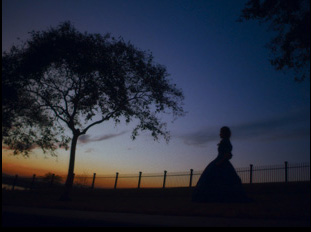
Suzannah Herbert: Noah Collier, our cinematographer, was very intentional. Darcy and I told him we wanted the film to be “Gone with the Wind” meets “White Lotus” meets “Night of the Living Dead” with a little bit of “Get Out” in there, so we had a visual style that we were going for and one that we wanted to also disrupt, like “Gone with the Wind,” this romanticized version of the past. It is still the highest grossing film adjusted for inflation of all time and it has this hold on white dominant culture and how we think about the Civil War and the past, so we wanted to shoot it on a tripod to make it feel like a a narrative fiction. Noah shot it on these vintage Zeiss prime lenses, which gives it an old timey, mythological type feeling.
Darcy McKinnon: We’re also fans of Southern literature and cinema. There’s so many genre conventions of documentary that we could have used to tell this story, but this is a film about history and fantasy and how it enters into pop culture. These stories become part of our own collective understanding and what we think of as history when in fact and many times they’re pop mythologies that have been repeated over and over until they feel like they’re true, even to the storytellers. So we could have done a more traditional talking heads and archive documentary, but we weren’t actually that interested in telling the “real history,” because it’s comprehensive, complex and nuanced and no one film could do it. We were really interested in how people are telling history and for us, especially when you’re going to a historical site or you’re being invited into someone’s home, that’s a very different experience than scholarship. That in between there of sense memory and pop culture that’s dominated understanding of the American South, that’s where “Natchez” lives.
Was there anything that like happened during the course of this that really changed your ideas of what this was or took it in a direction you didn’t expect?
Suzannah Herbert: I didn’t know what was going to happen and a lot of times when you’re raising money and trying to get people on board, people want to know, “Well, what’s the narrative? And it’s sometimes really hard for directors because we don’t know. But I was most surprised with just how much did happen by turning on the camera and witnessing people’s everyday lives and the tours that we were taking and just the amount of incredible work that’s happening in Natchez. The people who are doing it is really something to behold and gives me inspiration and hope for where we are in this country right now.
Darcy McKinnon: For me, it was the absolute confidence in their own position of some of the folks in town. We talk about this a lot in Q & As and it’s made me really understand a thing that as someone Gen X, I’m the oldest person on our team, but I’m one of the younger people in Natchez when we go there and I didn’t understand the depth of emotional need that the folks in Natchez have to tell this story. There’s a certain group of people who do this and it is all for the performance. It’s how they they keep their home together. But there’s a lot of people in Natchez who haven’t spent great time outside of Natchez, but cannot imagine that the story that they were told their whole lives is not true, so there’s a real need to stick in that story.
 It’s been fascinating to see the rollout of this ahead of being available more widely on PBS. Your theatrical run really concentrated on the South rather than the coasts where most documentaries have a fairly traditional rollout before moving inward. What was it like to figure out? From what I understand, it’s been a major success.
Darcy McKinnon: Yeah, I think because we had PBS support during production of the film, we already were in a position to know that our rights and territories were going to be carved up and that was actually a real positive in this instance. It’s an incredibly challenging market right now and it was really to a certain degree being on PBS and and knowing that broadcast rights were taken, we didn’t even have the ability to consider at that point a global streaming deal, which would have lifted our theatrical rights. So we were able to partner with Oscilloscope, who has been amazing, and Cinephil for our International and that’s been really actually really effective for the film.
I think it’s been a combination of luck, the quality of the film and the fact that the film spawns conversation and a lot of old-fashioned impact or outreach organizing. Suzannah did tons of outreach. We had Pablo cut our trailer, which went viral on multiple platforms. People wanted to talk about it. And that was really a lesson to both Suzannah and I about how powerful social media is. Sometimes as doc filmmakers, we act like it’s separate from content and I think it’s not and shouldn’t be because that’s where people are getting information. It’s been a lot of elbow grease on our end, some actual luck and a film that is really inspiring in conversation and a sense of where we knew the conversations were going to be most resonant, which is in the American South.
Suzannah Herbert: Yeah, we’re so grateful for the audiences who have come out and the people who have watched the film multiple times in theaters. I hear about it all the time, the Southerners who come out all over the country. It’s been really fulfilling to witness. We worked with Oscilloscope, who also distributed my first film, “Wrestle” and they’re such a brilliant team of ten who really put in the work and tailor each release to what they think audiences will gravitate towards. And we were really adamant about wanting to play in in Southern towns, not just the big hubs, and they were all for that and really put in the effort to connect with those independent arthouse theaters. Then we’re thrilled PBS and ITVS was the first organization to really believe in the film pretty early on. This film would not be possible without PBS and ITVS, so we’re very grateful to that public media support and we’re excited that the film is going to be available to millions and millions of Americans for free.
“Natchez” premieres on Independent Lens on PBS on May 11th and available thereafter on the PBS app and YouTube.