



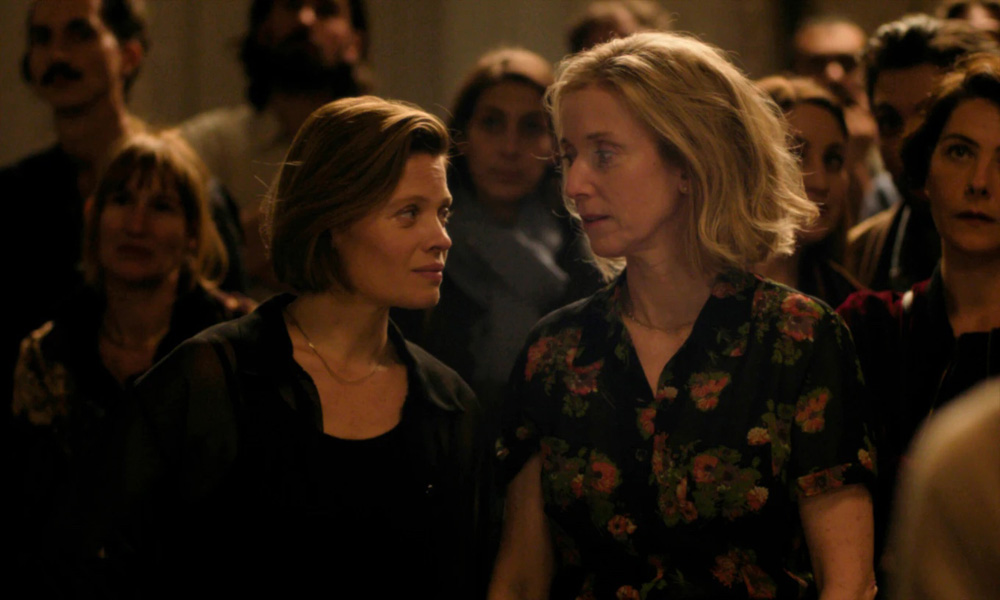

“Without Gabrielle, there’s no book,” Frida (Mélanie Thierry) tells others gathered at a party in “A Woman’s Life,” after spending a month-and-a-half researching the surgeon (Léa Drucker) for a novel she’s been working on. The sentiment may sound trite, but even by this a quarter of the way into Charline Bourgeois-Tacquet’s radiant second feature, it’s become obvious just how true this is for nearly everyone in Gabrielle’s life and while the doctor can take a certain pride in holding up so many – a not entirely selfless endeavor when she’s carefully curated the kind of life she’s wanted to have – the returns are increasingly diminishing, leaving her to wonder what space she can carve out for herself when her time and energy is taken up with the concerns of others.
After Drucker’s powerhouse turn in Catherine Breillat’s “Last Summer,” it could be difficult to imagine as juicy a role for the formidable French actress than the conflicted middle-aged mother who flirted with blowing up her life by having an affair with her teenage son-in-law, but she might have even more to dig into as Gabrielle, who is reminded fairly often that she never had kids, though all she does is take care of others, both professionally at a public hospital and back at home where she has ensured her partner Henri’s (Charles Berling) son will make it to college and her mother Arlette (Marie-Christine Barrault), increasingly in the grips of dementia, has the right balance of agency and assisted living as she ages. However, for her troubles, Arlette, in her compromised state of mind, will suggest that Gabrielle is the less responsible of her two daughters when she isn’t a mother herself, despite the fact that her sister Sandrine is MIA from all the meetings regarding their mother’s situation, and Gabrielle also grows increasingly distant from Henri when he seems to offer little help with anything, not even bothering to break up his son’s late night partying that causes her to lose sleep in a more direct way than she already is.
When Bourgeois-Tacquet maintains a brisk pace to keep up with all that’s going on in Gabrielle’s daily life, the film reminds of Eric Gravel’s recent pressure cooker triumph “Full Time,” only unlike Laure Calamy’s desperate housekeeper, Gabrielle needn’t worry about staying afloat financially, but whether or not she’ll ever have enough time to herself to breathe. The answer might be standing right in front of her quite literally when Frida, often off to the side as an observer during surgeries with a notebook in hand, increasingly moves towards the center of the frame, demanding far less attention than anyone else and offering something unfamiliar when it seems as if there’s some romantic sparks between them. Drucker is remarkable as Gabrielle, confident while not taking anything so seriously that it becomes unconquerable, yet displays minor cracks amidst an otherwise steely facade when she can be wounded by a stray remark that sparks real questions about the decisions that she’s made in putting others’ needs above her own and must allow herself to become vulnerable to indulge in a relationship with Frida.
As much as the drama is a marvelous showcase for Drucker, it also serves as one for Bourgeois-Tacquet, whose playful debut “Anaïs in Love” demonstrated an impressive access to the inner lives of her heroines and further corrals all the cinematic tools at her disposal to get inside Gabrielle’s head without a heavy hand. It is not a coincidence that Gabrielle’s hospital is under construction as she rebuilds her life based on what she wants now and a little more jackhammering can spring up in the sound design as she faces some tense moments at work or the camera can glide alongside the character when she’s in her element and things come effortlessly even in the most challenging of situations yet can be appropriately stunted in the moments when she’s at a loss for what comes next. (Staging the scene where her passion is reawakened during a date to an immersive ballet with Frida is one of the film’s truly stunning sequences.) There surely will be speculation about how personal the film could be for the director when telling a story of a woman having a different set of priorities for herself than traditional cultural expectations, but Bourgeois-Tacquet obviously identifies in one way when she has such facility for making the complicated look easy and as Gabrielle contends with deciding whether to live up to society’s standards or her own, “A Woman’s Life” is winning by any measure.
“A Woman’s Life” will screen again on May 14th at the Grand Theatre Lumiere at 9:30 am, the Salle Agnes Varda at 11:30 am and 2:15 pm at the Le Cineum IMAX and May 15th at 8:45 am at the Le Cineum Aurore.