



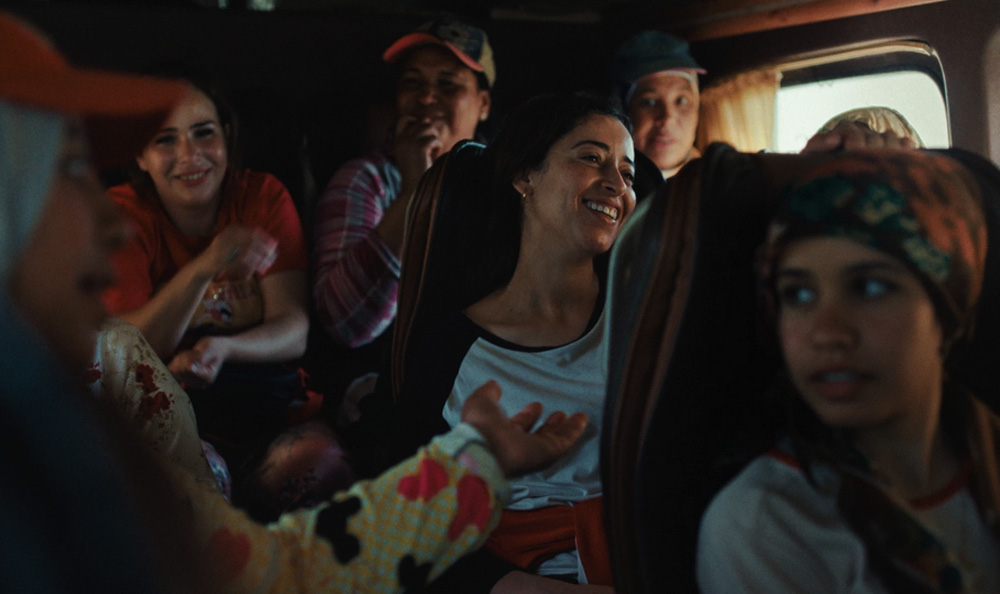

“After all this, will I be able to buy a washing machine?” Hasna (Nisreen Erradi) asks after her arrival at the Fresa del Carmen farm in “Strawberries,” having just made the pilgrimage from Morocco to Spain when the promise of earning €35 a day to pick berries beckoned. She’s just rinsed her undergarments in the shower, and the idea of being able to afford an apartment can make it easy to overlook how lacking the accommodations are right in front of her when saving up any money appears to be futile when she’s nickel and dimed just to be able to afford the opportunity of such work, having to pay a couple of euros to access the wi-fi and told after the fact that her pay has been docked for taking breaks that are too long. However, as the bus full of women that traveled hundreds of miles like her before joining an even greater number at the farm attest, this is a coveted occupation, even if it isn’t by the locals who see the hard labor as too inhumane to be worth the effort.
The most haunting scene of Laïla Marrakchi’s stirring drama is when Hasna eventually tries to flee Fresa del Carmen, running away from one strawberry field where she’s had enough and is confronted with dozens upon dozens more crops down the road, which doesn’t even begin to describe the full extent of the system working against women such as her, perhaps willingly taking the work in the first place when the alternative in their homeland is worse, but subsequently snagged in a situation they can’t possibly escape. It’s a nifty element of the film that cinematographer Tristan Galand’s untethered camerawork, often circling around Hasna, doesn’t have to adjust much to affect a different feeling throughout from agency to a paralysis that sets in when for as much open space is in front of the young woman, it seems like there’s nowhere to go as she roams around the compound where lives and works with greater and greater frustration setting in that the dream of improving her life through hard work was a sham. She finds friendship quite quickly with the other women in her bunker – Khadija (Fatima Attif), who’s spent five years working these crops, and the younger Zineb (Hind Braik), who has spent two, yet she feels the closest to Meriem (Hajar Graigaa) after they first met on the way over to Spain and have to learn the ropes together.
Notably, Marrackchi teams on the screenplay with Delphine Agut, who previously was able to expose the perilous world of modern food delivery in Boris Lokjine’s “Souleymane’s Story” (also shot by Galand with a similarly brisk energy) and again finds that sustenance for much of the world has been built on the backs of the most marginalized, with “Strawberries” quite literally gets at the roots of a rotten industry as a whole at its inception point. It can be mildly disappointing at times that for as much detail is put into outlining the infrastructure that allows such a dehumanizing business to persist from the dismissal of indignities in the fields as trivial to power protecting power should anyone come forward to complain, the characters themselves can bit a bit broad – no one in an administrative position at Fresa del Carmen ever so much as thinks they’re in the wrong or behaves with any empathy, rendering them as generally uninteresting. But Marrackhi and Agut do create a complicated heroine in Hasna, who is revealed to once have been a Taekwondo champion and contends throughout with protecting herself against fighting for the greater good.
That inner conflict gives the film its most fascinating flashpoint when a chasm begins to develop between Hasna and Meriem based on a most difficult choice the former has to make that leaves the latter feeling abandoned, having ripple effects beyond the distrust it breeds. Eventually, Hasna is able to enlist the pro bono services of an attorney (Itsaso Arana) via a kindly Moroccan-born shopkeeper (Larbi Ajbar) who will act as a translator on occasion when she has evidence of the abuses at Fresa del Carmen and after feeling insignificant with her treatment out on the farm, she somehow can feel more cut down to size as she tries navigating the legal system where omissions on her immigration application are brought up as indictments on her character and the odds are clearly in favor of the business that is a key part of the local economy than any individual workers who may be taken advantage of. Erradi, who was so memorable as the title character in Nabil Ayouch’s “Everyone Loves Touda,” is equally unshakeable here as Hasna, clearly resolute once she puts her mind to something, but as compelling when she’s uncertain as when projecting strength with the actress showing great savvy in playing a character that demands respect while never being the smartest in the room. Although “Strawberries” is clearly the product of great intelligence, it never feels intimidating, giving a ground-level view of an issue that could be overwhelming in its scope, yet the true devastation comes across in its effects on just one person whose efforts to improve her standing only seem to set her back.
“Strawberries” does not yet have U.S. distribution.