

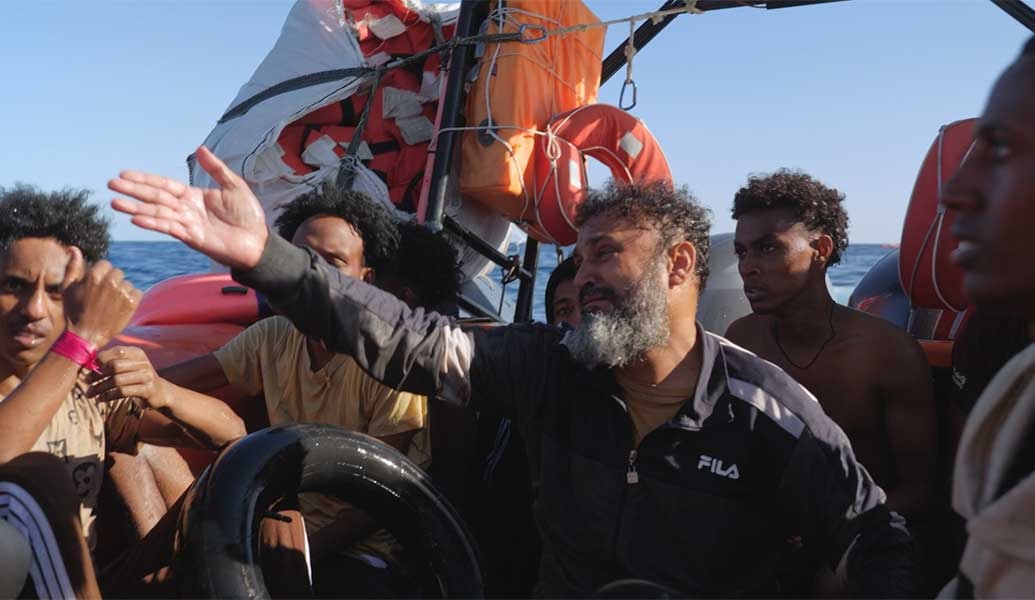

Sine Plambech took the idea of jumping into the deep end to its literal extreme in “Rescue,” though her dedication to documenting the plight of migrants knows no bounds. Having previously devoted over a decade to following a Thai refugee’s resettlement in Denmark and the growing pains that came with assimilation, the documentarian with a background in anthropology sets her sights on following a refugee from the point of inception, somehow managing to capture the brave team from Doctors Without Borders traveling into international waters on the Geo Barants to collect a number of migrants seeking safe harbor. Among them is Hani, who has made the arduous trek from Egypt to Yemen and faces the horrifying reality that while he is rescued, his wife Roro was not as fortunate, with Hani learning later that she was scooped up by the Libyan Coast Guard and imprisoned, setting up a desperate quest for the two to reunite.
The film is too exhilarating to realize what must’ve went into the making of it when Plambech couldn’t have possibly known what story she’d end up with when she first boarded the largest rescue vessel in the world, the Geo Barants with her crew, perhaps thinking only it would be about the obstacles that good samaritans face now in trying to help refugees on the open water when the European Union has outsourced their border control to national coast guards such as Libya that are incentivized to rack up apprehensions to collect funds. However, “Rescue” continues to compel even after its harrowing opening moments when Hani and even Roro track their movements on iPhones as they struggle to reconnect, with Hani eventually plotting a reunion in Germany while he sits in an Italian refugee camp, and the Doctors Without Borders team are increasingly boxed out from doing their work by governments that are hardly enforcing laws for reasons of national security. The story of a single couple trying to cross the Mediterranean Sea ends up speaking to the whole world in more ways than one and it’s another extraordinary film from a filmmaker who tackles the most important subjects with the skill to actually seize attention for them.
While the film made its premiere at the Toronto Film Festival, Plambech spoke about flying blind with her latest film, how she ended up chronicling a tale of migration she couldn’t know she’d have the footage for and why she remains inspired to keep doing the films she does.
There’s obviously a connection here between your previous work, but how did you set your sights on this?
It’s been something I’ve made all my films about in different kind of ways. But now I really wanted to see what it looks like if you put a camera at sea because that place is like a microcosm. It’s so condensed, and I got the access to Doctors Without Borders. I knew that I had to be there for a long time, not just one rotation [at sea] and I didn’t know what would unfold. The first thing I learned was that on that ship you will meet people from all over the world with all kinds of stories, so it was a documentary that I couldn’t really plan. I had an overall idea in my mind with my team and my script writer Janus Metz, who I also made “Heartbound” with as well, but I didn’t know what I would meet.
I did have an idea that I wanted the film to be three rooms — on the North African coast, the sea, and then following [migrants] after, and for a little while, maybe we would only be on the ship, but quite quickly, I [thought], “No, we have to tell the background story and [what happens] after.” I also knew that we would probably meet the Libyan militia because all the rescue ships meet the Libyan militia, so there were things that I couldn’t anticipate, but I also knew that I had to be there several times, as I said, to encounter that. The first time I was out there [at sea] was one month, and we didn’t have an encounter with the Libyan Coast Guard. It was 65 people and what the rescuer called “a normal rescue” [without incident], which for people like us, it’s not a normal rescue [given how fraught it still is].
How did you land on Hani as someone to follow through this journey?
Yeah, that [first] month I was there with my first photographer, we talked about that when you get there, there’s so much adrenaline, so he ended up filming back and forth between different people who were rescued and then when I came out the third time, I told my brilliant photographer Troels [N’Koya Jensen], “Okay, I give you the permission to just film one person. The first person who come on board your rib [the floatation device to bring migrants onto the Doctors Without Borders boat], you just film the first person that comes on board that you feel like we can follow.” And then Hani came. And as a documentarian, you can see he has a face. He wanted to be filmed. He was sitting there [crying], “My baby, my baby,” and Troels came back and said, “I think we’re going to follow him.” You have to ask for permission, of course, but a few moments later, I said, “Is it okay if we follow you with the camera?” He said, “Yes, you follow me throughout.” And then all these things happened.
Unbelievable. I imagine it’s such a traumatic moment for him and you’ve got your own adrenaline going. What’s it like approaching someone at a time like that to be in the film?
You’re there as a filmmaker and as a human being, so these things really become intertwined. On one hand, when you are invited on a ship like Geo Barats and Doctors Without Borders, you are invited to document human rights violations, so I wanted to really make sure that we were there to do that job. I need to make sure that I get all that and at the same time I need to really take care of the people that we film, then at the same time also as a human being just witnessing someone being rescued, the strongest feeling I had was that if we had not been there, they would have drowned. So even though I have worked with this topic for so many years, this moment of seeing that if the rescue ship was not there, they would have drowned.
And then the next morning [after the rescue] is always very special because [the migrants] are sleeping, they get a shower, and some protein powder food and then the next morning you can come and talk more with them. They are allowed to rest and then you can suddenly see maybe a smile. That moment is very powerful. I thank my photographer for being able to be not only in the rib and filming an entire kidnapping. I was standing on the bridge and I saw the children and the women being kidnapped and sail away, but I was not directly in the rib [that my cinematographer was]. But he just came on board and he just continued filming. So you also just need to be really professional at that time. The job is to film that. I can cry after.
When you’ve made several films around this same subject of migration, does one film lead to another in terms of a part of the experience you want to capture?
Yeah, with “Heartbound,” it was this much more long-term project that we developed over several years, more about belonging and longing for the homeland and family connection and what happens over the years. But with the state of the world, I felt like I want to do something much more like urgent and really show like what is the brutality going on and how does that influence people’s lives. In a European perspective, the Mediterranean is something that we almost stopped talking about — there’s the climate crisis and Ukraine and Gaza, all kinds of really important things to talk about — but people drown every day in the Mediterranean still, so I wanted to put a focus back on that. And I wanted to try to see what it means to make a film with someone you don’t know in advance because the films I make are so built on my anthropological work over several years, I can [usually] write a script. This was just like, “Turn the camera on and run.” And that requires something very different from a narrative point of view, because you might have all kinds of ideas what you want, but then reality is something different.
You’ve obviously got to put a lot of energy to figuring out the logistics of shooting at sea, but what was it like to figure out how to capture the story after leaving the ship.
It was interesting because a film like “Heartbound” and also documentaries five or ten years ago [about this subject], even though they were about these brutal stories, it was still these beautiful images [that could engage audiences] and you would have these incredibly good photographers to bring there. I imagined that with the sea and you really telling a story that would still get people into the cinema. But then quite quickly I [realized], “This is not the way we’re telling this story. Because it’s much more eclectic. It was more [fragmentary] like, “there’s a little message here or someone sending a video,” like how our lives are these days for us, but for refugees crossing, that’s how they communicate.
So Hani started to film [on his phone], and the interesting thing about him, which is not in the film is that when he was living in Yemen, he was a SIM card operator, so he loves mobile phones, and he was also a local actor before the war, so he also loved to be on camera. And I thought, what are the odds that I meet this person [to be in the film]? He started to send me the videos [from his travels]. And I thanked him for them, but I didn’t see it as something in the film. Then slowly I [realized], “This is the film.” I was frustrated I could not be there when all these things are happening, but then [it felt] like I am because they’re sending me all these videos and that is the story. Of course, you need a brilliant editor when we had 200 or 300 hours of material, to be like, “Okay, we can actually put all this together for a story.”
Structurally, this is quite surprising when you introduce Roro, who Hani is looking for, shortly into the film. What was it like to put that upfront and find the shape of the story as a whole?
It’s really the work of my editors and the entire team, but we wanted to start with her in a way to say, you’re going to meet someone later, so stay put, but also to calm people because this topic is so brutal. So you don’t know who you’re going to meet, but we wanted to emphasize you will meet someone. But it is narratively quite challenging because first you meet Nesma [who works with Doctors Without Borders], then you go to the next main character Hani, and then you go to Roro and we decided that we just wanted to follow that chronology because that was how it happened to me. But I didn’t know that the film would be so much about Roro.
“Heartbound” and my other films were very much focused on women’s experiences of migration, but [meeting Hani, I thought] “This is the first time I’m going to make a film about a Muslim man and get to know him.” Because how do you make a film about a woman who’s kidnapped? You’re not there with her and she only sent these occasional videos to Hani. But then one point, we were sitting in the editing room and my editor Per Kierkegaard, [said], “I think the story is about Roro.” And I [said], “Really? She’s kidnapped. She sent some videos.” and he [said], “Let’s dig everything up we have with her” and I [asked Hani], “Do you have more videos that she has sent you?” That was the biggest surprise [because] I didn’t know that it would be possible to have a main character who was kidnapped and you could not film but still have her as your main character. I didn’t know it would be a film about a woman seeking justice in the way that Roro does. I had a main character that I had never met, so that was very special.
You’re able to strike a great balance by focusing on the individual experience of this couple while seeing on the boat, so many others in these scenes of group interviews that the Doctors Without Borders conduct as debriefings. What was it like conveying everything that was going on in that environment?
Yeah, Doctors Without Borders goes around and sits down with each one of them to talk and then I quite quickly understood that we were with Nesma, the rescuer, she would be the one who’s taking us to the people and I trusted her a lot [to conduct the conversation]. So I’d say, “Who are you going to talk with right now?” And she’d talk to these Egyptian men or men from Mali and Mauritania and you can see how much they want to tell their stories. Another thing that also surprised me was that the day after you have a rescue, the communication manager on the ship would say to everyone who is on board after they wake up and have their breakfast, “There’s media on board. If you want to tell your story, you can go and tell your story. If you don’t want to, just let us know and we will film around them.” And I have never seen so many who wanted to tell their story. They would come up and say, “I also have a story to tell.”!So these small moments, it was like these small islands of storytelling that I really wanted to show and that it’s not only a story about Hani and Roro, but about everyone who comes on board there.
You got that across so well. What’s it been like getting to the finish line with this and sharing the film with audiences so far?
I’m so honored to be invited to TIFF with Roro and Hani’s story. They’re very honored. They’re sitting in the refugee camp in Munich waiting to hear what audiences will say and proud that we came here and presented to an international audience. Migration is a topic that involves all of us, no matter what country we are in, so what does it mean to bring kind of a more European, Mediterranean story to TIFF? Will people be able to see that it’s larger than just the story taking place there? And next week, we’ll have a European premiere at the Zurich Film Festival.
I just feel that there’s so many stories to be told by the people who are often not heard or asked, and from an ethnographic, anthropological and filmmaker perspective I want to continue to ask what’s underneath all these discussions. We read the headlines but you can see with Roro and Hani, then suddenly there’s a love story there, so [the story] continues. I’m a little bit exhausted because when you finish a documentary, we ran out of the editing studio and submitted the DCP to TIFF and right now, I’m like, “Will I make another film?” But I know I will because I continue to have that energy to explore these questions.
“Rescue” will screen again at the Toronto Film Festival on September 17th at the Scotiabank at 6:15 pm.