



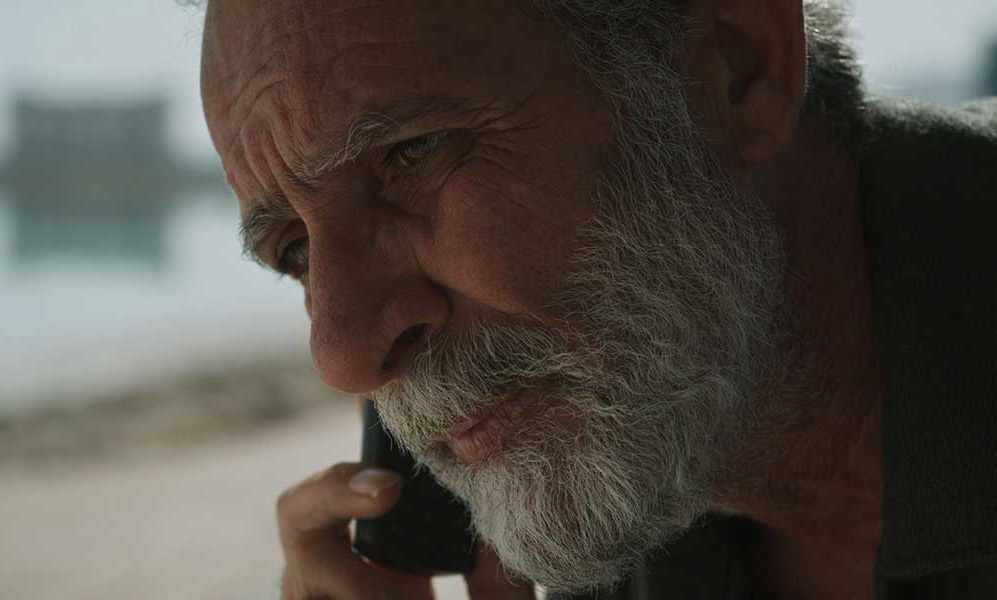

Even before Kamal (Kamel El Basha) is visited by a debt collector in “Conversations with the Sea,” it seems as if he has nothing left. A house in Jerusalem is not really a home when he has no family left to speak of, with both his wife Nawal and son Wael passed on and his daughter Wafa unlikely to return any of his calls. While he has a routine of baking bread in the morning to keep a roof over his head, the place is empty by dusk where he can’t look forward to the night sweats that regularly arrive. You might think you have an idea where this is headed when director Muayad Alayan opens his fourth narrative feature with scenes of the current strife in the West Bank, with streets filled with young Palestinian men in protest of the ongoing violence met with aggression by Israeli police, but the surprising drama reveals that Kamal was never one of them, having fled the country out of frustration of navigating the conflicted territory and now 60, he has to deal with the fallout from returning when he only felt more uncomfortable elsewhere, illuminating a far less explored dimension of the displacement that many Palestinians have experienced, fracturing families beyond repair and robbing Palestinian of their most active years as they imagine a future that is impossible to fulfill when the past never seems settled.
Alayan and co-writer Rami Musa Alayan come up with a beguiling structure to show how Kamal is threatened to be dragged even further back in time when his hold on his house becomes dependent on learning what actually happened to Wael 20 years earlier after the father left for America, ideally to bring his family across once he had some stability that never came. The family, seeing it as a being deserted, stopped talking to him before tragedy struck, leaving only Wafa to correspond with, and when any attempt to reach out to her has been futile, Kamal must do some detective work on his own when he’s alerted to his social security being held up and must explain his residential situation in front of a court when the paperwork doesn’t line up in the system. He has a sympathetic attorney who, if nothing else, can speak Hebrew to an Israeli judge when Kamal has never picked up the tongue, but it is the start of a lonely journey for the middle-aged man who comes to learn about what the rest of his family experienced in bits and pieces during his time abroad, not justifying his decision to leave but also not exactly suggesting he should’ve stayed either.
It can come across as mildly schematic when Alayan has Kamal knocking on doors of various Israelis once he gets a clue about a woman named Einat, the last person known to spend time with Wael, allowing a variety of different reactions to him as a Palestinian. (Somehow he ends up being invited into a dinner of young intellectuals as well as ringing the doorbell of a brusque hard-liner.) However, the fragmentary approach that gives Kamal new information at the same rate as an audience receives it proves effective when the father is pulled closer towards reconnecting with a time and place he thought he could ignore to his peril, with a similar feeling taking root for anyone observing. A predatory real estate developer that has long coveted Kamal’s family house could be seen as a villain as he continues to press Kamal with an offer, but he pales in comparison with the self-loathing Kamal feels from abandoning his family, no matter how good the intentions were. As the enormity of the consequences dawn on him, the impact seems even larger when that choice has been thrust upon so many Palestinians in general and the ripple effect of “Conversations with the Sea” can’t be denied.
“Conversation with the Sea” will screen again at the Toronto Film Festival on September 17th at 11:40 am at the Scotiabank.