


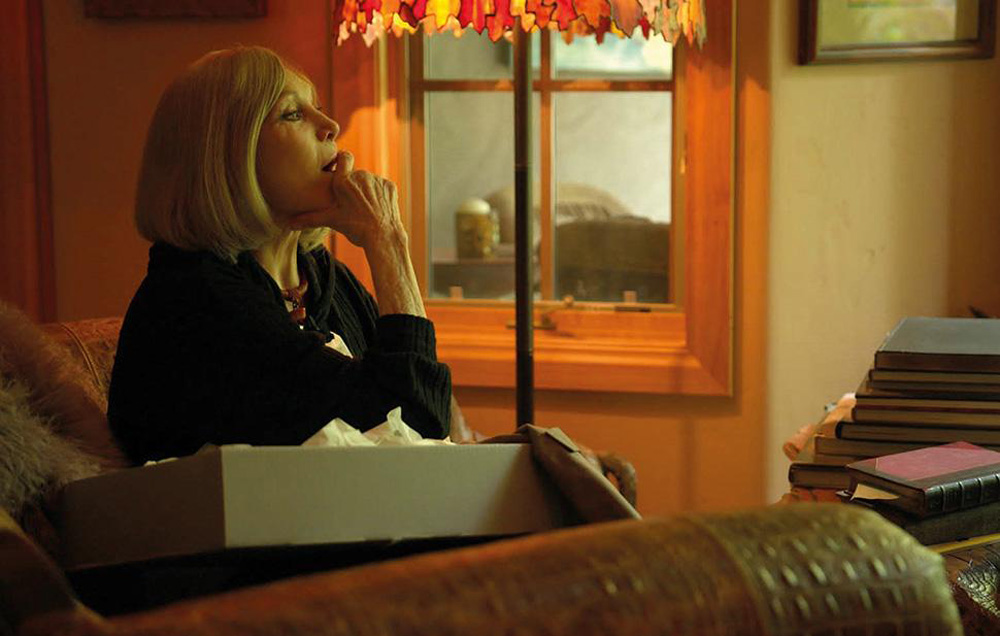

“Have you ever gone up to someone’s attic?” Kim Novak asks director Alexandre O. Philippe in “Kim Novak’s Vertigo,” perhaps not entirely sure what she’s getting herself into after agreeing to let the documentarian rummage through her voluminous, well-maintained archives, to which the filmmaker offers the amusing reply, “Certainly not Kim Novak’s attic.”
As is generally the case in Philippe’s films, there are truths to this moment that neither can entirely be aware of in the moment they’re committed to celluloid when the director does plan to be in the upper reaches of Kim Novak’s mind as much as her house, having made a career of explaining the psychological effects that certain movies have on people, considering the scars left by the shower scene in “Psycho” with “78/52” or how “The Texas Chainsaw Massacre” reinvented the vocabulary for all the horror films that followed. But at the same time, in spite of occasionally involving people that were participants the films being analyzed in films about “Alien” and “The Exorcist,” he’s never done exactly this before – engaging in a career-spanning conversation with Novak (as he did previously do with William Shatner in “You Can Call Me Bill”), but inserting himself into the proceedings to a greater degree he ever has before when his very first memory of a movie was from “Vertigo” and he could imagine Novak walking into his own house that had similar wallpaper to a key scene in the Hitchcock classic.
When Philippe has often presented the production of a movie as a fever dream where everyone miraculously was on some strange, same wavelength, it can feel as if his latest film is the kind he’s usually celebrating, both in quality and spirit, when the rapport with Novak, who largely left the spotlight when she left Hollywood at the peak of her career, flows so effortlessly she’s led to remark herself that it seems like he’s been sent to open up certain doors for her. With the film beginning with a recollection of how she’s always had a fear of being suffocated since her birth as a literally unwanted child of a couple who lost a potential son and was nearly smothered by her mother, it is clear there won’t be anything off limits and the steam-of-consciousness style that Philippe has developed over the years suits Novak well when she’s constantly connecting various threads in her life together, of which acting was just a part.
By now, Philippe rarely does any hand-holding upfront for the uninitiated, so those unfamiliar with Novak and her films might need to play a little catch-up as her thoughts are studded with film clips in no particular order, in effect acting a bit as her subconscious, but with the actress who came up during the studio contract days under Columbia boss Harry Cohn (who is revealed to have unkindly referred to her as “the fat Pollack”), the director is able to explore the effect that being a part of the movie industry had on someone more than just any one film, discovering how Novak could be emboldened by certain roles she played that were far from who she was personally and afraid to lose herself in the overall part of being a movie star with all its trappings. The story itself of a woman without agency in the movie business may not be much of a revelation, but as Novak shares specifics about how her “Picnic” director Joshua Logan described it exactly right when he said to Novak that for her “being pretty was like wearing a crown of thorns” and her style of acting wasn’t suited to the overly theatrical era she was in, it raises considerations about the profession and its demands that aren’t typically addressed and while there aren’t many salacious stories, it remains juicy throughout.
Philippe makes a couple questionable choices in occasionally filming Novak with a shallow depth of field that clashes with the unfiltered nature of the conversation and structures the film so that a career overview gives way to a final third of the film devoted almost exclusively to “Vertigo,” offering the kind of meticulous dissection that’s catnip for the inveterate film buffs that make up the director’s core constituency, but feels slightly at odds with the fluid, anachronistic film that’s come before. However, when the thesis of Philippe’s films has usually been how the movies make us, hearing Novak talk about how the famous spirals of the film reminded her of her father’s process of making Easter eggs and the duality of playing Judy and Madeline in the film was easy to slip into when she was always Marilyn (her real first name) playing Kim suggests the unconscious symbiosis of reality and pretend that makes the special movies what they are. That Novak’s contributions haven’t always been properly acknowledged makes “Kim Novak’s Vertigo” particularly poignant and Philippe offers a strong corrective.
“Kim Novak’s Vertigo” will screen again at the Venice Film Festival on September 2nd at 5 pm at Sala Volpi, 7:30 pm at Astra 2 and 9:30 pm at Astra 2.